
There is a moment most growing insurers recognize. The pipeline is healthy, distribution is working, and new submissions are coming in faster than anyone expected. Underwriting teams get stretched, and turnaround times start to slip. The instinct is to hire, but experienced underwriting talent doesn’t materialize quickly, and headcount added to meet a spike can become overhead the moment volume stabilizes. Insurers end up facing a situation where they need to balance speed of growth with excellence of delivery.
The insurance industry has been quietly solving this problem through remote underwriting support, with the global insurance underwriting market growing steadily at over 7% each year. As insurers grow by adding new product lines or entering into new markets, the ability to scale underwriting capacity without a corresponding increase in fixed costs has become a meaningful competitive advantage, with over 80% of insurance business leaders finding this operating model preferable. This article walks through how to build that model.
What is a remote underwriting support model?
A remote underwriting support model is a structured, ongoing arrangement in which defined underwriting support functions are handled by a specialist remote team operating within the insurer’s workflows, documented guidelines, and systems. It is built to scale with submission volume rather than respond to isolated requests.
This is different from project-based or ad hoc outsourcing, where tasks are handed off one at a time with no continuity. In a proper remote model, the external team is an extension of your operation. They work inside your processes, follow your guidelines, and are measured against your performance standards. That distinction is what separates a one-off vendor relationship from a working operating model.
Why growing insurers and MGAs need a model, not just a vendor
Submission volume doesn’t increase steadily; it tends to spike. Factors such as a new distribution partnership, a change in market demand, or seasonal surges can cause volume to exceed what your in-house capabilities can handle. In these situations, relying on a vendor you occasionally use might not be effective. What you need is a team already integrated into your systems and that understands your guidelines.
There is also the question of finding the right talent. Relying purely on recruitment to solve a capacity problem means waiting months and paying premium salaries for roles that may not be needed at the same level year-round.
A defined remote model solves both problems. It provides predictable capacity that scales with your submission volume, and puts that capacity in place before you need it rather than after the backlog builds up.
Building blocks of a reliable remote underwriting support model
Setting up a remote underwriting model is a sequential process. Each step depends on the one before it. Here is how to do it right:
1. Define the scope of supported functions
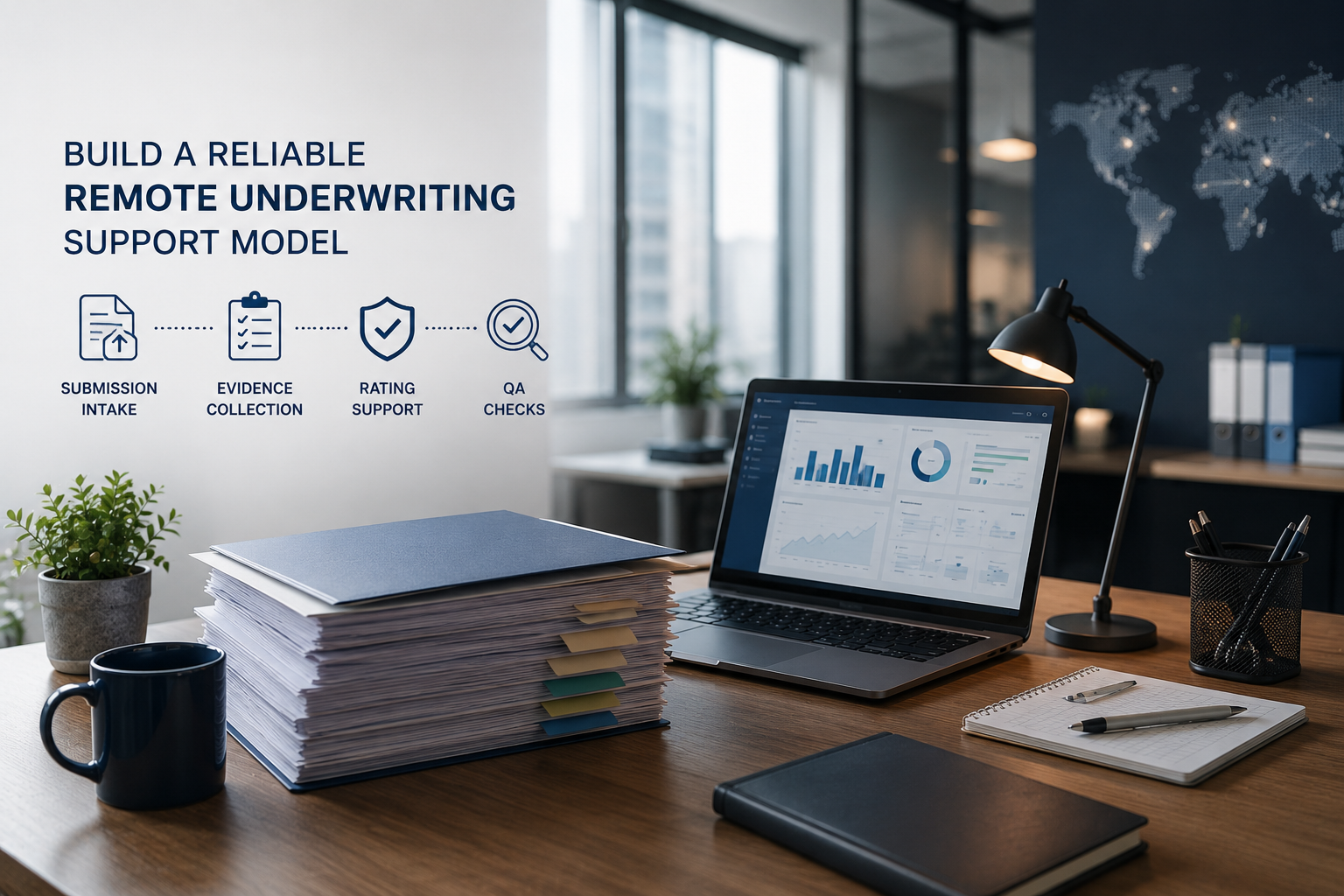
Define the specific functions the remote team will handle. Functions such as submission intake, data collection, file preparation, rating entry, and quality assurance checks. The narrower the scope at the start, the faster the remote team can get up to speed. The scope of engagement can easily be expanded once the model has been proven to run well.
2. Document underwriting guidelines and decision parameters
The remote team works according to your guidelines, so you have to document them. Well-documented guidelines ensure that the remote team knows what they can and cannot do. The remote team should know about everything they can handle without having to escalate to you.
3. Establish system access and how the remote team will work within your tools
The remote team needs access to rating systems, submission portals, and document management tools. This involves determining access levels, managing credentials, and setting security protocols. Each team member should have access only to the systems needed for their role.
4. Set up communication and escalation paths
A remote model without a defined communication setup creates confusion. You need points of contact on both sides, a regular review cadence, and a documented escalation path for submissions that fall outside standard parameters. The table below shows the key communication components that should be in place before the model goes live:
| Component | Scope |
| Named contacts | A primary contact on the insurer’s side and a team lead on the remote side for day-to-day questions |
| Review cadence | Weekly or biweekly calls to go over volume, performance, and any flagged issues |
| Escalation path | A documented process for submissions that require underwriter review or decision-making |
| Shared issue log | A running record of flagged items, resolutions, and any pattern issues |
| Service dashboard | A shared view of work status and volume, accessible in near real time |
5. Establish service level agreements and key performance indicators
KPIs defined at the start will set the basis for evaluating whether the model is working or where it needs adjustment. Here are some of the standard KPIs for underwriting support models:
- Intake turnaround time: How quickly submissions are processed from receipt to completion
- File completeness rate: The percentage of files that are complete and ready for underwriting review on first submission
- Evidence collection cycle time: How long it takes to gather the required documents and data from brokers or applicants
- QA error catch rate: The percentage of file errors identified during quality review before the file reaches the underwriter
- Escalation volume: The number of files escalated per week and the reasons behind them
6. Pilot before scaling
Before expanding the model, conduct a pilot with 20 to 50 transactions from a single line of business. Monitor turnaround time, file accuracy, and gather feedback from underwriters during this period. The pilot will help you identify gaps in documentation, system access issues, and lapses in communication.
How to maintain oversight in a remote model
A concern insurers often raise is how to maintain control over underwriting quality and risk appetite when part of the workflow is handled remotely. The answer lies in the governance structure, not the team’s geography.
The remote team operates within the underwriting guidelines and risk appetite you set. The key is to ensure those guidelines are up to date, distributed, and version-controlled so the remote team is always working from the latest version.
Here is how ongoing oversight works in a well-run remote model:
- Guidelines are insurer-owned and periodically reviewed. The remote team receives updated versions when changes are made. Version control on guideline documents makes it easy to confirm which version is in use at any given time.
- Performance reviews are scheduled. Scheduled reviews against established KPIs keep performance visible and allow course corrections before issues compound.
- Consistent use of escalation paths. Non-standard submissions are escalated to the appropriate underwriter rather than handled independently by the remote team. This ensures centralized decision-making.
- Audit sampling is built into the model. Periodic sampling of completed files allows the insurer to independently verify quality without relying on the remote team’s QA process.
Scaling the model as submission volume grows
One of the key advantages of a structured remote model over a purely in-house team is that it can be scaled without the delays and costs of hiring. But scaling needs to happen in a deliberate sequence. Expanding too fast without updating documentation and processes creates the same problems you were trying to avoid. The table below maps growth stages to the corresponding remote model configuration:
| Growth stage | Submission volume | Recommended model setup |
| Early stage | Low, variable | One to two functions in scope; single remote contact; weekly review calls |
| Growth stage | Increasing, with spikes | Three to four functions in scope; dedicated remote team lead; biweekly calls plus shared dashboard |
| Scaling stage | High, consistent | Full intake-to-QA workflow covered; segmented team by function; daily check-ins during high-volume periods |
| Mature stage | Multi-line, high volume | Remote model covers multiple lines; separate escalation contacts by line; monthly strategic reviews plus real-time dashboards |
Keeping the model on track
Running a remote underwriting model is not a set-and-forget arrangement. There are a few areas where problems develop gradually and are worth monitoring on an ongoing basis.
- Data security and access protocols should be reviewed periodically, especially when the scope expands. Each time a new function or system is added, revisit who has access to what and confirm that security protocols are still appropriate.
- Periodic output audits are separate from the day-to-day QA process and serve a different purpose. The QA process checks files before they reach the underwriter, while periodic audits evaluate patterns across completed files over time. These audits identify systematic issues that individual file checks may overlook.
- Documentation currency is another ongoing requirement. As your guidelines evolve, your risk appetite shifts, or new products come to market, the documentation the remote team operates from needs to stay up to date. A mismatch between current practice and documented guidelines creates inconsistency in how files are handled.
Common pitfalls when scaling underwriting support models
Underwriting support models often encounter headwinds as they scale. Here are some of the most common issues they face:
- Scope expanding more rapidly than documentation can keep up with: When the remote team acquires new responsibilities or product lines without an update to procedures, they end up making calls outside their depth, creating inconsistency and rework.
- The remote team is treated as a black box: some insurers dump responsibilities on it but otherwise do not get involved until something is wrong. Without constant monitoring and periodic evaluations, little problems turn into big problems before anybody catches on. The KPIs and evaluations mentioned above are designed specifically to avoid this.
- Skipping the pilot when expanding into new lines of business: Even when the remote model is well established and performing well on existing lines, a new line has different documents, different data requirements, and often different systems. A short pilot period protects against assumptions that prove wrong.
- Underestimating the communication setup: A remote team without a clear escalation path risks bottlenecks or unresolved issues. Defining the communication structure at the beginning reduces friction later.
Conclusion
The shift from outsourcing a task to building a model is a meaningful one. A partner with experience in underwriting-specific workflows reduces the time it takes to get the model set up and makes scaling smoother
Techsurance provides exactly this kind of ongoing underwriting support, with services that cover intake, data collection, rating, and quality assurance, all within a model built around your workflows and guidelines. In addition, Techsurance also offers operational support across claims processing, hindsighting, and back office operations, with teams of trained insurance professionals backed by ISO 27001/9001-certified processes and the latest in efficiency-enhancing technology. If you are thinking about what a phased remote underwriting support model could look like for your current growth stage, reach out to our team to start a conversation.
FAQs
What is a remote underwriting support model?
A remote underwriting support model is a structured arrangement in which a specialist remote team handles defined underwriting support functions within the insurer’s workflows, systems, and documented guidelines.
How do growing insurers scale underwriting operations?
Growing insurers scale underwriting operations by building a remote support model that handles repeatable, process-driven functions such as submission intake, data gathering, and file preparation.
What does a successful underwriting outsourcing setup look like?
There are six elements that constitute a good setup, and these include scope of functionality, documentation of underwriting rules, system access control, communications and escalation process, KPIs agreement starting on day one, and the pilot implementation of the model.
How do MGAs manage remote underwriting support teams?
MGAs manage remote underwriting support teams through named contacts on both sides, a regular review cadence against defined KPIs, version-controlled guideline documents, and a documented escalation path for non-standard submissions.
Can underwriting support scale with business growth?
Yes, but scaling needs to follow a defined sequence. New functions or lines of business should be added with updated documentation and a short pilot phase each time. A remote model that is well governed at a small scale can expand to cover a full underwriting workflow across multiple lines, with the team configuration and communication structure adjusted at each growth stage to match the volume and complexity of the work.
