
US managing general agents wrote an estimated $114.1 billion in direct premiums in 2024, up 16% from the year before, according to Conning’s 2025 MGA study. Fourth straight year of double-digit growth for the sector. Good news if you’re running an MGA. Less good news if your underwriting, policy servicing, and claims teams are still sized for last year’s volume.
That’s the gap many MGAs are quietly running into. Business is coming in faster than internal teams can process it, and hiring takes months you don’t have. MGA outsourcing has become one of the more practical answers to that problem, but the term gets thrown around loosely. There’s a real difference between handing work to a general BPO vendor and partnering with a firm that actually understands underwriting judgment, claims adjudication, and US insurance compliance. This is about that difference, and what specialist back-office support looks like once you’re actually in it.
What is MGA outsourcing?
MGA outsourcing means delegating specific back-office insurance functions, underwriting support, policy servicing, claims processing, and compliance checks to an external partner with insurance-domain expertise so the MGA can handle higher volume without growing internal headcount at the same pace.
It’s not the same as outsourcing a customer service line or basic data entry. The work involves risk judgment and regulatory exposure. The partner needs to understand insurance, not just process paperwork quickly.
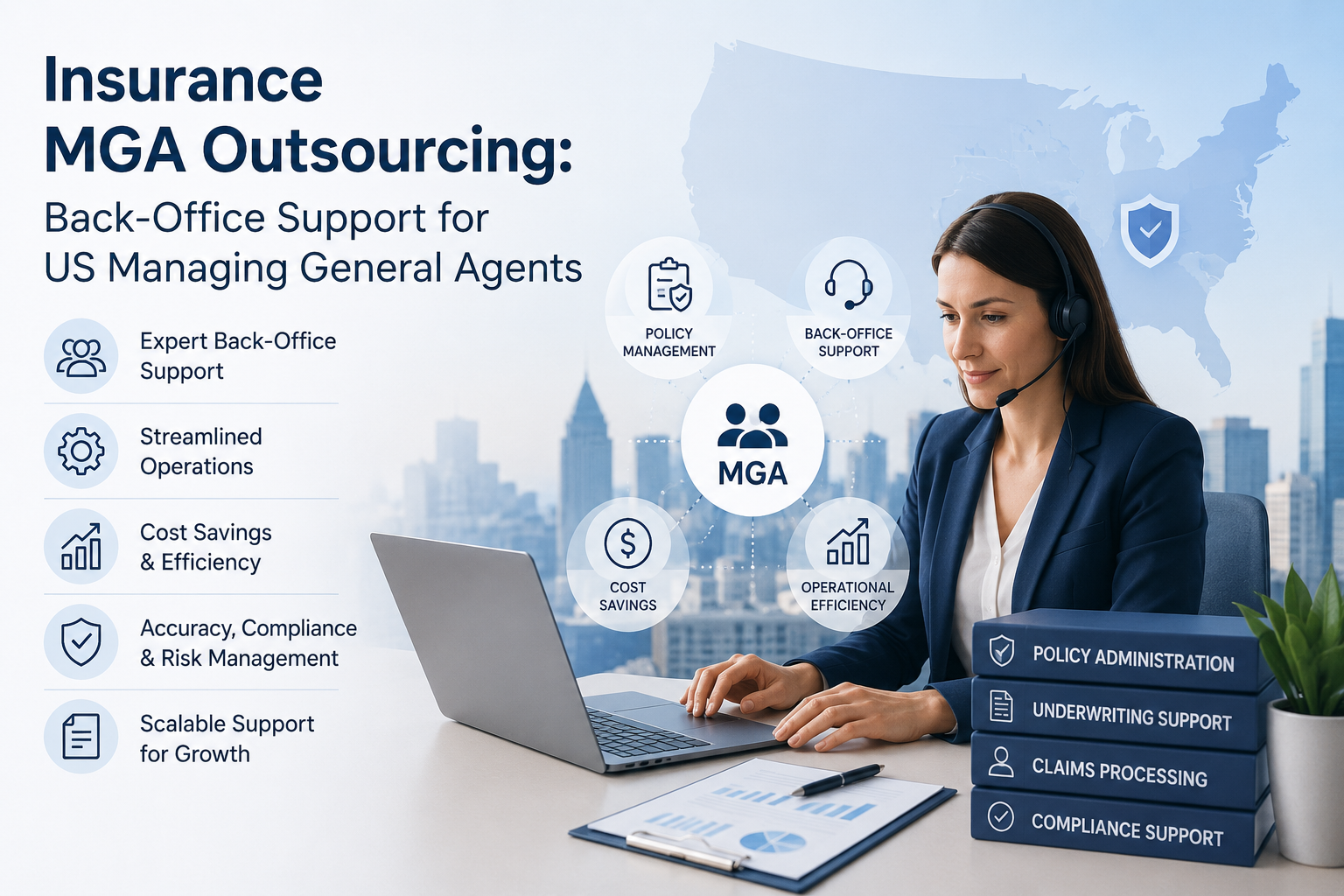
Functions MGAs hand off commonly: underwriting intake and risk triage, policy issuance and renewals, claims processing and adjudication support, compliance audits and QA/QC, and document management and data cleanup.
Why US MGAs are looking outside for operational support
Premium growth is outrunning internal capacity:
AM Best’s June 2025 report found MGAs posted 15% premium growth in 2024, 14.9% in 2023, 19.5% in 2022, and 17% in 2021. Nineteen MGAs now write over $500 million a year, up from twelve the year before. Six crossed the $1 billion mark in 2024 versus three in 2023. Growth at that pace tends to outrun whatever operations team you had in place two years ago.
Underwriting talent is harder to hold onto:
A good chunk of MGA growth has come from experienced underwriters moving over from carriers and brokers. Great for the MGAs doing the hiring. Not so great for everyone else drawing from the same shrinking pool. Building an internal bench fast enough to match premium growth is getting harder, not easier.
Regulatory and E&S complexity keeps climbing:
More business is flowing into excess and surplus lines, and specialty risks like cyber and climate exposure carry their own documentation demands. Add state-by-state variation on top of that. None of it is optional to get right.
Investors are watching operational efficiency closely:
MGAs have attracted significant private equity interest over the past few years. That capital comes with expectations around margin and scalability, and back-office efficiency is usually one of the first things investors poke at during diligence.
Core back-office functions MGAs can outsource
| Function | What it involves | Why it matters |
| Underwriting support | Intake review, data validation, risk triage, renewal processing | Faster quote-to-bind cycle |
| Policy servicing | Endorsements, renewals, policy issuance | Fewer backlogs during peak volume |
| Claims processing | First notice of loss handling, adjudication support | Better turnaround time and accuracy |
| Compliance and QA/QC | Documentation audits, regulatory review | Lower exposure to compliance findings |
| Data and document management | Digitization, indexing, cleanup | Cleaner records when auditors come knocking |
These can be outsourced individually or bundled, depending on where the actual bottleneck sits. Some MGAs only need claims support during catastrophe season. Others need permanent underwriting support because renewal volume never really lets up.
In-house vs. outsourced: a straightforward comparison
| Factor | In-house team | Outsourced insurance-KPO partner |
| Scalability | Tied to hiring cycles, slow to flex | Can flex up or down with volume |
| Compliance accuracy | Depends on internal training consistency | Governed by a dedicated QA process |
| Turnaround time | Varies with staffing and workload | Tracked against defined SLAs |
| Cost structure | Fixed salaries and overhead regardless of volume | Scales with actual work volume |
| Domain expertise | Built slowly, at risk when people leave | Pre-trained teams, less turnover risk |
Neither model is automatically right. A small MGA writing a narrow book of business might do fine in-house for years. A growing one juggling multiple career relationships usually reaches a point where the math no longer works out.
How MGA outsourcing actually works
Most engagements follow a similar arc, whether the scope is underwriting, claims, or compliance.
- Workflow audit:
The partner reviews current processes and volume patterns to find where delays or errors tend to happen. Gets skipped more often than it should, and that’s usually where problems trace back to later. - Team onboarding matched to the work:
Staff assigned to the account should already understand the relevant line of business, not just insurance in general. - SOP and compliance alignment:
Procedures get mapped to the MGA’s carrier requirements and state regulations before any live work starts. - Pilot run with QA checkpoints:
A parallel run on a smaller slice of work catches gaps before full volume shifts over. - Full transition under SLA governance:
Ongoing work moves over with turnaround targets and accuracy benchmarks the MGA can actually measure.
Skip step one or step four, and the gaps usually surface later, often during an audit or a carrier review.
Compliance and risk considerations
This is where many MGAs become cautious about outsourcing, and reasonably so. Handing over underwriting or claims work means handing over data that touches policyholders, carriers, and regulators all at once.
Worth checking before signing anything: does the partner hold recognized security certifications (ISO 27001 is a common baseline)? Are audit trails maintained on every file rather than just summarized at month-end? Does the team understand state-specific regulatory nuance or just general insurance terminology? Is there an actual documented QA process rather than something informal?
If a partner can’t answer these clearly and quickly, that’s worth noting before you go further.
If audit-readiness or compliance accuracy is what’s slowing your MGA down right now, it’s worth checking how your current back-office setup stacks up against a specialist partner built for this. See how Techsurance structures compliance-first MGA support.
How Techsurance supports MGA back-office operations
Techsurance works as an insurance-KPO partner, not a general staffing vendor. The team carries over 100 years of collective domain expertise across underwriting, claims, and risk assessment and operates under ISO 27001 and ISO 9001 certification.
The services map directly to what’s covered above. Underwriting support across intake, data validation, and policy issuance. Claims processing and adjudication with defined turnaround targets. Risk assessment with audit-ready documentation. Compliance and QA/QC built into the workflow rather than added on afterward. Plus broader back-office support for data and document management.
This tends to fit mid-to-large MGAs, TPAs, and brokers that are past the point where a small internal team can keep up but are not ready to build out a full department for every function. Techsurance’s case studies show the kind of quality checks that catch problems before they turn into audit findings.
Choosing the right MGA outsourcing partner
Worth asking any vendor before signing: do they specialize in insurance, or is it one vertical among many, what certifications back up their security and quality claims? How is quality actually measured, and can they show you the process? Does their technology stack integrate with yours? Can they scale if volume doubles next year? Do they have real experience with US insurance regulation rather than general operations experience?
If a vendor’s pitch leans heavily on cost savings and headcount flexibility without much mention of insurance expertise or compliance processes, that’s usually a sign they’re built for general BPO work, not insurance operations.
Conclusion
The MGA outsourcing conversation has shifted. It used to be mostly about cost. Now, with premium growth running ahead of hiring capacity and compliance getting more complicated every year, the real question is whether your back-office partner understands insurance or just processes paperwork at scale.
A specialist partner brings underwriting judgment, claims expertise, and compliance discipline to work that carries real regulatory weight. Different proposition than a call center with an insurance client list.
If you’re weighing whether your current setup can keep pace with where your MGA is headed, it’s worth a conversation. Talk to Techsurance about a back-office operations review built around your underwriting, claims, and compliance workflows.
FAQs
What is MGA outsourcing?
Delegating back-office insurance functions, underwriting support, policy servicing, claims processing, and compliance to an outside partner with insurance expertise so the MGA can handle more volume without growing internal staff at the same rate.
How is MGA outsourcing different from general BPO?
General BPO is built for high-volume administrative work. MGA outsourcing through an insurance-focused partner involves underwriting judgment and regulatory documentation that require actual domain knowledge, not just process speed.
What functions can MGAs outsource?
Underwriting support, policy issuance and servicing, claims processing and adjudication, compliance audits, and data or document management.
Is it safe to outsource compliance-sensitive work?
It can be, provided the partner holds relevant certifications, maintains audit trails, and understands state-specific regulatory requirements. Confirm that upfront, don’t assume it.
Can outsourcing actually improve claims turnaround time?
Usually yes, mainly because dedicated teams working against SLAs don’t have the competing priorities internal staff tend to juggle.
What’s the difference between an MGA and an insurance carrier?
An MGA holds delegated underwriting authority from a carrier, meaning it can bind coverage, set rates, and manage claims on the carrier’s behalf, without holding the underlying risk on its own balance sheet.
How do I know if my MGA is ready to outsource part of its operations?
If renewal backlogs are growing, claims turnaround is slipping, or your team spends more time catching up than staying ahead, that’s usually the signal. A workflow audit is the fastest way to find where the actual bottleneck sits.
