
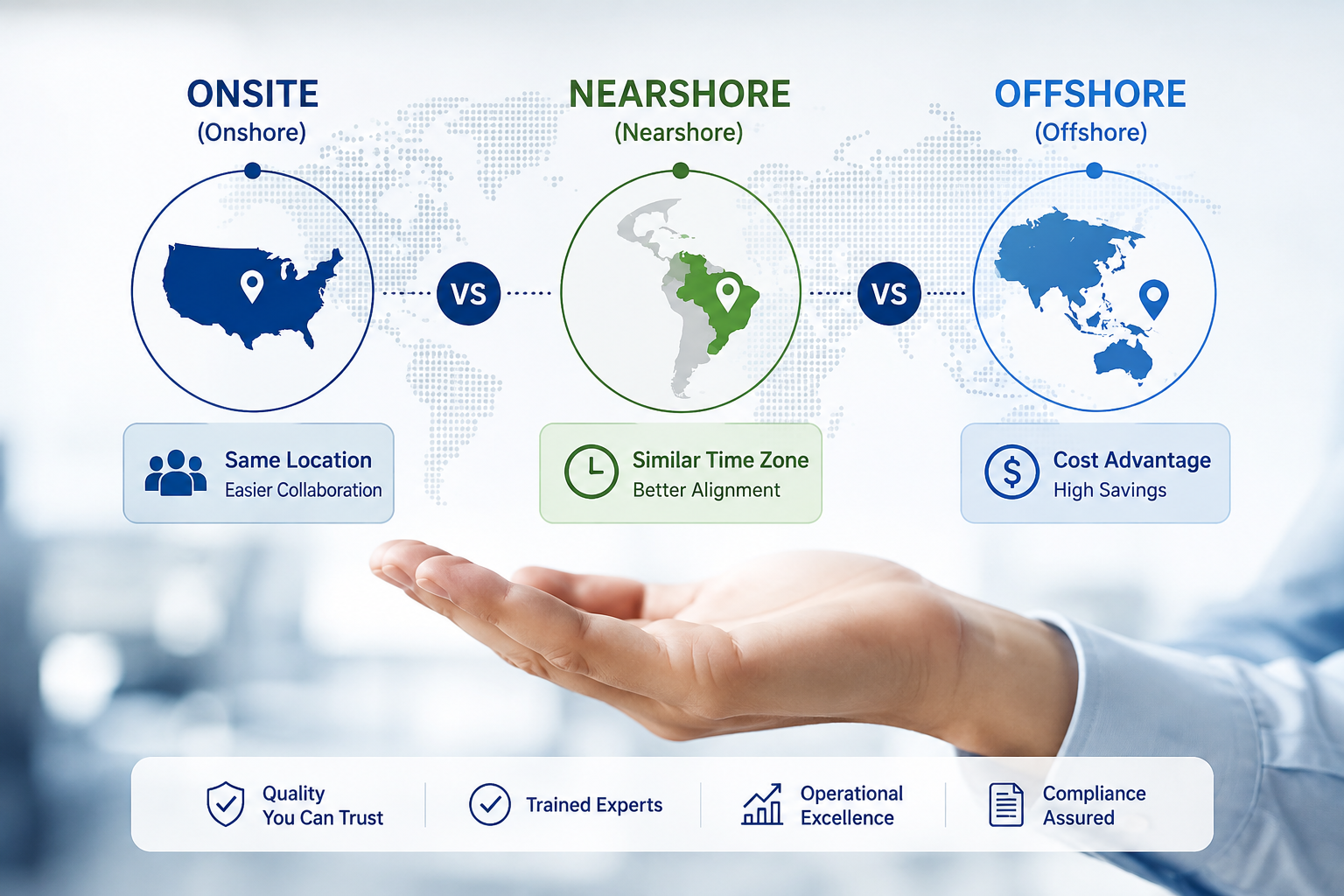
When an insurer is considering the option of outsourcing, it usually begins by looking at a rate card. The cost of onshoring is the highest, the cost of offshoring the lowest, and nearshoring falls somewhere in between. This is the version that most outsourcing guides provide, and it is the incorrect approach to take when making this decision in the case of insurance operations.
The regulatory risk involved in underwriting, handling claims, and providing policy servicing is something that a customer service queue does not have. The appropriate location model should be based on the particular workflow you are moving, not merely on the cost per hour. This article examines the differences between offshore and nearshore outsourcing, explains why onshore outsourcing is still worthwhile even though it has the higher price, and describes how to match each model to the correct part of your insurance operations rather than simply choosing the one that has given the lowest quote.
What “onshore,” “nearshore,” and “offshore” mean for insurance operations
Most of the content produced through outsourcing treats these three models as if they are interchangeable in all industries. In the insurance sector, however, the differences are more important since the outcome is not a closed support ticket but an underwriting file, a claims decision, or a compliance record that has to stand up to audit.
Onshore insurance outsourcing
An onshore arrangement is a collaboration with a provider in the same country as the insurer; there is a common regulatory environment, a common time zone, and a shared language. Although the cost savings in this model are the least of the three, usually ranging from 10 to 20 percent compared to setting up an internal team, the level of operational friction is also the lowest.
Nearshore insurance outsourcing
“Nearshore” refers to a company in a country that is geographically close, typically within a few time zones; for a US insurer, this usually involves Latin America or Canada. Although cost savings are greater than those achieved with onshore providers, same-day collaboration is still feasible due to overlapping working hours.
Offshore insurance outsourcing
By “offshore” we mean a company based in a foreign country, typically India or the Philippines in the case of US insurers. Insurance KPO services are centered on such locations since the advantage in labor costs enables the formation of large, specialized teams who are trained specifically in the areas of underwriting, claims, and policy administration rather than in employing general-purpose workers. With only limited overlap in time zones, this approach is most suitable for workflows that do not demand real-time interaction.
The comparison between offshore and nearshore outsourcing in terms of cost and quality
This is the kind of comparison that insurers really have to make, since pure onshore services are usually priced so high that they are out of reach for heavy back-office work.
Offshore and nearshore outsourcing each have their own strengths. Offshore teams can offer a cost advantage, while nearshore teams may be easier to coordinate with because of closer time zones and, in some cases, greater cultural familiarity. However, location alone does not determine the quality of insurance operations. Training, quality checks, and proper process management have a much bigger role in maintaining consistent quality.
An offshore insurance KPO, featuring ISO-certified processes, maker-checker quality control, and staff who have been specifically trained in insurance workflows, is more accurate than a nearshore generalist BPO. When deciding between offshore and nearshore outsourcing, the matter should not depend on the map, but rather on whether the provider specializes in insurance operations or handles your work in the same way that they would retail customer support.
| Factor | Onshore | Nearshore | Offshore |
| Typical cost savings | 10 to 20 percent | 25 to 40 percent | 40 to 60 percent |
| Time zone overlap | Full | Partial to full | Limited |
| Insurance-specific talent pools | Smaller, expensive | Growing | Large, cost-efficient |
| Compliance and data security | Easiest to govern | Manageable with clear SLAs | Requires strong contractual and audit controls |
| Best suited for | Judgment-heavy, regulated work | Blended teams needing overlap | High-volume, standardized workflows |
As Techsurance itself has shown in its comparison of in-house and outsourced insurance operations, insurers generally find that their costs are 40 to 60 percent lower when they shift their work to an offshore KPO partner; this is consistent with the range of cost savings most insurers report in relation to underwriting support, claims processing, and back-office functions.
Where onshore still wins despite the cost
Cost is not the only factor in the equation, and in many cases onshore outsourcing or carrying out the work in-house is still the better option. When it comes to making highly judgment-oriented underwriting decisions regarding complex or high-value risks, it is often advantageous to remain close to the carrier’s own risk tolerance and institutional knowledge. Similarly, work that involves direct communication with policyholders in sensitive situations, for example, in the case of claims disputes with potential legal exposure, can also benefit from being based onshore.
The trade-off is straightforward. Onshore insurance outsourcing costs more per hour, but for a narrow set of high-stakes workflows, that cost buys reduced coordination risk.
Where offshore and nearshore both work for insurers
It is not necessary for most insurance operations to have their headquarters in an overseas country. What then needs to be decided is which of the other two options is suitable for the particular workflow.
Workflows suited to offshore
The greatest returns are obtained from standardized, high-volume, rule-based work, such as policy administration data entry, claims intake and documentation review, underwriting file preparation, and hindsighting. These tasks involve following defined checklists and payer or carrier rules, so a well-trained offshore insurance KPO team can carry them out accurately without requiring real-time collaboration with the insurer’s staff.
Workflows suited to nearshore
For work that calls for a quicker back-and-forth but does not need full onshore proximity, a nearshore arrangement is more appropriate. This applies to blended underwriting support in which a nearshore analyst has to send questions to an underwriter based in the US within the same working day, or to claims escalation handling where time is more important than cost.
Compliance and data security across all three models
Nothing by itself determines the level of compliance risk in terms of location; governance does. Whatever option the insurer takes, whether it is onshore, nearshore, or offshore, the same controls must be implemented: signed data protection agreements, role-based system access, encrypted data handling, and documented audit trails.
Offshore insurance outsourcing tends to attract greater compliance scrutiny because the distance raises all sorts of questions. Such scrutiny is reasonable but shouldn’t be the only factor taken into account. A provider with ISO 27001 certification and a history of insurance-specific compliance work generally handles data security more thoroughly than an in-house team, which treats it as just one of many responsibilities. For a more detailed examination of what is required for compliant outsourcing, refer to Techsurance’s page on insurance compliance services.
How to evaluate an insurance outsourcing company regardless of location
Before deciding between onshore, nearshore, and offshore, insurers should evaluate any insurance outsourcing company against the same baseline questions:
- Is the company specialized in insurance operations, or is it a generalist BPO employing the same process across all industries?
- What certificates support their claims regarding data security and quality, and will they be able to provide documentation rather than just making a statement?
- What is the method used to assess quality, and how frequently are the results passed on to the insurer?
- What is the SLA for turnaround time by workflow type, in writing?
- What measures does the provider take when dealing with volume spikes in order not to miss deadlines?
- Who has the ultimate authority in deciding on underwriting and claims outcomes?
Techsurance covers this evaluation process in more depth in its guide on how to select an insurance outsourcing company, which walks through the SLA and documentation questions worth asking any provider before signing.
Common mistakes when choosing a location model
A few patterns show up repeatedly when insurers get this decision wrong:
- Choosing purely on hourly rate: Based solely on the hourly rate, the lowest quote does not take into consideration the rework, missed SLAs, or compliance gaps, which result in higher costs later on.
- Treating all workflows the same: Treating all kinds of workflows equally is not advisable; high-volume data entry and complex underwriting judgments should not be included in the same outsourcing approach.
- Skipping the specialization check: The specialization check is being omitted, since a general BPO and an insurance KPO can offer similar rates even though they deliver very different levels of accuracy when it comes to insurance-specific tasks.
- Underestimating governance needs: Failing to appreciate the need for governance; both offshore and nearshore models should require the same documented controls as onshore work would, not a simplified version of these controls.
How Techsurance fits into this decision
Techsurance functions as an offshore insurance KPO (knowledge process outsourcing) company, being set up particularly for the purposes of underwriting, claims processing, and back-office operations for US insurance carriers, MGAs, and TPAs. The team carries out its activities using processes certified to ISO 27001 and ISO 9001, incorporating a maker-checker quality control system into every workflow, whether it’s handling an insurance outsourcing process for claims intake or preparing underwriting files. The decisions regarding coverage and underwriting remain with the insurer’s own team, while Techsurance takes care of the volume and consistency associated with those decisions, which is precisely where the cost and time-saving benefits of offshore insurance outsourcing are derived.
Conclusion
The choice between offshore and nearshore outsourcing isn’t something that insurers make just once; it’s a decision that has to be considered on a workflow-by-workflow basis, and the appropriate answer is generally going to involve more than one model being used together. Standardized, high-volume operations suit offshore arrangements best, while those requiring faster real-time coordination are better off being nearshored. In some cases, a small number of decisions that demand a high degree of judgment and carry high stakes may be worth keeping onshore even if that means higher costs. In all cases, what’s important is that the outsourcing company specializes in insurance operations, since this factor has a far greater impact on quality than the location does. If you’re looking at an insurance outsourcing company and would like to discuss which workflows are best suited to which model, Techsurance’s team will be able to go into the details with you.
FAQs
What is the difference between onshore, nearshore, and offshore insurance outsourcing?
To put it simply, ‘onshore’ refers to a company located in the same country, ‘nearshore’ refers to one in a neighboring country that has an overlapping time zone, and ‘offshore’ refers to a company in a distant country, usually providing the greatest cost savings.
Is offshore outsourcing safe for insurance data and compliance?
It can be arranged on the condition that the provider keeps documented certifications such as ISO 27001, has signed data protection agreements, and implements role-based access controls. Compliance is based on good governance rather than on distance.
How much can insurers save with nearshore vs. offshore outsourcing?
Nearshore outsourcing generally results in cost savings of between 25 and 40 percent as compared with onshore outsourcing, while offshore outsourcing can lead to savings of between 40 and 60 percent, although the actual amount of savings will vary according to the workflow and the provider.
Does onshore outsourcing provide better quality than offshore?
Quality is determined by training, quality assurance frameworks, and process governance rather than by where a company is based; a specialist offshore insurance KPO is in fact able to beat a generalist onshore provider.
Can insurance companies combine onshore, nearshore, and offshore models?
Correct. Many insurance companies adopt a combined approach, retaining the more judgment-oriented tasks in-house while sending the standard, high-volume ones offshore or to nearby countries.
Which insurance workflows are most appropriate for offshore outsourcing?
Standardized, rules-based work such as policy administration data entry, claims intake and documentation review, underwriting file preparation, and hindsight tends to fit offshore well.
How can I assess an insurance outsourcing company no matter what its location is?
Look to see whether the company has insurance-specific specialization, verifiable certifications, clearly stated SLAs by workflow type, and transparent quality reports, and make sure that the insurer keeps the final decision-making power.
