
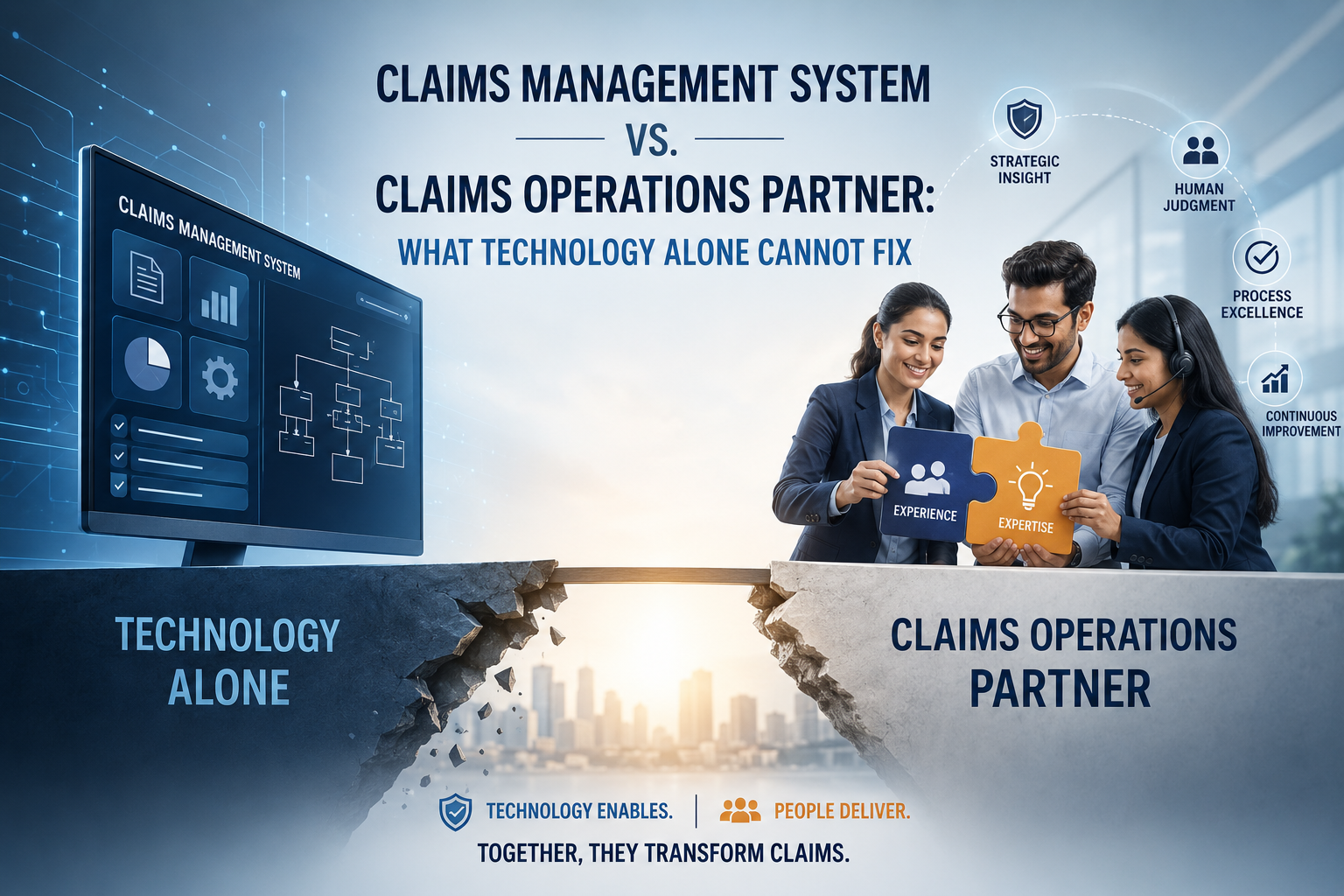
When a new claims management system is put into use, the dashboards appear clean for the first two weeks, only for the backlog to return eventually. If this situation rings a bell, then the software wasn’t actually the root of the problem. Generally speaking, insurers, TPAs, and MGAs purchase a claims management system with the hope that it will resolve issues relating to cycle time, staffing shortages, and quality all at once. This usually doesn’t happen because the system automates certain procedures, whereas it doesn’t provide the necessary staffing or training or deal with the exceptions that fall outside the workflow for which it was designed.
This article explains exactly what a claims management system is designed to achieve, the point at which that is no longer sufficient, and where a claims operations partner takes over. Whether you are considering the purchase of a platform, comparing that option with claims operations outsourcing, or are trying to understand why your present system still leaves claims in a queue, this piece addresses all aspects of your decision.
What Is a Claims Management System?
A claims management system is software that insurers, third-party administrators, and MGAs use in order to receive, track, process, and settle insurance claims; it substitutes spreadsheets, shared inboxes, and paper files with a single record for each claim and ensures that the claims move through the various stages from intake to closure.
At a functional level, a claims management system usually takes care of key day-to-day tasks, including:
- Receiving claims through channels such as web portals, email, phone, and EDI
- Sending each claim to the appropriate adjuster or team
- Keeping claim documents organized while tracking updated versions
- Workflow automation for standard claim types
- Reserve tracking and payment processing
- Reporting dashboards for cycle time, volume, and status
The claims management system keeps a record of what happens to a claim; it is not the team that decides what should happen next in the case of a claim that does not fit the template.
Why Insurers Invest in a Claims Management System
It is worthwhile first of all to identify the actual improvements that a claims management system provides. Such a system substitutes manual tracking for a structured and auditable workflow, and this single change eliminates a type of error that spreadsheets are unable to detect.
Consistency across claim files: The claim files are consistent since regardless of which adjuster opens them, every claim goes through the same intake fields, the same required documents, and the same status stages.
Faster access to claim history: Get quicker access to the claim history. Rather than searching through email threads or the shared drives, adjusters, underwriters, and compliance staff can view a complete claim record.
Built-in audit trail: There is a built-in audit trail; the claims management system records who accessed a file, when, and what changes were made, which is important during regulatory inspections and disagreements.
Reports indicate where claims stall: Dashboards show how many claims are getting older, the rate at which claims are being reopened, and adjusters’ workload, enabling managers to identify bottlenecks without preparing manual reports.
Reduced manual data entry: Clean, simple claims can be processed straight through, saving adjusters time on paperwork and letting them focus on judgment calls.
They are genuine improvements; when a company stops using spreadsheets and moves on to a proper claims management system, it will experience quicker intake and cleaner records within the first few months. The error, however, is to assume that the system will continue to deliver those benefits all by itself after it has been put into use.
Where a Claims Management System Stops Being Enough
A claims management system is based on the idea that claims will arrive in a foreseeable amount and in a regular form. In practice, the actual claims books do not behave in this way, and it is this discrepancy that reveals the limitations of a claims management system.
Volume spikes break the model
A claims management system does not employ more staff when there is a catastrophe, during a seasonal rise in business, or as a result of a sudden influx of new business. The workflow engine continues to assign claims at the same rate as before, and the queue increases because the number of people who review exceptions has not increased alongside it. The software enables the process to scale but does not cause the number of people carrying out the process to scale.
Exceptions still need a person
Most claim management system platforms can handle effectively the 60 to 80 percent of claims that follow a clear, rule-based process. The rest of the claims, those lacking necessary documentation, involving conflicting statements, or raising unusual coverage questions, require a qualified adjuster or claims examiner to look over the file, make a judgment, and record the reasons for that judgment. Nothing can replace that workflow rule.
Data quality depends on the person entering it
A claims management system retains everything that is typed into it; if intake staff rush filling in a field, misclassify the type of claim, or omit a necessary note, the system will retain an incomplete or inaccurate record with the same level of confidence as it would a properly completed one. The platform is unable to distinguish between a well-documented file and one that has been rushed.
Quality control is a separate discipline
It is necessary to have a dedicated quality control function in order to pick up errors before a claim is closed, to verify the accuracy of the payout, to make sure that all the required documentation is complete, and to identify any patterns throughout the portfolio. A claims management system is able to mark a field as incomplete, but it cannot carry out a second check of the adjuster’s interpretation of the coverage or detect a leakage pattern across hundreds of files.
Training and turnover sit outside the software
New employees still require several weeks of training on different types of claims, state regulations, and internal standards before they are able to deal with files on their own. A claims management system does not reduce the length of this training period, and it doesn’t address the turnover that causes a claims team to be short-staffed during a busy quarter.
Compliance execution is ongoing work
The rules concerning claim-handling timeframes, communication requirements, and documentation standards vary from state to state and by business type. Although a claims management system can be set up to match current regulations, someone must track changes, update the configuration, and ensure staff follows the new procedure every day.
Claims Operations Outsourcing: What It Adds
It is in this context that claims operations outsourcing comes in, not as a substitute for the claims management system but as the operational layer that functions within it.
A claims operations partner supplies the trained staff, carries out quality checks, and ensures process discipline since a platform by itself is unable to do so. In practice, insurance claims support services provided by an experienced partner usually include:
Trained claims staff who work inside your existing platform: A claims operations partner does not usually ask you to switch systems. Teams are trained to work inside whatever claims management system you already run, so the software investment stays intact.
Surge capacity without a hiring cycle: There is capacity to respond without going through a hiring process. If the number of claims rises due to a catastrophic event or a seasonal pattern, the claims operations partner is able to add trained staff within a few days, rather than having to wait the months it would take with an internal hiring and onboarding process.
Structured quality control layers: Quality control is organized through various layers. Typically, back-office services involve a maker-checker review procedure, where a second set of eyes checks the accuracy of the payouts, the completeness of the document closing, and the interpretation of the coverage before the file is closed.
Consistent process documentation: Clear procedures for each claim type give adjusters a common way to handle claims. When everyone works from the same guidelines, there is less room for differences caused by individual interpretations of the rules.
Regulatory tracking built into daily work: Regulatory tracking is incorporated into everyday work. Instead of treating state-level claim-handling requirements as a separate compliance project, an experienced partner in outsourcing claims operations handles them as part of normal operations.
Reporting on the metrics that matter to leadership: Providing an analysis of the key metrics that are important to leaders; in addition to the figures produced by a claims management system’s dashboards, a claims operations partner generally reports on leakage trends, reopen rates, and turnaround time as compared to the SLA, including the reasons behind the figures.
Claims Management System vs. Claims Operations Partner: A Comparison
| Function | Claims Management System | Claims Operations Partner |
| Claim tracking and workflow | Handles this directly | Works inside the existing system |
| Straight-through processing | Automates clean, rules-based claims | Not applicable; software-driven |
| Exception handling | Flags exceptions | Reviews and resolves exceptions |
| Staffing during volume surges | Fixed capacity | Scales staff up or down |
| Quality control on closed files | Limited to configured checks | Structured maker-checker review |
| Regulatory rule updates | Requires manual configuration | Tracked and applied by trained staff |
| Training new adjusters | No training function | Standardized training and SOPs |
| Data entry accuracy | Depends on the person entering data | Includes validation and QC steps |
| Cost structure | License and implementation cost | Variable, tied to claim volume |
If you read the table from left to right, the pattern is clear: the claims management system forms the infrastructure, while the claims operations partner constitutes the workforce operating on top of it, picking up the things that the infrastructure was never designed to catch.
Do you need a claims management system, an operations partner, or both?
Most transportation companies, third-party administrators, and mutual guarantee agencies of any significant size end up requiring both, although the combination depends on where the present problem lies.
A claims management system is only suitable for organizations that have a steady and predictable volume of claims, a fully staffed internal team, and well-established internal quality control procedures already operating. In the case where your problem is truly the lack of a structured workflow tool, then the software will deal with that particular issue.
Claims operations outsourcing is often a good fit for companies that already have a claims management system but need more hands to manage the workload. This may happen when teams are understaffed, employee turnover is high, or there is no dedicated quality control team in place. The existing claims platform stays the same, while the outsourcing partner provides support where the internal team needs it most.
This combination works well with books that are growing in number or that show seasonal volatility. The system includes a claims management system to provide the necessary structure and audit trail. The claims operations partner supplies the trained staff, the quality control discipline, and the extra capacity that ensure the figures in the system remain accurate when operating in real conditions and not just in a stable testing environment.
The proper question to ask ourselves is not “Which one shall we buy?” but rather “Which portions of our claims backlog are due to the absence of a tool and which are due to the absence of a team? “A claims management system addresses the first of these issues, while a claims operations partner deals with the second, and most backlogs consist of a combination of both.
What to Look for in a Claims Operations Outsourcing Partner
If claims operations outsourcing is on the table, the evaluation criteria differ from a software RFP. A few things worth checking before signing:
- Get hands-on experience with your own claims management system; a partner who has already been trained on Guidewire, Duck Creek, or your specific platform will be able to start producing work sooner than one who is learning the system from scratch.
- Require a documented quality control process, not just a verbal promise of “quality checks”; find out about the workflow involving the person who makes the item and the person who checks it and how errors are tracked over time.
- Certifications relating to data handling and process discipline, for example ISO 27001 relating to information security and ISO 9001 relating to process quality.
- It is necessary to provide transparent information regarding turnaround time, accuracy rate, and reopen rate, not just the number of claims processed.
- The ability to increase or decrease staff without having to renegotiate contracts each time the volume changes.
- The lines regarding who has the authority to make decisions should be clear: a claims operations partner should carry out the process and identify any judgments that need to be made, while your team should retain the responsibility for final claim decisions and overall strategic direction.
Techsurance operates in this manner with insurers and TPAs throughout the areas of underwriting, claims processing, and back-office operations by offering a team of trained staff together with a quality control function that is incorporated within the insurer’s own claims management system rather than replacing it. If you would like to know more about how that handover usually functions on a day-to-day basis, the guide on outsourcing insurance claims handling explains the tasks that typically go to the partner first.
Conclusion
A claims management system is worth the investment, even though it isn’t the end of the story. While the software handles the workflow accurately and consistently, it stops there. All the other aspects, such as exceptions, surges, training, quality checks, and keeping up with regulatory changes, still require people to turn up every day and carry out that work with discipline.
The solution isn’t always to introduce a new platform if your claims management system isn’t achieving the results it claimed to. At times it has been the operations layer all along that was missing.
FAQs
Does a claims management system replace the need for adjusters?
No, a claims management system automates the workflow associated with a claim; however, coverage decisions, judgments concerning unclear facts, and negotiations with claimants still need to be carried out by a qualified adjuster or examiner.
Is claims operations outsourcing only for large carriers?
On the contrary, smaller carriers, MGAs, and TPAs tend to benefit more directly because they generally do not have sufficient internal staff to cope with sudden increases in volume or to set up their own dedicated quality control function.
Will outsourcing claims operations mean switching claims management systems?
It is not the case usually. A claims operations partner is generally trained to work within the platform that the insurer already uses, whether that platform is a major core system or a smaller proprietary tool.
What is the difference between claims back-office services and full claims outsourcing?
Claims back office services usually focus on specific administrative tasks, such as data entry, document review, and other day-to-day support work. Full claims outsourcing covers a broader part of the claims process and may also include adjudication support, quality checks, and reporting, depending on the responsibilities agreed upon with the outsourcing partner.
How fast can a claims operations partner add capacity during a surge?
The time it takes depends on the partner, but a provider who has experience and has access to a trained team of staff can generally hire additional personnel within a few days instead of waiting weeks or months as happens with an internal recruitment process.
