Day: March 25, 2026

  • Insurance Loss Run Report: How It Impacts Underwriting, Premiums, and Risk Assessment

    Insurance Loss Run Report: How It Impacts Underwriting, Premiums, and Risk Assessment

    An insurance loss run report is a document that provides insurers with a structured view of past claims behavior, helping them understand potential future exposure and price policies more accurately. This blog explains what an insurance loss run is, how an insurance loss run report helps in risk assessment, and how insurers interpret insurance loss runs. We will also discuss how to get a loss run report and why reviewing a detailed loss run report helps insurers make more informed underwriting and premium decisions.

    What is loss run in insurance, and why are insurers dependent on it?

    A loss run is a document that lists all claims under a given insurance policy over a specified time period. This data will enable insurers to examine previous losses and know how likely they are to make future claims. An insurance loss run report generally comprises claim-level information that helps insurers understand the financial and operational consequences of past losses. When insurance loss runs are reviewed by the underwriters, attention is paid to patterns that show whether a policyholder is a stable or high-risk exposure.

    The value of an insurance loss run report becomes clear during underwriting and renewal evaluations. By studying a run loss report, insurers gain a clearer picture of how frequently claims occur and how severe they are.

    Key reasons insurers review insurance loss runs include the following:

    • Evaluating the claims behaviour of policyholders
    • Identifying recurring claim patterns that may signal operational risks
    • Supporting underwriting approval or policy renewal decisions
    • Determining whether coverage terms should be adjusted
    • Improving risk assessment in insurance through historical data

    Because claims history often reflects future claim probability, the insurance loss run report is considered one of the most reliable underwriting documents.

    How an insurance loss run report supports risk assessment in insurance

    Risk assessment in insurance requires reliable historical data to evaluate potential future losses. Insurers analyze claim patterns to determine whether a policyholder presents an acceptable level of risk exposure. An insurance loss run report provides the structured claims history needed for this evaluation.

    When underwriters review insurance loss runs, they analyze multiple aspects of the claims data. Claims patterns often reveal operational vulnerabilities. For example, repeated workplace injuries, frequent liability claims, or recurring property damage losses may indicate underlying risks that require attention.

    A run-loss report helps insurers conduct stronger risk assessment in insurance by providing the following insights:

    • Frequency of claims across multiple policy years
    • Severity of losses and financial impact
    • Operational patterns that may increase exposure
    • Trends in claim development over time
    • Potential emerging risks within a business operation

    By reviewing an insurance loss run report in detail, insurers can more accurately classify risk profiles and maintain balanced underwriting portfolios.

    Components included in an insurance loss run report

    An insurance loss run report contains several data elements that help insurers understand the nature of past claims. Each section within insurance loss runs provides valuable information that supports underwriting analysis and risk evaluation.

    The most common components included in insurance loss runs are:

    • Policy identification details, such as policy number and coverage period
    • Claim numbers assigned to each reported loss
    • Date of loss and date the claim was reported
    • Current status of each claim, including open or closed
    • Amount paid for each claim
    • Reserved funds for open claims
    • Total incurred loss values
    • Brief description explaining the cause of loss

    These elements enable underwriters to interpret a run-loss report more effectively. For example, open claims appearing in insurance loss runs may still develop financially, requiring insurers to consider both paid and reserved losses.

    Claim descriptions included in the insurance loss run report also help insurers understand the context behind losses. This information strengthens insurance risk assessment by revealing operational hazards or recurring loss triggers.

    How insurance loss runs influence underwriting decisions

    Underwriting decisions rely heavily on historical data, and insurance loss runs provide the most reliable view of a policyholder’s claims history. When insurers evaluate a new policy application or review a renewal request, they carefully examine the insurance loss run report.

    Underwriters generally evaluate two major factors within insurance loss runs:

    • Claim frequency
    • Claim severity

    These indicators help insurers determine the overall risk profile.

    Several underwriting insights can be derived from a run-loss report:

    • Frequent claims may indicate operational risks or weak safety practices.
    • Large losses may signal exposure to high-impact incidents
    • Recurring claim types may highlight industry-specific risks
    • Open claims within insurance loss runs may increase uncertainty for insurers

    If the insurance loss run report shows a stable claims history, insurers may continue coverage under similar terms. However, unfavorable insurance loss runs may result in adjusted policy conditions or revised pricing.

    How insurance loss run reports affect insurance premiums

    Insurance premiums are closely tied to claims history. An insurance loss run report allows insurers to determine whether the premium accurately reflects the level of risk associated with a policyholder.

    When insurers review insurance loss runs, they evaluate several factors that influence premium pricing:

    • Number of claims recorded in the run loss report
    • Severity of losses reflected in the insurance loss run report
    • Financial reserves assigned to open claims
    • Long-term claims patterns across several policy periods
    • Indicators discovered through risk assessment in insurance

    Businesses with stable insurance loss runs often qualify for more competitive premium rates. However, frequent claims in insurance loss runs may increase premiums because insurers must account for higher potential loss exposure. Stepping aside from insurance premiums, another way in which loss run reports may be used by insurers is as inputs to LLM models to derive insights that can drive advancements in risk assessment and other operational efficiencies.

    How to get a loss run report from an insurer

    Understanding how to get loss run report documentation is important for businesses applying for insurance coverage or renewing existing policies. Insurance brokers and underwriting teams often request insurance loss runs before issuing quotes.

    To obtain an insurance loss run report, policyholders typically follow these steps:

    • Submit a request to their insurance carrier or broker
    • Provide authorization for the release of claims information
    • Request insurance loss runs covering the past three to five years
    • Receive the run loss report via email or via the broker

    Keep in mind that if the policy has been switched across carriers, the request for loss run has to be placed separately with individual carriers. Many insurers process requests for insurance loss runs within a few business days. Brokers often assist policyholders in obtaining insurance loss runs to simplify underwriting and risk assessment.

    Why insurers rely on insurance loss runs for long-term risk management

    Insurance loss runs are valuable not only for underwriting but also for long-term risk management. Insurers analyze insurance loss run report data across multiple policies to identify emerging claims patterns and operational risks.

    Insurance loss runs that are done on a long-term basis enable insurers to:

    • Figure out common industry-specific risks.
    • Enhance underwriting based on claims history.
    • Enhance portfolio risk evaluation.
    • Keep an eye on the trends in claims development.
    • Have balanced portfolios.

    By consistently reviewing insurance loss run reports, insurers can anticipate potential risks and adjust their underwriting policies. This is a long-term outlook that enables the insurers to be financially stable and provide sustainable coverage solutions.

    Conclusion

    An insurance loss run report is one of the most valuable tools used in modern insurance underwriting and risk management. Insurers can conduct an in-depth analysis of past claims behavior and risk exposure by reviewing insurance loss runs.

    Knowledge of what a loss run is in insurance enables insurers to conduct better risk evaluation, make better underwriting decisions, and match premiums to the exposure. Frequent review of insurance loss runs and run-loss reports helps insurers achieve better underwriting performance and long-term portfolio stability. Techsurance helps insurers achieve this by delivering process excellence in underwriting, claims processing, risk assessment, and back-office operations. To learn more about how our team can add value to your business, get in touch with us today.

    FAQs

    What is an insurance loss run report?

    An insurance loss run report summarizes a policyholder’s claims history over a given period. Claim dates, claim status, paid losses, and outstanding reserves are generally found in insurance loss runs. An insurance loss run report is a document that insurers examine to assess the behavior of past claims and support risk assessment during underwriting or policy renewal.

    What is a loss run in insurance?

    A loss run in the insurance industry helps an insurer assess a policyholder’s risk profile. A loss run is a historical account of the claims made in respect of the particular insurance policy. Through insurance loss runs, underwriters can analyze claim trends, estimate future losses, and refine the ultimate risk evaluation before coverage is accepted.

    What is the way to receive a loss run report from an insurance company?

    To obtain a loss run report, policyholders typically contact their current insurance company or broker. The insurer creates insurance loss runs that typically contain three or five years of claims history. This insurance loss run report is then provided to brokers or underwriters to assess insurance risks.

    Why do the insurers request insurance loss runs?

    Insurers demand insurance loss runs because they provide insight into a policyholder’s claims behavior. An insurance loss run report is a detailed report that enables underwriters to assess claim frequency and severity. By examining a run-loss report, insurers can conduct proper risk evaluation and determine relevant policy terms and premiums.

    What is the impact of insurance loss runs on the insurance premiums?

    The insurance losses run significantly, contributing to the premium price. A clean insurance loss run report and a few claims will lead to reduced premiums, as they indicate low-risk exposure. The high claims in insurance loss runs, however, may raise premiums because risk assessments are higher.

    What information is included in a run loss report?

    Some key data points included in a run loss report are policy number, claim dates, claim status, and financial loss amount. There are also insurance loss runs, which comprise reserves, paid losses, and a description of the claim. The insurance loss run report is analyzed by insurers to help reinforce insurance risk evaluation and underwriting decisions.


  • Insurance Premium Audits: A Complete Guide to Premium and Policy Reviews

    Insurance Premium Audits: A Complete Guide to Premium and Policy Reviews

    Insurance costs are rising in a market that is already writing more business than ever, which is why audits matter. A review can confirm whether the premium charged matches the exposure that existed during the policy term. It can also uncover whether records or claims-handling processes need correction before they create higher costs or compliance problems. For businesses, that means fewer surprises at renewal and fewer disputes after the audit letter arrives. For insurers, it means better pricing integrity, better governance, and more reliable underwriting and claims performance. This guide explains how these reviews work, which records matter most, and how to prepare.

    Insurance premium audits matter because exposure rarely remains constant

    Insurance premium audits exist because carriers often issue coverage using projected payroll, projected sales, or estimated subcontractor spend, but those figures often change during the policy term. A premium review compares the estimates used at policy inception with the business’s operations during the period. That matters in a market where businesses grow quickly, add locations, change their staffing mix, or increase their use of subcontractors without updating the insurer in real time. When those shifts are not captured correctly, the original premium may be too high or too low, and either outcome creates problems later.

    There is also a larger operating reason these reviews matter. Premium accuracy affects underwriting integrity, broker relationships, and customer trust. If the billed premium is materially out of line with the true exposure, the correction does not just affect finance. It can affect renewal negotiations, cash flow planning, and the perceived fairness of the insurer’s process. Strong review practices therefore protect more than premium. They protect the operating model around the premium.

    Why reviews happen What changed during the year Why it matters
    Exposure changed Payroll, sales, headcount, subcontractors The final premium may differ from the estimated premium
    Policy data was incorrect Wrong class codes, wrong assumptions, missing endorsements Coverage and billing may no longer align
    Claims or payment controls need validation Repeat defects, exceptions, and payment variance Governance and financial accuracy may weaken
    Regulatory or issuer review is required Program rules, payment integrity, compliance checks Findings can affect corrective actions and reporting

    What is an insurance premium audit, and what does it usually cover?

    An insurance premium audit verifies whether the terms of an insurance policy accurately reflect the true risk the business is exposed to. The process compares original estimates with business activity over the policy term, so the premium reflects the true risk basis.

    The scope depends on the line of business and the purpose of the review. A workers’ compensation review may focus heavily on payroll by class code. A liability review may focus more on sales, subcontractor costs, or gross receipts. A health-related review may look more like a payment integrity or compliance check. In all cases, the underlying logic is similar: verify the data, confirm the rule application, and correct what does not match.

    Insurance premium audit basics every business should understand

    An insurance premium audit is one of the most common reviews businesses encounter after a policy period ends. It is a review of a company’s operations to ensure the premium paid matches the coverage needed during the policy period. The audit confirms whether changes in business operations during the term affect the premium originally estimated. This is why businesses that treat the original premium as a fixed, final number are often surprised. For many policies, it is better understood as a deposit premium based on expected exposure.

    The review can go either way. If the exposure was lower than expected, the business may receive a credit. If the exposure was higher, the business may owe additional premiums. Various parameters that determine exposure and how it can impact premiums are as follows:

    Common exposure basis Typical documents reviewed Why does it affect the premium
    Payroll Payroll journals, 941s, wage reports Many policies use payroll as the exposure basis
    Sales or receipts Sales reports, tax returns, P&L Liability premiums may depend on receipts
    Subcontractor cost Invoices, certificates of insurance Uninsured subcontractor costs can increase exposure
    Operations detail Class codes, job descriptions, contracts Wrong classification can distort the premium

    What is a premium audit, and why is it not the same as a government investigation

    A premium audit is a carrier review intended to reconcile estimated exposure with actual exposure over the policy term. This definition matters because many businesses respond defensively when they hear the word “audit,” even though the process is routine and often contractual.

    Insurance premium audits have a valid reason for being done. If the nature of your business changed during the year, the carrier needs current information to charge the correct premium. If your records are well-maintained, the process is usually far less painful than people fear. Problems tend to arise when payroll is not organized by class, when subcontractor certificates are missing, or when revenue is booked in a way that does not map neatly to insured operations. An audit is therefore partly a test of exposure and partly a test of administrative discipline. Businesses that prepare continuously usually get through it faster and with fewer disputes.

    General liability insurance, audit records, and red flags

    A general liability insurance premium audit usually concentrates on the exposure drivers that matter most for third-party risk. A review of this kind examines payroll and risk exposure to ensure the business is paying the correct amount and carrying the appropriate coverage. In practice, gross sales, subcontractor costs, payroll tied to certain operations, and certificates of insurance often become central. The review is meant to answer whether the policy accurately reflects the business activity that actually occurred during the term.

    The biggest red flags are usually administrative:

    • Missing certificates of insurance for subcontractors can increase chargeable exposure.
    • Revenue booked under the wrong operational category can result in receipts being assigned to a more expensive classification.
    • Unclear job descriptions can lead to payroll errors.
    • Rapid business expansion can also create discrepancies between what was communicated to the carrier at inception and what actually occurred.

    Businesses can reduce these issues by reconciling sales, contracts, and subcontractor records quarterly rather than waiting for year-end.

    General liability insurance premium audit checklist

    • Reconcile annual sales with the policy’s exposure basis.
    • Organize subcontractor payments separately from employee payroll.
    • Collect insurance certificates before project work begins.
    • Review how each line of business is described in internal accounting records.
    • Match class descriptions to what teams actually do in the field.

    Business insurance premium audit preparation should start before the policy expires

    A business insurance premium audit goes far more smoothly if the business keeps documentation ready at all times. Waiting until an auditor requests records usually means the entire organization scrambles under time pressure, which is inefficient and risky.

    A strong prep routine usually has three parts:

    1. Keep exposure records in the same structure the policy uses, such as payroll by class or sales by operation.
    2. Keep supporting records close to the primary records, especially subcontractor certificates, tax forms, and contract summaries.
    3. Review operational changes at least quarterly to update the policy, if needed, before the end-of-term review.
    Preparation task Best timing Benefit
    Organize payroll by class Monthly Reduces classification disputes
    Reconcile sales and receipts Quarterly Prevents revenue mismatches
    Collect subcontractor certificates Before work starts Avoids chargeable uninsured labor
    Review operational changes Quarterly Supports midterm policy updates
    Build audit folder Ongoing Speeds response when notice arrives

    Insurance claim audit activity helps insurers find leakage and repeat defects

    An insurance claim audit differs from a premium reconciliation, but both play an equally important role in insurer performance. The goal is to review how claims were handled and whether the file, payment, and documentation match policy terms and internal standards.

    A strong review of claim files can answer several high-value questions:

    • Were payments made according to policy terms?
    • Were exceptions documented and approved correctly?
    • Are certain adjusters or teams generating repeat defects?
    • Are denial letters, reserve changes, and settlement decisions easy enough to explain?

    A disciplined claims review process turns these questions into measurable findings, which then flow into training, system changes, and process changes.

    Insurance premium audits become easier when execution support is strong

    Insurance premium audits are easier to manage when the operating layer is disciplined. Techsurance supports insurers with operational excellence in risk assessment, claims processing, and back-end operations. That matters because many audit problems stem from poor execution. Here’s how insurers benefit:

    Techsurance support area What it improves Why insurers benefit
    Risk assessment support File quality and exposure review Better underwriting defensibility
    Quality checks Defect detection and consistency Fewer repeat errors
    System testing Release and rule stability Lower operational variance
    Claims process support File completeness and review readiness Stronger claim governance

    Conclusion

    Insurance premium audits help carriers demonstrate that premiums and policy terms align with actual risk exposure. Insurers that maintain well-organized, precise payroll, sales, and operational data usually handle premium reviews with less hassle. Insurers that invest in documentation, testing, and payment integrity controls usually handle compliance and claim reviews with fewer surprises. The process may feel administrative, but the impact is strategic because it touches cost, governance, renewals, and customer trust. Techsurance helps insurers strengthen the execution layer across underwriting, risk assessment, claims processing, and insurance operations. Get in touch today to learn more about how our team can help your business.

    FAQs

    1. What is an insurance premium audit?

    An insurance premium audit is when the insurance company reviews the terms of an insurance policy to check whether the assumptions made at the time of policy issuance are accurate and whether the premium is in line with the risk the business is exposed to.

    2. What is a premium audit in insurance?

    A premium audit is when the insurance company checks the estimates they made when you got the policy. They compare these with your business data, like payroll and sales, to see if the assumptions made at the time of policy issuance are still in force at the time of the audit.

    3. When does a general liability insurance premium audit happen?

    A general liability insurance premium audit usually happens after your policy term ends. Sometimes, the insurance company might start the audit a little before your policy renews. This often occurs when your premium is based on estimated sales or subcontractor expenses, and they want to ensure the premium you’ve paid aligns with the actual risk exposure.

    4. Can a premium audit increase my insurance cost?

    Yes, a premium audit may result in a higher insurance premium if your actual exposure exceeds the initial estimate at the start of the policy. This is often caused by a rise in payroll, sales, and costs from uninsured subcontractors.

    5. What documents are required for an insurance premium audit?

    The documents necessary for an insurance premium audit vary depending on the type of policy being audited; however, some common documents requested during an audit include payroll reports, Federal 941s, state wage reports, general ledgers, profit/loss statements, and sales reports.

    6. What is the difference between an insurance premium audit and an insurance claim audit?

    An insurance premium audit generally focuses on insurance premiums, exposures, policy classifications, and whether the premium amount was accurate based on operations. An insurance claim audit generally focuses on insurance claim files, payments, documentation, and whether the claims were handled in accordance with policy and company rules.

    7. How can businesses avoid audit penalties?

    A company can avoid an audit penalty by maintaining accurate records throughout the year and responding to audit requests on time. A company should keep its payroll, sales, and subcontractor records accessible. Additionally, it is important to consider changes that have occurred throughout the year rather than waiting until an audit notice arrives.

  • Outsourcing Data Processing Services: A Complete Guide

    Outsourcing Data Processing Services: A Complete Guide

    In the U.S., the volume of data that insurance businesses need to manage, as well as the complexity of managing it, is increasing. Insurance businesses in the US process approximately 2.5 quintillion bytes of data every day, according to certain estimates. However, insurance businesses can effectively use only around 27% of this data, underscoring the upside of doing this well. Private-sector health insurance spending rose 8.8% to $1.64 trillion in 2024, while national health expenditures reached $5.3 trillion, underscoring the growing volume of operational data that needs to be managed. In this context, handling data processing in-house is increasingly not viable. This includes staffing, training, employee development, deployment of managerial resources, and providing bandwidth for repetitive, specialized tasks that require experts.

    For these reasons, many companies are choosing to outsource their data processing needs rather than develop these processes internally. In certain business segments, such as insurance, health care, and financial services, one of the most critical benefits of outsourcing lies in the quality of inputs. This guide is here to help you understand outsourced processing, where it is most valuable, and what you should be concerned about.

    When do businesses outsource data processing services?

    The decision to outsource data processing services typically begins when the internal team cannot keep up with growing data volume without sacrificing quality. Of course, most businesses try to resolve this by throwing more overtime, temporary staff, and/or more spreadsheets at the problem. However, as data volume increases, so does the cost of inconsistency. That’s when it becomes a no-brainer.

    A well-implemented outsourcing solution will help you separate routine processing from high-value internal work. This frees up your internal teams to focus on review, exception analysis, analytics, decision-making, and more. To better help you understand this, here’s a brief overview of operational conditions under which most businesses outsource data processing services:

    Operational pressure What happens internally Why outsourcing becomes attractive
    Rising transaction volume Teams fall behind on routine updates External capacity adds stability
    Higher error rates Rework and escalations increase, hampering fraud detection Standardized processing reduces defects
    More systems and formats Staff spend time converting and cleaning up data Dedicated teams improve consistency
    Stringent compliance timelines Reporting risk increases, the business cannot generate insights/trends Better workflow discipline supports deadlines


    Benefits of data management outsourcing

    Data management outsourcing creates the most value when internal teams are currently spending too much time fixing avoidable issues. That usually happens when analysts, claims teams, underwriting staff, finance teams, or customer support agents become de facto data cleaners. This kind of hidden work is costly because it quietly drains skilled labor and lowers morale, because people are doing process repair instead of higher-value work. Here’s how an outsourced setup can add value:

    Internal team challenge What outsourced support can absorb Internal benefit
    Manual record cleanup Validation and standardization More time for analysis
    Missing attachments Indexing and document prep Faster case handling
    Duplicate records Reconciliation and QA Better data trust
    Backlog of routine updates Batch processing and maintenance More stable throughput
    Inability to process large amounts of data in real-time System integration, which permits better data processing workflows Better business insights, stricter fraud detection ability

    How to set up your outsourced data processing operations for success

    Data processing outsourcing tends to fail when organizations get too ambitious right from the get-go. Another issue is when expectations are too vague. A strong approach is to begin small with one or two well-defined workflows. Each workflow should have well-defined and easy-to-understand inputs, outputs, SLAs, exception rules, and QA expectations. This creates a pilot environment where quality and control can be tested.

    Starting narrow lets the organization see those complexities before scale. It also helps build trust because internal teams can see whether the outsourced model actually improves speed and quality. A process that you can follow is as follows:

    Best way to structure outsourced data processing for success

    • Start with one repeatable workflow
    • Define required fields, formats, and exception paths
    • Build a QA baseline before scaling
    • Review issue trends every week during launch
    • Expand only when volume and quality are both stable

    Claims-related and insurance operations often benefit first from outsourcing

    Insurance is an environment where processing support can create immediate value, as it combines high volume, extensive documentation, and strict workflow dependencies. Claims operations rely on precisely documented intake, indexed documents, status support, and repeatable record handling before human decision-making can work well. Policy operations depend on endorsements, customer updates, and accurate system records. Audit preparation depends on the completeness and consistency of the files. Underwriting support depends on structured evidence and validated inputs. When any of those layers are weak, the insurer experiences delays, rework, and inconsistent customer communication.

    When organizations outsource well, they reduce that inconsistency. Here’s how insurance businesses can benefit from outsourcing claims processing and insurance operations:

    Workflow issue Typical impact Outsourced processing benefit
    Missing fields Delay and repeated outreach Early completeness checks
    Inconsistent formatting System rejection or manual correction Standardized templates
    Bad document indexing Lost time in review Faster file retrieval
    Duplicate data Inaccurate reporting, bad business decisions PRecise data

    How to choose the right work to outsource first

    The first workflow to outsource is typically high-volume, repetitive, and painful, but not heavily dependent on internal judgment calls. That’s often document processing, indexing, enrichment, validation, reconciliation, or structured follow-up support. The best selection criteria for outsourcing typically involve a series of basic questions:

    • Is this workflow prone to repeated defects?
    • Is this workflow consuming skilled internal time that could be more productively used elsewhere?
    • Is this workflow rule-based enough to be easily trained?
    • Can the quality of this workflow be easily measured?
    • Can exceptions in this workflow be easily escalated?

    Conclusion

    The most effective data processing outsourcing models eliminate hidden rework, improve record consistency, and enable internal teams to focus on analysis, decision-making, and customer-related priorities. In industries with high transaction volumes and increasing administrative demands, this support is no longer just a cost-management strategy but also a competitive edge. When the scope of work is clear, controls are in place, and feedback is active, outsourcing can build excellence in insurance businesses.

    At Techsurance, our team is dedicated to helping insurance businesses achieve operational excellence through our underwriting, claims processing, and back-office services, with processes backed by certifications such as ISO 9001 and ISO 27001. We help insurance businesses focus on what matters most by taking care of the rest. Get in touch with us today to learn how we can help add value to your insurance business.

    FAQ

    What does outsourcing data processing services mean?

    Outsourcing data processing services means that you are hiring a third-party team of experts to take care of data processing tasks instead of handling them in-house. Businesses that outsource data processing to such services benefit from improved data handling accuracy and lower error rates.

    What are data processing services?

    Data processing services refer to the collection, organization, cleaning, conversion, validation, and maintenance of business data to make it usable across systems and workflows. In insurance operations, data processing services help insurers better understand client profiles and risks, playing a crucial role across underwriting, claims management, and risk assessment.

    How does data processing outsourcing work?

    Data processing outsourcing is the practice of outsourcing a specific workflow to an external team that adheres to agreed-upon service standards, quality requirements, and rules. The service provider executes, while the principal (client) maintains control and oversight, benefitting from greater process orientation, faster throughput, and lower error rates.

    Is it safe to outsource data processing in the U.S.?

    Outsourcing data processing is less dependent on location and more on the partner’s security orientation, including their governance, security, and compliance. Before choosing an outsourcing partner, you must clarify how data is stored, how accessible it is, and the security measures in place to prevent unauthorized access.

    How much does data processing outsourcing cost?

    Data processing outsourcing depends on the workflow’s complexity, the number of records, the time required, and the quality assurance built into the process. Your business can benefit from outsourcing by saving time, reducing errors, and reducing the burden of ensuring team deployment during spikes/slowdowns in business volume.

    What is the difference between data processing outsourcing and data management outsourcing?

    Data processing outsourcing services are generally limited and operational, i.e., they focus on tasks such as entering, validating, formatting, indexing, or reconciling data, whereas data management outsourcing services are generally more comprehensive and strategic.

    What are the KPIs that need to be tracked in data processing outsourcing?

    Turnaround time, first-pass accuracy, defect rate, rework, backlog, service-level agreement, exception rate, etc., are KPIs to track in data processing outsourcing. When evaluating KPIs for outsourced services, it is important not only to assess the direct business impact but also to assess adherence to processes.

    How do I choose the right data processing outsourcing company?

    You need to choose the right data processing outsourcing company based on the workflow, quality discipline, security, and the definition of the output. Techsurance works with insurance businesses across geographies to build process excellence across underwriting, claims, risk assessment, and insurance back-office operations.

  • What is a Loss Run in Insurance?

    What is a Loss Run in Insurance?

    A loss run is a document that summarizes claims under an insurance policy over a given period. With this record, insurers can review the policyholder’s past claims history and assess how the policyholder has been managing risk. Loss runs also show trends behind how losses occur and how risk exposure evolves over time. Understanding loss runs enables insurers to examine past claims to assess risk exposure and correctly price the policy.

    This blog will discuss in detail what an insurance loss run is, how insurance loss runs operate, why insurance loss run reports are important in underwriting, and why insurers use loss runs as the baseline to assess risk and determine premiums.

    Why do insurers request loss runs?

    Insurance loss runs aid underwriters in gauging the consistency of a high-risk exposure by an applicant. Insurance companies can determine the frequency and severity of past losses by studying a loss runs insurance report. The data is critical in policy terms and limits of coverage, as well as underwriting eligibility.

    The reasons for which insurers demand loss runs include:

    • They offer a verified claims history record.
    • They assist underwriters in understanding the financial effects of prior claims.
    • They disclose trends that can reflect operational or safety hazards.
    • They assist with underwriting new policies or renewals.

    The knowledge of loss runs in the insurance industry enables businesses to appreciate why insurers depend on such reports when assessing coverage claims.

    What information is included in insurance loss runs?

    Insurance loss runs contain detailed information that helps insurers evaluate claims history. These reports present structured data on past losses, enabling underwriters to quickly interpret a policy’s risk profile.

    A typical loss-run insurance report includes several key elements. Each component helps insurers understand the nature and financial impact of claims recorded under the policy.

    Common information found in insurance loss runs includes:

    • Policy identification details, such as policy number and coverage period
    • Claim numbers assigned to each reported incident
    • Date of loss and claim reporting date
    • Current claim status, such as open, closed, or pending
    • Paid claim amounts and financial reserves for open claims

    In addition to these data points, insurance loss runs may also include brief descriptions explaining how each loss occurred. This context helps insurers interpret the claims more accurately.

    Why insurance loss runs matter for underwriting decisions

    Insurance loss runs play a critical role in underwriting because they provide a clear picture of a policyholder’s claims behaviour. Underwriters rely on historical claims information to evaluate the likelihood of future losses. Understanding what a loss run in insurance is helps explain why insurers analyse these reports carefully before approving coverage.

    When insurers review loss runs and insurance reports, they often focus on two primary factors:

    • Claim frequency, which measures how often claims occur
    • Claim severity, which reflects the financial impact of each claim

    Frequent claims recorded in insurance loss runs may suggest operational risks or weak safety practices. Underwriters may interpret repeated losses as a sign that the policyholder could generate additional claims in the future.

    Large individual claims can also influence underwriting decisions. Significant losses may indicate exposure to high-risk incidents that require additional evaluation.

    Because of these insights, insurance loss runs serve as an important reference point during underwriting. They help insurers decide whether to approve coverage, modify policy conditions, or request additional risk mitigation measures.

    How insurance loss runs impact premium pricing

    The insurance loss run directly affects premium prices, as it indicates the financial impact of prior claims. The claims history provides insurers with the opportunity to determine the probability of future losses and adjust premiums. It is better to understand what a loss run in insurance is, so businesses can understand the impact of past claim behaviour on the cost of cover.

    Below are some factors that affect premium pricing:

    • Number of claims recorded in insurance loss runs
    • Loss intensity is indicated in the report.
    • Among open claims, there are financial reserves.
    • Trends indicating repetitive operational risks.

    Companies with steady insurance loss experience tend to receive better premiums, as their claims records indicate they are not at risk. Conversely, when claims are frequent in the loss run reports for insurance issues, insurers tend to raise premiums to cover the increased risk of future losses.

    How to request or obtain loss run insurance reports

    Loss run insurance reports are regularly required when businesses are either seeking new coverage or renewing an existing policy. Knowledge of what a loss run in insurance entails also includes the methods for obtaining and disseminating these reports to insurers during underwriting.

    Insurance loss runs are normally ordered by policyholders of their insurance company. The claim can be made by the business or an insurance agent on behalf of the policyholder.

    To obtain an insurance loss run report, you typically need to go through the following steps:

    • Making a formal application to the insurer.
    • Creating approval to disclose claims information.
    • Asking to receive three to five years of claim history reports.
    • Electronic receipt of the insurance loss runs report.

    Insurance brokers usually help companies compile such reports, as insurers need them when conducting underwriting assessments.

    Access to the correct insurance loss runs at the push of a button can streamline the application process and enable the insurance companies to conduct risk assessment more effectively.

    Common misunderstandings about what loss runs in insurance are

    Many businesses misunderstand what loss runs in insurance are and how insurers interpret the information within these reports. Some policyholders assume that any claim appearing in insurance loss runs will automatically lead to higher premiums or policy cancellation. However, insurers analyse claims data more carefully before making underwriting decisions.

    Insurance loss runs are evaluated in context rather than viewed as isolated events. Underwriters look for patterns rather than focusing solely on individual claims.

    Some common misconceptions include:

    • Believing that a single claim automatically increases premiums
    • Assuming all claims carry equal weight in underwriting evaluations
    • Thinking that closed claims no longer influence risk assessment
    • Misunderstanding the difference between claim frequency and severity

    In reality, insurers evaluate insurance loss runs using a broader risk analysis framework. A single claim caused by an unexpected event may not significantly affect underwriting outcomes.

    Understanding what is a loss run in insurance helps businesses interpret these reports accurately and better understand how insurers evaluate risk.

    Why insurance loss runs are essential for long-term risk management

    Underwriting insurance loss runs are also useful for long-term risk management. To determine trends, insurers compare insurance loss runs across policies to identify how these trends can affect future claims. Understanding what a loss run in insurance is will underscore the significance of these reports in making strategic decisions.

    When insurers review loss runs and insurance reports across entire portfolios, they can identify recurring loss patterns specific to certain industries or operational environments. These findings can assist insurers in refining underwriting policies and enhancing risk selection.

    Insurance loss runs support long-term risk analysis in several ways:

    • Identifying recurring claims trends across industries
    • Monitoring claim development for open losses
    • Improving underwriting guidelines using historical data
    • Supporting portfolio-level risk management strategies

    Such long-term analysis enables the insurers to enhance the underwriting models, exposure management, and adherence to balanced insurance portfolios.

    Conclusion

    Both policyholders and insurers need to understand what a loss run in insurance is. Insurance loss runs provide a clear account of past claims history, which assists insurers in assessing the level of risk taken and making prudent underwriting judgements.

    Reviewing loss run reports allows insurers to gain a clear picture of claim patterns, financial losses, and operational risks. Understanding loss runs in insurance helps insurance businesses understand how claims history can affect underwriting results and premium rates. Insurance businesses are increasingly turning to knowledge experts such as Techsurance to build excellence in insurance operations, including underwriting, risk assessment, and claims processing, with processes certified with ISO 9001 and ISO 27001. To learn more about how we can add value to your insurance business, get in touch with us today.

    FAQs

    What is loss run in insurance?

    An insurance loss run is a report that summarizes a policy’s claim history. The insurance loss runs comprise the claim dates, claim status, and the financial loss information. Insurance runs: This is a process insurers use when issuing or renewing their cover, and they review the loss runs report to determine their exposure to risk.

    What are insurance loss runs used for?

    The knowledge of loss runs in insurance can be used to explain their application in underwriting. The insurance loss runs are a systematic record of past claims to enable insurers to analyse past losses. Insurance companies use loss reports to determine whether a policyholder is an acceptable risk.

    Why do insurers demand insurance loss runs?

    During coverage approval, insurers request insurance loss runs to assess insurance claim behaviour. Claim frequencies and amounts of financial loss are presented in loss run insurance reports. By reviewing insurance loss runs, insurers can understand risk exposure and make informed underwriting decisions.

    What are the impacts of loss-run insurance reports on premiums?

    Loss runs and insurance reports affect premium prices because they reflect prior claims activity. Premiums usually decrease when there is no prior claim history. A higher frequency of claims, on the other hand, can result in higher premiums due to perceived risk exposure.

    How can a business get insurance loss runs?

    Insurance loss runs may be requested by the businesses from the insurance carrier or insurance broker. The insurance runs reports by the insurer covering several years of claims history. These reports are usually necessitated when businesses seek new coverage or renew some policies.

    What are the contents of insurance loss runs?

    An insurance loss run usually includes policy numbers, claim dates, claim status, and amounts of financial loss. Loss runs insurance reports can also contain reserves and settlement details. Insurers use insurance loss runs to review trends in claims to estimate the underwriting risk.

  • Outsourcing Insurance Claims Handling Explained

    Outsourcing Insurance Claims Handling Explained

    Outsourcing insurance claims handling is no longer viewed only as a cost play. Over 80% of insurers now prefer outsourcing this process due to efficiency gains, turnaround time reduction, service consistency, and resilience during spikes in volume. Claims demand can swing quickly in response to weather events, changes in medical utilization, litigation trends, or portfolio growth. Internal teams often handle routine periods well, but challenges arise when existing structures can’t keep pace with growth. In that environment, outsourcing becomes attractive because it can add structured capacity without forcing the insurer to tweak its operating model.

    This shift also reflects changes in claims workflows themselves. Modern claims functions must handle digital intake, fraud screening, medical or policy validation, regulatory documentation, and customer communication in parallel. When insurers outsource with that reality in mind, they usually get more value than when they outsource only for headcount relief. Read on to learn all you need to know about insurance claims handling and how insurance businesses can gain value from outsourcing this function.

    What claims processing outsourcing covers

    Claims processing outsourcing usually covers repeatable rule-driven tasks such as claim registration, indexing and document management, completeness checks, diary management, customer or provider follow-up, status updates, payment support tasks, and post-decision quality checks. In health-related workflows, it may also include claim status handling, pend management, and documentation validation before adjudication. In property and casualty environments, it may include file setup, exposure summaries, estimate support coordination, or settlement documentation prep. The exact scope depends on the insurer’s business model, but the common feature is that these tasks are high-volume and process-sensitive. A summary of claims processing tasks, together with why insurers outsource them, is as follows:

    Outsourced activity What it typically includes Why insurers outsource it
    Intake support Claim registration, data validation, and indexing Faster setup and cleaner file quality
    Documentation management Missing item follow-up, pend support Fewer avoidable delays
    Workflow coordination Diary actions, routing, status updates Better throughput and visibility
    Quality support QA sampling, issue tagging, closure review Better consistency and lower leakage
    Payment support Settlement package prep, payment documentation More reliable downstream execution

    Outsourced claims management should be built around measurable outcomes

    Outsourced claims management should never be evaluated only on cost per file or headcount replacement. Those metrics matter, but even more important metrics are first-pass resolution, pend aging, turnaround time, documentation quality, and repeat issues. If an outsourced team closes more tasks but results in upset customers, that’s not a good result.

    This also changes how insurers should govern vendors. A basic vendor dashboard is not enough. Leaders need stage-level visibility, exception patterns, code quality metrics, audit issue types, and handoff performance between internal and external teams. They also need to know when the outsourced team is relying too heavily on escalation because that may signal training or scope design issues. Key metrics include:

    • First-pass resolution rate by claim type
    • Pend rate and average pend age
    • QA accuracy and defect category mix
    • Customer or provider inquiry rate
    • Reopen frequency
    • Escalation rate by reason

    Insurance claims outsourcing services vary by line of business and claim complexity

    Insurance claims outsourcing services are not one-size-fits-all. In health lines, external support may focus on claim intake, pend management, documentation validation, status handling, and payment integrity support. In property and casualty, it may include claim registration, estimate support coordination, vendor follow-up, coverage file prep, subrogation support, or post-closure audits. In specialty lines, the model may be narrower because authority and complexity are more concentrated. The point is that the line of business should shape the scope. A carrier should not outsource because “everyone else does.” It should outsource because the workflow in that line has repeatable operating pain that a structured partner can help solve.

    This is also why expertise matters. A vendor that is strong in high-volume health administration may not automatically be the best fit for complex commercial casualty support. The strongest insurers, therefore, match vendor capability to claim type, documentation style, and control intensity. Outsourcing scope by line of business varies as follows:

    Line of business Typical outsourcing scope Main benefit
    Life, health Claim intake, beneficiary validation, death certificate validation, decisioning More consistent decisions
    Auto Claim registration, follow-ups, payment support, and file readiness Faster setup and better throughput
    Property Document collection, vendor coordination, QA Better handling consistency
    Workers’ comp Medical record prep, workflow support, audit checks Stronger documentation and control

    Claims management solutions and technology still matter after outsourcing begins

    Even after outsourcing begins, the external team needs reliable workflow tools, document access, visibility into status, and structured rules to work effectively. If the platform is confusing or fragmented, outsourcing may simply move the confusion to another team. A good technology environment, therefore, amplifies the value of the outsourced model. It supports better handoffs, cleaner queue management, and more transparent performance measurement. It also reduces the risk of duplicated work across internal and vendor teams.

    The same applies to insurance claims technology more broadly. Automation, AI-assisted triage, and digital status tools can make outsourcing more effective when the underlying rules are clear. Deloitte has highlighted how AI is expanding insurers’ ability to detect fraud and improve claims productivity. But technology should support the operating design, not replace it. If the insurer has not defined the workflow well, better tools will only accelerate weak execution.

    Insurance claims best practices for outsourcing start with scope discipline

    Insurance claims best practices for outsourcing begin with a clear SOW and easily understandable process maps. Carriers should define exactly which activities are being moved, which data are required, which exceptions must be escalated, and which service levels matter most. They should also decide which outcomes belong in the vendor scorecard and which stay purely internal.

    Another best practice is building a feedback resolution loop. If the outsourced team repeatedly encounters the same document gap or routing issue, that should trigger process correction. Strong insurers use vendor findings to improve intake standards, communication templates, and system logic. They also calibrate regularly so that internal and external teams interpret the same rule consistently. This keeps the workflow from splitting into two different operating cultures.

    Practical outsourcing best practices

    • Define escalation triggers before work starts
    • Use QA to find process issues
    • Track outcome quality alongside speed
    • Review communication templates and pend reasons regularly
    • Reassess the scope after each phase

    How Techsurance supports insurers through disciplined claims execution

    Techsurance supports insurers by strengthening the execution layer around claims. Its services include claims support, quality checks, risk assessment support, system testing, and rule engine validation. Those capabilities matter because outsourcing only creates lasting value when the underlying workflow becomes more stable and more measurable. Claims support improves file readiness, handoff quality, and closure discipline. Quality checks help identify recurring issues before they spread. System testing and rule validation reduce the risk that configuration issues distort outcomes after releases or product changes.

    For insurers, the benefits include 10-15% efficiency gains, 30-50% time saving, reduced rework, and improved consistency in output. It can also free internal handlers and leaders to focus more on judgment-heavy work such as authority decisions, exception handling, litigation strategy, or complex claim negotiation.

    Conclusion

    Outsourcing insurance claims handling adds value to insurance businesses by enabling seamless workflows, greater scalability, stronger quality controls, and more time for internal teams to focus on growth and exception handling. Carriers that clearly define their scope to outsourcing partners, govern third-party teams closely, and measure both speed and quality usually get more from outsourcing than those that chase only cost reduction. In a market shaped by rising premium volume, massive health spending, and ongoing pressure to automate administrative work, disciplined claims execution is becoming a competitive advantage. Techsurance helps insurers strengthen that execution layer through claims support, quality checks, risk assessment support, and operational support. To learn more about how Techsurance can support your business, get in touch with us today.

    FAQs

    1. What is outsourcing insurance claims handling?

    Outsourcing insurance claims handling means specific tasks related to insurance claims are handed over to an external entity, while overall ownership remains with the insurance company. The tasks that can be handed over include intake, documentation review, pend management, workflow coordination, quality checks, and many more.

    2. How does claims processing outsourcing work?

    The process of outsourcing claims processing involves transferring repetitive, rule-based processes to a specialist external resource that follows the insurer’s processes, service levels, and escalations. This can include claim setup, indexing, document collection, status updates, quality checks, and subsequent transfer to internal decision-makers.

    3. What are the benefits of claims management outsourcing?

    Claims management outsourcing helps with scalability, backlog clearance, and consistency in handling routine claims. It also helps free up internal claims teams to focus on complex claims, negotiations, and other issues rather than repetitive follow-ups and claims coordination. It helps improve turnaround time, documentation, and the stability of claims processing, as well as keeping insurance businesses ready for audits.

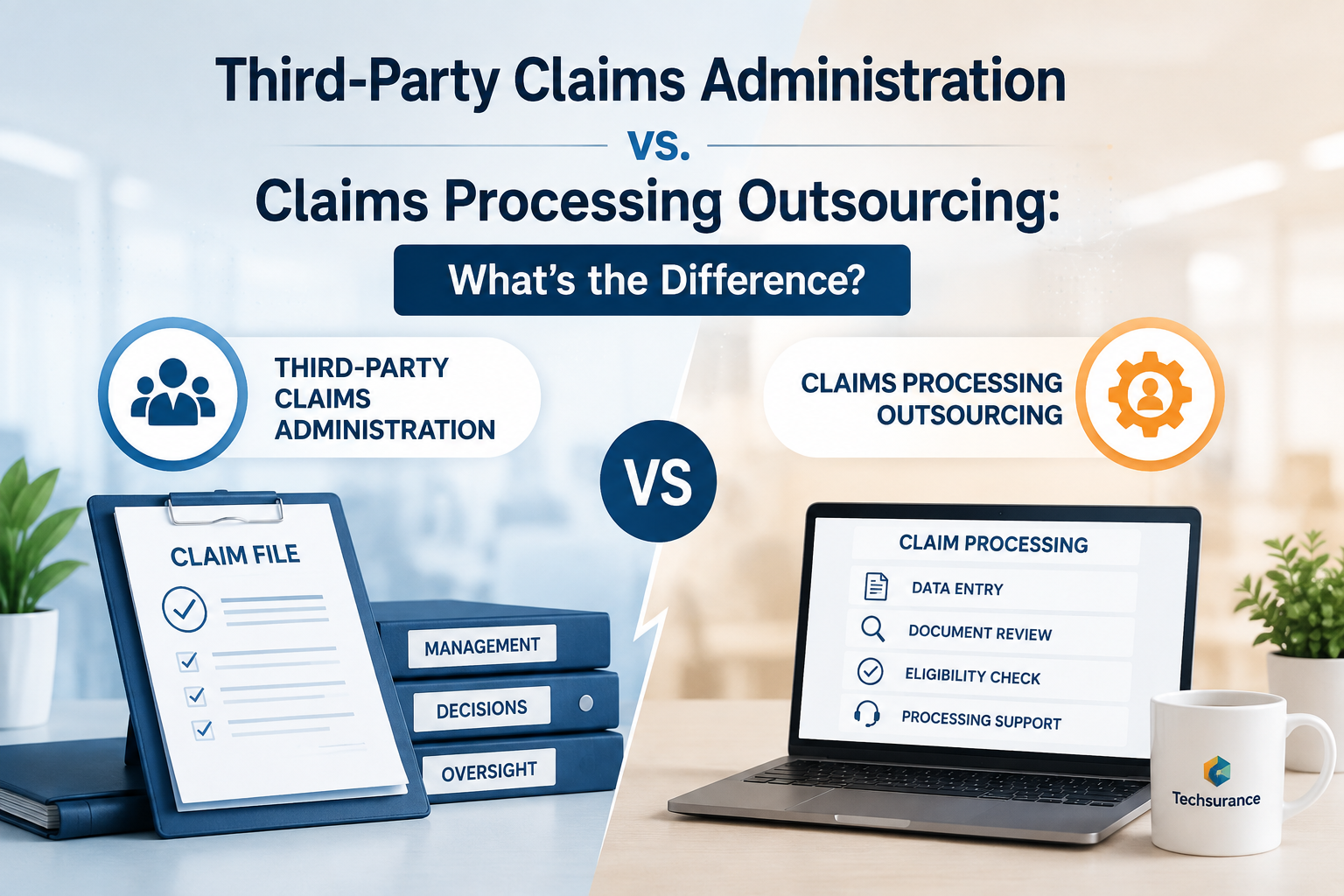
    4. What is the difference between third-party claims handling and full outsourcing?

    Third-party handling of claims is the handling of specific aspects of the claims process by a third party under the insurer’s close control. Outsourcing, on the other hand, refers to a more general transfer of the handling of claims, which may include various aspects of processing, supporting, etc., of the claim.

    5. Is outsourcing insurance claims cost-effective?

    Yes, outsourcing insurance claims is cost-effective because it removes the burden of recruitment, staffing, and demand variability from the insurance business and places it on the service provider. Service providers also invest in productivity-enhancement tools and technological advancements, which are one-time expenses for them and can be obtained at a fraction of the cost by insurance businesses if they choose to outsource to them.

    6. How do insurers maintain compliance when outsourcing claims?

    Insurers retain control over claims processing even after outsourcing by setting defined processes, approval matrices, and SLAs with the service provider. Claims processing outsourcing partners like Techsurance are happy to work closely with client teams, enabling reviews and reporting frameworks to ensure that client teams always have real-time visibility into operational metrics.

    7. What KPIs should be used to evaluate outsourced claims performance?

    The most common KPIs used to evaluate outsourced claims performance are first-pass resolution rate, turnaround time by stage, pend rate, pend age, QA accuracy, issue categories, escalation rate, reopen rate, and inquiry volume. These metrics show whether the outsourced team is improving flow without creating hidden downstream problems.

Inquire Now