
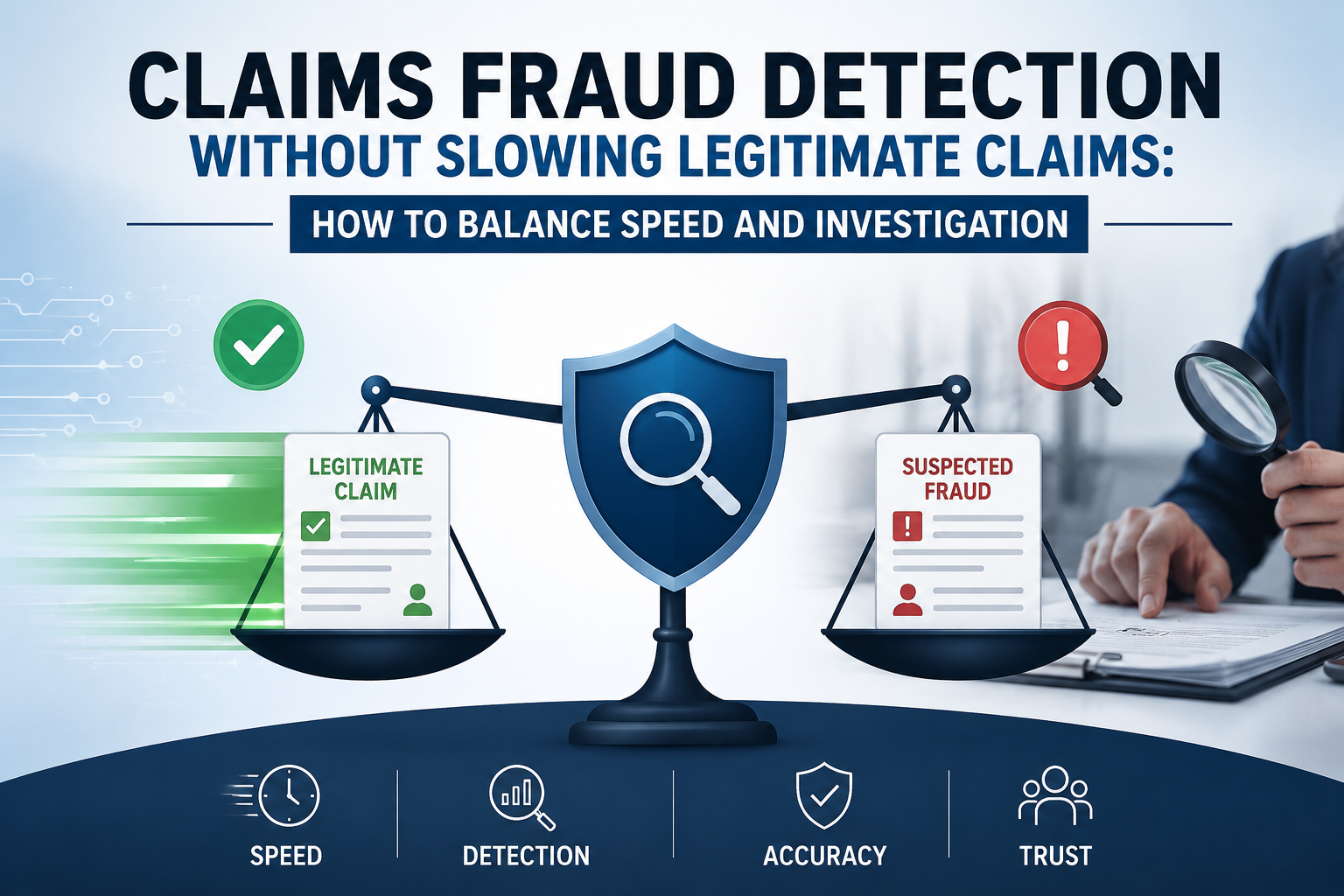
On a Tuesday morning in Ohio, a claims desk raises a $14,000 claim for water damage. The photographs appear to be consistent, and the plumber’s invoice is valid. However, the policy had been bound eleven days prior to the loss, and that one date causes an automatic suspension of the claim. It remains in abeyance for six days while an investigator works through a backlog of forty other referrals. The policyholder makes two calls. On the seventh day the investigator approves it and finds that there is no issue. The insurer had simply spent a week treating a genuine claim as if it were a suspect one.
That’s the real challenge with claims fraud detection: finding the relatively small number of claims that are actually fraudulent without putting every questionable claim through the same lengthy manual review. Insurance fraud is estimated to cost the U.S. economy around $308.6 billion each year, based on a 2022 study conducted for the Coalition Against Insurance Fraud. So, ignoring potential fraud isn’t an option. At the same time, not every flagged claim should be treated as confirmed fraud. That’s where insurance claims fraud detection has to find the right balance. This article looks at how claims fraud detection works, why speed and investigation can clash during the process, and what claims teams can improve in their overall workflow instead of relying only on new software.
What Is Claims Fraud Detection?
Claims fraud detection refers to the processes and checks an insurer uses to spot claims that include misrepresented, exaggerated, or fabricated information before any payment is made. It is incorporated into the claims workflow rather than being located alongside it; all claims go through some form of fraud screening as they move from the initial intake to settlement, whatever that screening may be, whether it’s carried out by a rules engine, results from a predictive score, or is based on an adjuster’s own judgment.
The difference between claims fraud detection and claims fraud prevention is that prevention involves upstream steps, such as underwriting checks, policy design, and agent controls, measures that make it harder to commit fraud from the outset. Detection of inconsistencies placed after a claim has been submitted consists of identifying inconsistencies such as those in a repair estimate, the claimant who has reported three similar losses in two years, or the provider whose billing pattern does not match those of the rest of the network.
Under US insurance regulations, insurance claims fraud detection is also a compliance requirement in most states, not merely a loss-control activity; insurers must draw up a documented anti-fraud plan and report any suspected fraud to state fraud bureaus. The main objective of effective claims fraud detection is easy to state but difficult to carry out: it is to separate out the claims that deserve a more detailed examination from the much larger number that do not, all in such a way that the honest majority hardly notices.
Why Insurers Can’t Optimize for Only One Side
Those insurers who place too much emphasis on speed end up making payments on claims that should have been picked up, while those who place too much emphasis on investigation end up causing policyholders to become alienated, thus affecting the business’s operation, and in both cases the errors appear in different sections of the profit and loss statement than the majority of claims managers anticipate.
According to research carried out by the Coalition Against Insurance Fraud, fraud in the area of property and casualty claims accounts for about 10% of the industry’s claims losses and loss adjustment expenses; this is one of the reasons why budgets for detecting insurance claims fraud have increased even though the total number of claims has not. That percentage has a direct effect on the loss ratio. On the other hand, when a policyholder experiences a slow and adversarial claims process, particularly in the case of a claim that is actually legitimate, they are considerably more likely to look for a new insurance company when the policy is renewed. Delays in the claims handling process are consistently among the most frequently reported complaint categories that state insurance departments monitor.
The 2022 Insurer SIU Benchmarking Study, also produced by the Coalition Against Insurance Fraud, showed that Special Investigation Unit staffing increased by only 1.4% that year, which was considerably less than the 2.5% growth experienced in previous years, even though both the volume of claims and the sophistication of fraud had risen. Since the investigation teams are now achieving more while having proportionally fewer staff members, this is precisely the situation that results in a six-day holding period for a $14,000 water-damage claim.
| Approach | What goes wrong | Who feels it first |
| Optimizing for speed only | Fraudulent claims get paid, loss ratios drift up | Finance, reinsurance renewals |
| Optimizing for investigation only | Legitimate claims stall, complaints and churn rise | Customer service, retention |
| No clear triage logic | Every claim gets the same review depth regardless of risk | Adjusters and investigators, who burn out on low-value review |
How Claims Fraud Detection Actually Works
A claims fraud detection process goes through five stages. Although the tools differ from insurer to insurer, the sequence usually remains the same.
- Intake and data capture: The recording of claims and the collection of data involve the claims staff entering the claim together with the policy details, a description of the loss, the relevant documentation, and any previous claims associated with the same policyholder, vehicle, property, or provider.
- Automated screening: The claims are screened automatically by using a set of rules and predictive models that evaluate the claim based on known signs of fraud, such as mismatched dates, identical claim numbers, the claimant or provider networks having made previous referrals, and inconsistencies between the description of the loss and the supporting evidence.
- Triage: Triage involves moving claims that have passed the screening process and are of low risk directly on to settlement; the system identifies those claims that exceed the risk threshold for further investigation.
- Investigation: An investigation is carried out by either a special investigation unit or by a trained investigator, who looks at the claim that has been flagged, retrieves the relevant records, conducts interviews, checks other claims across different carriers using the shared databases, and then records the results.
- Resolution: The insurer will either approve the claim, adjust it, reject it, or refer it for additional legal or regulatory action and will keep the investigation file for audit and, if necessary, for use in litigation.
The factor that ensures that speed and thorough investigation remain in balance is triage; indeed, all that comes before it (data quality) and all that comes after it (investigator capacity) depend on triage correctly sorting the claims the first time.
Where Speed and Investigation Actually Collide
The greatest amount of friction that claims teams experience in the claims fraud detection process comes from three points.
Screening thresholds set too wide: The screening thresholds are set too broadly. A model designed to detect every possible sign of fraud flags many normal claims, for example, a recent change in policy, a claimant who made a valid claim two years ago, or a claim only slightly above the median for the area. Once the flag rate gets too high, investigators are overwhelmed by false positives, and legitimate claims in that queue are delayed just as much as genuine fraud cases.
No risk-based routing: There is no routing based on risk. Even now, claims teams tend to send every claim that has been flagged to the same investigation queue, no matter how large the amount involved, how strong the evidence is, or what the claimant’s history is. A claim of $2,000 with just one soft flag is treated in the same way as a claim of $150,000 with five hard flags.
Investigation capacity that hasn’t scaled with volume: The ability to carry out investigations has not kept pace with the volume of claims. For several years now, the number of staff assigned to the SIU has failed to keep up with the volume of claims. If the volume of referrals increases faster than the number of investigators, the queue will still build up regardless of how accurate the screening model is.
| Friction point | Typical cause | Practical fix |
| High false-positive rate | Screening thresholds calibrated to catch everything | Recalibrate scoring against actual investigation outcomes, not just flag volume |
| Uniform queue | No severity or confidence tiering | Route by claim value and flag strength, not just presence of a flag |
| Investigator backlog | Staffing didn’t scale with claim or flag volume | Move lower-complexity file prep and documentation review off investigators’ plates |
Four Ways to Build the Balance Structurally
These four levers improve claims fraud detection without necessarily adding headcount.
1. Tiered triage instead of a single flag or no-flag gate
Divide the flagged claims into three or more categories: straight-through approval, expedited review (this involving a quick further examination by an adjuster without carrying out a full investigation), and a full referral to the SIU. Insurers who make this change typically discover that a significant number of the flagged claims require only the expedited level, which in turn frees up investigator time for the claims that truly deserve it.
2. SLA-based routing by claim value and evidence strength
A claim involving a large amount of money but with weak evidence should follow a different timeline from a claim involving a small amount of money having only one minor issue. Setting within-tier service level targets, rather than using a single company-wide turnaround figure, ensures that low-risk claims are processed quickly while at the same time allowing investigators the time that a complicated case actually needs.
3. Matching investigator capacity to actual referral volume
It is mainly as much a staffing issue as a technological one. Whenever the volume of referrals exceeds the number of SIU staff, the majority of insurers take one of two actions: they employ more investigators or they assign the less complex investigative preparation work such as document reviews, records requests, and claim history checks to a specialist external team so that their in-house investigators can focus on making judgments rather than dealing with paperwork. Insurers that choose neither option are the ones seeing their backlog grow.
4. Feeding investigation outcomes back into the screening model
A model which does not learn from cases where fraud has been confirmed and claims have been cleared continues to produce the same false alarms. Insurers that have a formal feedback mechanism linking the findings of the SIU to the fraud scoring model tend to find that the accuracy of their flags improves from quarter to quarter, a trend that has been recorded in case studies of insurers published by fraud technology companies such as SAS and FRISS.
In-House Claims Fraud Detection vs Outsourced Support
Most insurance companies make the final fraud decision themselves. The thing that differs is the extent to which various aspects of the work, such as the review of documents, verification of the data, checks on the claim history, and preparation of the case file, are carried out internally rather than by an external partner.
| Factors | Fully in-house | Insurance KPO support |
| Fraud determination | Made by internal SIU or adjuster | Stays with the insurer’s own team |
| Document and data review | Competes for the same investigator hours | Handled by a dedicated support team, freeing investigators for judgment calls |
| Handling claim volume spikes | Fixed headcount, backlog grows during a surge | Support team flexes with claim volume |
| Turnaround on routine flags | Depends on current backlog | Governed by agreed service-level targets |
| Domain expertise | Built internally over time | Insurance-trained teams, not general back-office staff |
Insurance claims outsourcing and claims processing outsourcing fit into this scenario as support for the other activities involved. The document checks, data validation, and file preparation, which account for most of the time spent on any investigation, do not compete with the insurer’s own investigators for time, the fraud judgment itself remaining in-house. Similarly, claims management outsourcing operates in the same way throughout the entire claims file, not just with the subset of cases that have been flagged for fraud: an external insurance KPO partners take on the volume-intensive, repetitive elements of insurance claims processing so that the in-house staff can concentrate on the claims and referrals that actually require judgment.
Before choosing a partner for any part of insurance claims outsourcing, it is necessary to examine the contents of a suitable selection guide for insurance outsourcing partners; such a guide should include documented experience in the insurance field, clear service level agreements which are differentiated by workflow type, and the ability to scale up during periods of increased claims without compromising accuracy.
KPIs That Show Whether the Balance Is Working
| KPI | What it measures | Why it matters |
| Average cycle time on non-flagged claims | Speed for the majority of honest claims | Directly tied to policyholder satisfaction and retention |
| False-positive rate on SIU referrals | Screening accuracy | High rates waste investigator time on clean claims |
| Confirmed fraud rate among referrals | Investigation quality | Low rates suggest thresholds need recalibration |
| Average investigation cycle time | Speed on flagged claims | Track separately from overall cycle time, not blended into it |
| SIU cost per confirmed fraud case | Efficiency of the investigation function | Ties fraud spend to measurable recovery |
| Policyholder complaint rate tied to claims handling | Downstream effect of the process | Early signal that thresholds or SLAs need adjustment |
Track these claims fraud detection KPIs by tier, not as one blended average. A single average cycle time can hide the fact that 85% of claims move in three days while the flagged 15% take three weeks.
Common Mistakes Claims Teams Make
- Every flag should be treated in the same serious way; for example, a soft flag (since this is a recent policy change) and a hard flag (in the case of a claimant linked to a known fraud ring) should not be sent to the same queue at the same priority.
- Evaluating investigators on the number of cases they close rather than on their accuracy causes them to prefer making quick denials or quick clearances rather than correct ones.
- Allowing the screening model to run without any oversight for several years means that fraud patterns change, so a model calibrated two years ago becomes ineffective against the fraud methods of yesterday.
- Omitting communication with the policyholder; a claim that is under review and which provides no updates usually seems to be a denial to them even if it isn’t. Sending a brief and clear message stating the current position of the claim and giving an approximate time for the decision reduces the number of complaints without altering the investigation.
- Focusing on software alone when it comes to detecting fraud. The technology is used to assign scores and trigger warnings without preparing a case file, interviewing the claimant, or making the final decision. Insurers who assume that a new fraud-detection tool can resolve the conflict between speed and the need for investigation without at the same time improving their staffing and triage procedures tend to be disappointed within a year.
If you want to look in more detail at the process by which a claim file goes from intake to closure, refer to Techsurance’s guide to claims administration.
Where Techsurance Fits
Techsurance supports US insurers, MGAs, and TPAs with the operational work that sits around insurance claims fraud detection rather than replacing the fraud decision itself. That includes document and data validation, claim history checks, file preparation for SIU referral, and quality control on the claims that pass straight through screening. The goal is simple: give in-house adjusters and investigators back the hours currently spent on document review and data entry so that time goes toward the claims that actually need a trained eye. Insurers evaluating claims processing outsourcing or broader insurance claims processing support can compare models on the in-house vs. outsourced operations breakdown.
The Real Fix Isn’t a Better Algorithm
A better fraud model can certainly help, but it won’t solve everything. If claims are sitting in a queue with no clear priority system, or the SIU team hasn’t grown in years, the problem goes beyond the algorithm. Claims fraud detection needs the right process, including clear triage rules, enough staff, practical service-level targets, and feedback from confirmed cases. These pieces help teams focus on claims that genuinely need investigation while allowing straightforward claims to move ahead. When the process is set up properly, most honest policyholders can go through claims fraud detection without even realizing it happened.
FAQs
Is claims fraud detection the same as claims investigation?
No, they are different. Claims fraud detection helps identify claims that may need further attention. If a claim gets flagged, the investigation starts. This may involve asking for documents, speaking with the people involved, and checking the evidence. An SIU or trained investigator reviews everything to determine whether the claim is genuine or needs further action.
When fraud screening is working properly, how long should a valid claim take?
Most claims that are not flagged should go through the review and settlement process within the insurer’s normal cycle time, which is usually a number of days rather than weeks. If honest claims are routinely being taken just as long as those that are flagged, then the screening or triage criteria should be revised, not merely increased investigator headcount.
What percent of insurance claims are really fake?
The figures differ by business type, and it is difficult to determine them exactly since confirmed fraud includes only cases investigators actually catch. Industry estimates of fraudulent claims in property and casualty generally place the fraudulent portion at a high single-digit to a low double-digit as a proportion of claim losses, according to research by the Coalition Against Insurance Fraud.
Can outsourcing claims processing weaken fraud detection?
Not necessarily. It doesn’t have to, especially when the final fraud decision remains with the insurer’s own team. In most cases, the work that gets outsourced is the supporting part of the process, such as reviewing documents, checking data, and looking through claim history. These tasks can take up a lot of an investigator’s time without requiring them to make the final fraud decision. When handled properly, insurance claims outsourcing can take some of this workload off investigators and give them more time to focus on claims that need closer attention.
What’s the difference between claims fraud prevention and claims fraud detection?
The main difference is when they take place. Claims fraud prevention starts before a claim is filed. It includes underwriting checks, agent training, and policy design that make fraud harder to carry out. Claims fraud detection comes into play after a claim has been filed. It helps identify claims already in the system that may need a closer look.
