
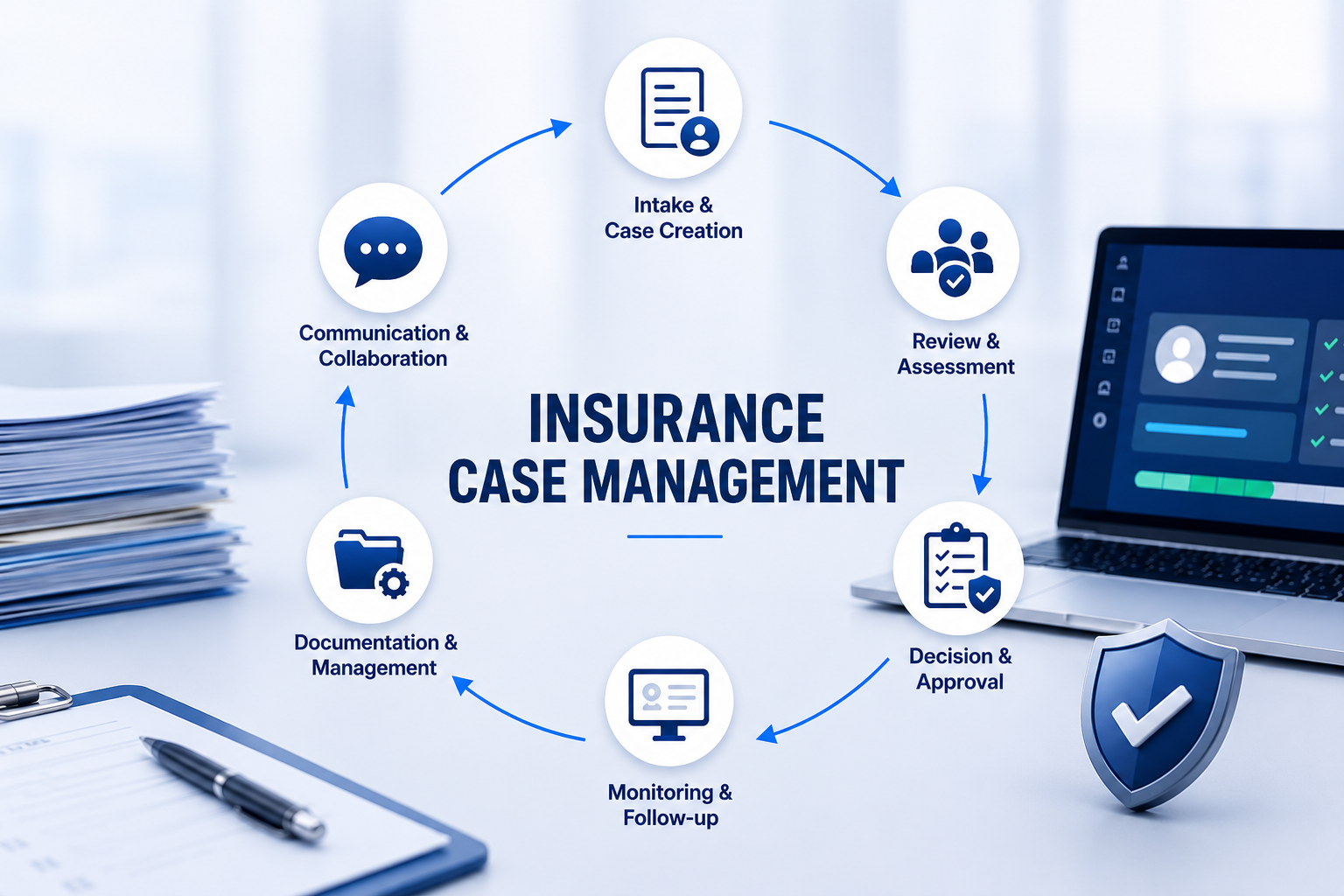
Insurance case management has emerged as an important requirement for insurers in the United States because claim teams are processing more claims due to disasters, underwriting teams are handling more complex submissions, and customer expectations for services are continually rising. Meanwhile, insurers face margin pressure; the US property and casualty industry recorded a combined ratio of 100.7% in 2024.
Insurance case management services provide insurance companies with tools to manage their claims, underwriting files, and service inquiries from inception to closure. This article explains what insurance case management is, how it differs from claims processing and underwriting, and how Techsurance helps insurers strengthen case workflows across claims and underwriting.
What is insurance case management?
Insurance case management is the coordinated handling of an insurance case from intake to closure. It includes capturing case details, validating documents, assigning tasks, routing work, tracking status, managing escalation, checking quality, and reporting progress against SLAs.
In insurance, this matters because claims and underwriting files don’t always follow linear workflows and may require various interventions along the way. Case management creates an operating framework that ensures that claims/underwriting files move along their defined workflows to closure.
Case management vs. claims processing vs. underwriting workflows
The terms case management, claims processing, and underwriting workflows each have distinct meanings. Here’s how they differ:
| Area | What it means | Main focus | Example tasks |
| Case management | Managing a case from intake to closure | Ownership, routing, tracking, escalation, QA/QC | Assign case owner, track documents, monitor SLA, escalate delays |
| Claims processing | Handling a claim through review and payment workflow | Claim review, claim status, settlement activity | Claim intake, coverage check, document review, payment setup |
| Underwriting workflow | Moving an application or renewal through risk review | File readiness, risk data, rating, approval | Submission intake, loss run review, rating data entry, quote prep |
Why case management has become an operational priority for US insurers
Insurance businesses face pressure from three directions:
- Tight margins: A combined ratio above 100% means losses and expenses exceed premium income. In that environment, every avoidable rework cycle adds cost.
- Claim volume spikes: In 2024, global insured natural catastrophe losses reached $137 billion. Severe storms, hurricanes, floods, and wildfires cause sudden spikes in claims. When cases arrive in large waves, weak routing and poor queue visibility create backlogs.
- Rising policyholder expectations: Digital claims studies show that customer satisfaction rises when carriers offer better digital claim features.
Here are the operational risks that arise due to weak case tracking:
| Industry pressure | What it creates | Case management value-addition |
| Combined ratio pressure | Less room for repeated work | Better task control and QA/QC |
| Catastrophe volume spikes | Sudden claim backlogs | Flexible routing and queue tracking |
| Rising customer expectations | More demand for updates | Better status visibility |
| Complex underwriting files | More documents and handoffs | Stronger intake and assignment rules |
| Multiple systems | Fragmented case records | Better coordination across teams |
| Regulatory review | More need for audit trail | Documented case history |
The core components of an effective insurance case management workflow
Strong insurance case management has several connected parts. Here are the core components:
Intake and triage
Intake for claims can include details such as Claim Intake, claimant data, policy number, date of loss, type of loss, documents, and contact information. Intake for underwriting can include details such as broker submissions, applicant data, line of business, requested insurance cover, loss runs, schedules, and prior policy documents. Sorting of the case into the appropriate queue is referred to as triage. The case can be sorted according to:
- Claim type
- Loss severity
- Product line
- State
- Broker or agent
- Coverage amount
- Renewal or new business
- Missing documents
- Escalation level
- Required review team
Validation and documentation checks
Validation confirms whether the case has the information needed for review. This step prevents incomplete files from reaching adjusters, underwriters, or managers. Documentation checks are especially important in insurance because a case often depends on several documents. Missing records create delays and repeated follow up. Common validation checks include:
- Policy number
- Applicant or claimant details
- Coverage dates
- Loss date or effective date
- Required forms
- Required signatures
- Schedules
- Loss runs
- Medical records
- Photos or estimates
- Prior policy documents
- Broker notes
Routing and assignment logic
Routing decides where the case goes next. Assignment decides who owns the next step.
A strong routing model uses defined rules. Routing can be based on case type, state, value, complexity, staff capacity, or required skill. Here’s how assignment varies by use-case:
| Case type | Routing factor | Assignment logic |
| Auto claim | Severity and coverage type | Claims reviewer or senior adjuster |
| CAT claim | Location and damage type | Catastrophe claim queue |
| Health claim | Claim amount and coding issue | Claim review specialist |
| New business submission | Line of business and premium size | Underwriter queue |
| Renewal file | Renewal date and prior loss activity | Renewal review team |
| Referral case | Risk or claim exception | Manager or medical director |
Escalation management
Escalation management handles cases that need senior review, special action, or a faster response. Without defined escalation rules, files don’t move while staff decides what to do.
Escalation rules should answer five questions:
- What issue needs escalation?
- Who receives the escalation?
- What information must be included?
- What response time applies?
- What happens if the issue stays unresolved?
In claims, escalation can apply to coverage disputes, high-value losses, fraud flags, medical review needs, or aged pending claims. In underwriting, escalation can apply to unusual risk factors, missing APS records, large submissions, authority limits, or pricing exceptions.
QA/QC and audit trail
QA/QC checks whether case handling meets the carrier’s process standards. The audit trail records what happened in the case. It should show who interacted with the file and what changed at every step. A strong audit trail helps with internal review, reinsurer review, regulatory questions, and manager coaching. QA/QC includes:
- Intake review
- Missing document checks
- Data field review
- Case note review
- SLA review
- Escalation review
- Closure review
- Sample-based audit
- Error trend reporting
Reporting and SLA review
Reporting gives leaders visibility into case movement. SLA review shows whether cases meet agreed timelines. Useful case management reports include:
- Open case count
- Cases by age band
- Cases by owner
- Cases by queue
- Missing document count
- SLA breach count
- Escalation volume
- Rework rate
- QA/QC error rate
- Average closure time
- Pending reason report
Claims case management: What strong execution looks like
Claims case management starts when a loss is reported and ends when the claim is closed. Strong execution requires excellence at all stages of the case management workflow. Here’s how insurers can build this excellence:
| Claims stage | Strong case management action | Business benefit |
| Claim Intimation | Capture loss details and documents | Faster case setup, reducing TAT |
| Coverage check | Verify policy and loss details | Fewer downstream delays, better service resulting in higher NPS |
| Documentation review | Check photos, estimates, invoices, records | Better file readiness, higher first-time right rate |
| Assignment | Route by claim type and severity | Better use of staff time |
| Escalation | Move complex claims to senior review | Faster action on high-risk cases, increasing CSAT |
| QA/QC | Review files for missing data | Fewer repeat touches |
| Closure | Confirm payment and file notes | Better audit trail |
Underwriting workflow management: Where case management reduces cycle time
Underwriting case management focuses on moving submissions and renewals through review faster. Underwriting files typically consist of several moving parts and involve multiple stakeholders. When teams are required to work in a fragmented manner, cycle time inevitably grows. Case management helps by creating a single case view and reducing cycle time by addressing issues including:
| Underwriting issue | Case management fix | Cycle time impact |
| Submission stuck in inbox | Intake queue and owner assigned | Faster file start |
| Missing loss runs | Early document checklist | Less back and forth |
| Wrong underwriter queue | Routing by line and premium size | Fewer reassignments |
| Manager approval delay | Escalation rule and SLA | Faster decision path |
| Renewal date risk | Renewal calendar and case aging | Fewer late reviews |
| Delay in follow-up information | Information checklists so that all information is collected at the start of the process itself | Fewer corrections, lower TAT |
How Techsurance strengthens case management for insurers
Techsurance helps insurers strengthen insurance case management through trained operations teams and ISO-certified process-first execution. Here’s how our teams can add value across the stages of case management workflow:
| Case management workflow stage | Techsurance service | Business benefit |
| Claims intake volume | Capture details and review documents | Faster case setup |
| Underwriting submissions | Prepare files and check missing items | Better file readiness |
| Queue monitoring | Track status and aging cases | Better workflow visibility |
| Escalation preparation | Summarize issue and next step | Faster senior review |
| QA/QC | Review files against process rules | Fewer repeated errors |
| Audit trail | Maintain file notes and review records | Better review readiness |
| SLA reporting | Track turnaround and pending reasons | Better management control |
Best practices for insurance case management services
Case management services work best when scope, roles, and reporting are set before work begins. The best case management programs follow best practices that help them move from reactive follow-up to a managed workflow. These include:
- Define case types before launch
- Create intake checklists by workflow
- Assign every case owner
- Track next action and due date
- Route by rules rather than memory
- Set escalation triggers
- Use QA/QC before closure
- Track rework by reason
- Review SLA data by case type
- Keep decision authority internal
- Use one reporting view for internal and partner work
- Review aging cases weekly
Conclusion
Insurance case management services help insurers move claims and underwriting files from intake to closure with better control. This is important because insurers are required to manage multiple strains, such as financial pressure, rising volumes, rising policyholder expectations, and document-heavy workflows, all of which expose weaknesses in case handling.
Strong case management reduces backlogs, improves file readiness, lowers rework, and gives leaders better visibility into case movement. It also helps internal team members spend more time on complex claim and underwriting decisions. Techsurance helps insurers strengthen case management through trained insurance operations teams, robust process adherence, and technology that boosts efficiency. A focused conversation with our team can identify the case type creating the most pressure within your business and define the best starting point for improvement.
FAQs
What is insurance case management?
Insurance case management is the coordinated handling of an insurance case from intake to closure. It includes case intake, document checks, task assignment, routing, escalation, QA/QC, audit trail, and SLA reporting.
How is case management different from claims processing?
Claims processing handles the claim workflow, including intake, review, settlement activity, and closure. Case management manages ownership, status, routing, escalation, and reporting across the full claim.
How does case management help underwriting teams?
Case management helps underwriting teams by organizing submissions, checking documents early, routing files to the right queue, tracking missing items, and escalating complex cases. This reduces idle time between steps and helps underwriters focus on risk review.
Why do insurers outsource case management services?
Insurers outsource case management services to add trained capacity, reduce backlogs, improve document checks, monitor queues, and track SLA performance. Outsourcing defined tasks helps internal teams focus on final decisions and complex cases.
Should insurers buy case management software or use a specialist partner?
Software helps track workflows, automate tasks, and centralize information. A specialist partner adds trained execution capacity and day-to-day process handling. Many insurers use both: software for workflow visibility and a partner for intake, validation, QA/QC, and reporting.
What metrics should insurers track in case management?
Useful metrics include open case count, average case age, SLA performance, missing document rate, escalation volume, rework rate, QA/QC error rate, closure time, and pending reason trends. These metrics help leaders see where cases slow down.
