
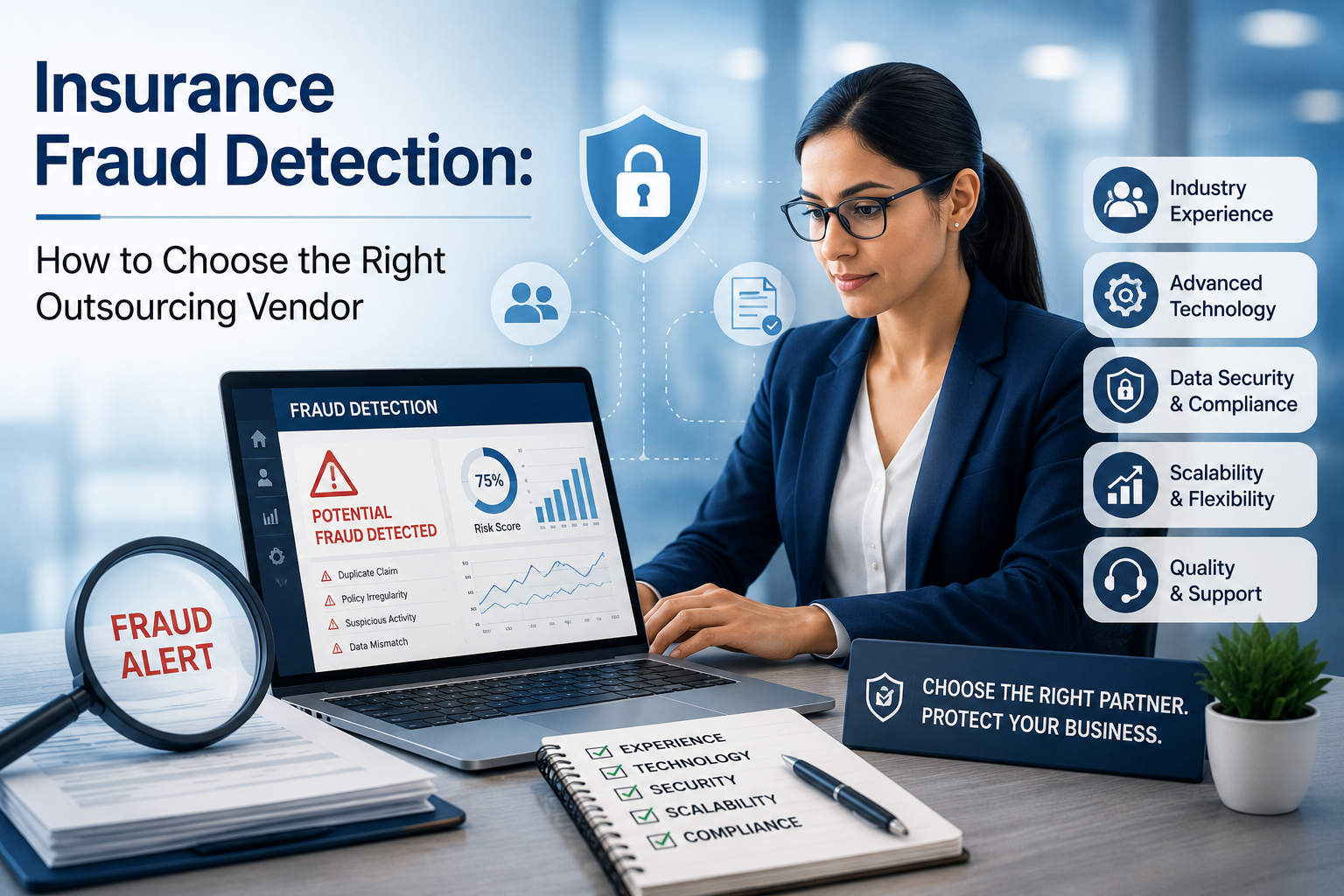
Insurance fraud costs Americans $308.6 billion a year, according to a 2022 study conducted for the Coalition Against Insurance Fraud. Most carriers already know that number. Fewer know that the NAIC’s Special Investigations Unit Model Regulation gives them an explicit choice: maintain an SIU in-house, or contract the function out to a third party. Outsourcing fraud detection support isn’t a workaround. Regulators built the option into the rule.
This guide covers how to evaluate an outsourcing partner for fraud detection support. It doesn’t compare AI fraud-detection software platforms. That’s a different purchase decision, and the two get confused often enough that it’s worth separating before you read another paragraph.
What insurance fraud detection outsourcing actually means
Insurance fraud detection outsourcing is trained human review, red-flag screening, document verification, and SIU referral support delivered by a third party as part of your claims or back-office operations, working inside the fraud detection procedures you already have on file. It sits next to your existing tools and staff. It doesn’t replace your fraud program; it adds capacity to it.
Software platform or outsourcing partner: which do you actually need?
Shift Technology, FRISS, SAS, BAE Systems NetReveal, and Guidewire sell AI-driven platforms that score claims and flag patterns at scale. That’s a technology purchase, and it answers a different question than the one this guide is answering.
An outsourcing partner supplies people: staff who review the files a system (or a claims examiner) has already flagged, verify documents, check claim history, and package referrals for your SIU. Plenty of insurers run both at once, a platform to surface the flags and a partner to work them. This guide is about choosing the second piece, not the first.
Why insurers look outside for fraud detection support
Claims volume keeps climbing, and SIU roles are hard to staff. New York’s Regulation 95 requires SIU investigators to meet specific education or experience thresholds, including five years of insurance claims investigation experience or law enforcement investigation experience. That’s a narrow hiring pool in a market where, as of July 2026, the average SIU investigator earns $75,325 a year, before benefits, training, or the downtime that comes with an unpredictable caseload.
Building a fully staffed SIU from scratch takes months and a real budget line. Outsourcing the review layer gets you trained capacity faster, without the hiring cycle. For a full breakdown of fraud types, detection techniques, and the tools available to catch them, see our guide on fraud detection in insurance claims. This post stays narrower: What makes a vendor good at the fraud-detection piece specifically, not fraud detection in general?
What a fraud detection outsourcing vendor should actually do
| Stage | What the vendor should handle |
| Intake screening | Flag red flags at first notice of loss against your defined criteria |
| Document verification | Cross-check forms, bills, and records for inconsistencies |
| Pattern and history review | Compare against prior claims, known vendors, and linked parties |
| SIU referral and documentation | Package the case with notes and evidence that hold up to audit or dispute |
| Reporting | Track fraud detection rate, false positive rate, and referral cycle time back to you |
A vendor that only does the first two rows is running document QC, not fraud detection support. The referral and reporting stages are where the actual value shows up, because that’s what your SIU and your regulators both look at.
Criteria for choosing an insurance fraud detection outsourcing vendor
| Criteria | What to look for | Red flag |
| SIU integration | A documented referral and hand-off process with your team | A vague answer about “flagging suspicious claims” with no defined process |
| Insurance-specific training | Staff trained on fraud indicators for your specific lines | Generalist BPO staff with no insurance-specific fraud training |
| Data security | ISO 27001 or equivalent, role-based access to sensitive files | No named certification, or a vague “we take security seriously” |
| Compliance awareness | Familiarity with your state’s fraud prevention plan and reporting requirements | No mention of state-specific anti-fraud obligations |
| Reporting transparency | Clear metrics: detection rate, false positive rate, referral cycle time | Only “volume processed” reporting |
Ask a prospective vendor to walk you through an actual referral, start to finish. If they can’t name who signs off, what documentation gets attached, or how long the handoff takes on average, the process probably doesn’t exist yet.
Questions to ask before you sign
- Who on your team reviews flagged claims, and what’s their background?
- What does a completed SIU referral package look like? Can we see a redacted example?
- How do you train staff on our specific lines and our fraud indicators?
- What certifications cover the data you’ll be handling?
- Which states’ anti-fraud reporting requirements does your team already work with?
- What happens when your reviewers and our existing SIU disagree on a case?
If a vendor can answer the data security and compliance questions in detail but goes quiet on referral documentation, that’s usually a sign they’re built for general claims processing, not fraud-specific work. Techsurance builds fraud flags and validation checks into claims registration and review under claims administration and insurance compliance support, so referrals come with the documentation trail your SIU needs, not just a flagged file and a shrug.
How Techsurance supports fraud detection within claims and back-office operations
Techsurance isn’t a fraud-detection software company, and we don’t claim to be. What we do is embed fraud flags and validation checks directly into claims registration and review, backed by documented QC and audit trails under ISO 9001 and ISO 27001 certification. That work sits alongside whatever fraud-detection technology your organization already runs. We’re not replacing your platform or your SIU; we’re giving both of them cleaner, better-documented cases to work with.
That shows up most directly in our health claims service, where validation checks catch inconsistencies before a claim moves further down the pipeline. If you’re separately evaluating a general claims outsourcing partner, our guide on choosing the right insurance claims outsourcing partner covers that broader decision.
Conclusion
The NAIC’s model regulation already settled the legitimacy question: contracting out your SIU function is a recognized path, not a shortcut.² The harder question is which fraud detection outsourcing vendor actually earns that trust. Look for documented SIU integration, insurance-specific training, and reporting that goes past “claims processed.” A vendor that promises to “catch fraud” without showing you how referrals get built and handed off is selling a pitch, not a process.
Ready to see how fraud flags and validation checks would fit into your claims workflow? Contact Techsurance to talk through your SIU support needs.
FAQs
What is insurance fraud detection outsourcing?
It’s the practice of having a third party handle parts of your fraud review process, red-flag screening, document verification, and SIU referral support, while your organization keeps ownership of the underlying fraud detection procedures and final decisions.
Is insurance fraud detection a software product or a service?
Both exist, and they solve different problems. AI platforms like Shift Technology or FRISS score claims and detect patterns automatically. Outsourced fraud detection support is staffing trained people who review flagged files, verify documents, and build SIU referrals. Many insurers use a platform for detection and a partner for the review work behind it.
Can insurers legally outsource their SIU function?
Yes. The NAIC’s SIU Model Regulation requires carriers above a certain premium threshold to maintain an SIU or contract the function out. New York’s Insurance Law and Regulation 95 explicitly permit using an outside contractor for SIU functions, provided the insurer files the contract details with its Fraud Prevention Plan. State rules vary, so check your specific state’s requirements before signing anything.
What should I look for in a fraud detection outsourcing vendor?
Documented SIU integration, insurance-specific fraud training (not generalist BPO staff), named data security certifications, awareness of your state’s anti-fraud reporting requirements, and reporting that covers detection rate and referral cycle time, not just claim volume.
Does outsourcing fraud review put sensitive claims data at risk?
It can, if the vendor doesn’t have real data security controls in place. Ask for named certifications like ISO 27001, and confirm role-based access limits: who on their team can see what. A vendor that can’t name a certification or describe access controls in specific terms hasn’t built the controls yet.
Can an outsourced team work alongside an existing in-house SIU?
Yes, and that’s the more common setup. The outsourced team typically handles intake screening, document verification, and initial pattern review, then hands documented referrals to your in-house SIU for final investigation and decision-making.
Does outsourcing fraud detection help with state anti-fraud compliance requirements?
It can, if the vendor understands your state’s specific fraud prevention plan requirements and builds referral documentation that meets them. It doesn’t remove your compliance obligations. Under New York’s framework, for example, the insurer remains responsible for compliance even when a contractor performs the SIU functions.
