
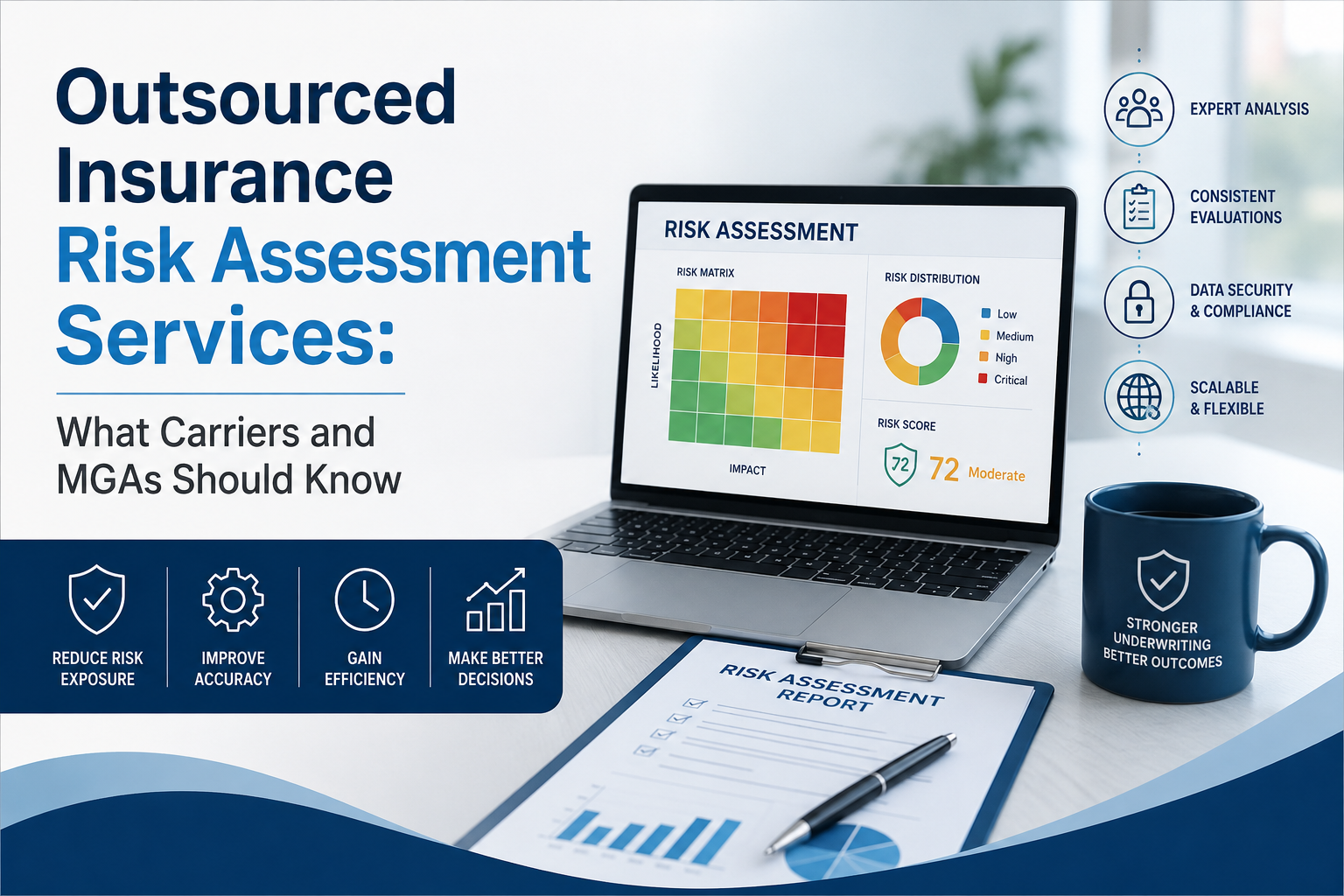
Even if an insurer has rigorous underwriting guidelines, the turnaround time can still be delayed since each submission requires a person to obtain the loss history, check the exposure data, and then compare it with the policy’s eligibility criteria before the underwriter gets a copy of the file. The work involved in this preparation is insurance risk assessment and is typically where delays occur when the number of applications exceeds the number of staff members.
The article explains what the process actually entails, how carriers and MGAs carry it out, and the reason why an increasing number of them have resorted to using outsourced risk assessment services in order to get the files processed without having to add any permanent staff.
What Is Insurance Risk Assessment?
The insurance risk assessment The process involves insurers and MGAs carrying out an evaluation in order to establish the level of risk involved in a submission before a decision about coverage, pricing, or the terms is reached. This assessment comes before the underwriting decision is made. To decide whether to accept a risk and at what price, an underwriter relies on the data and analysis from the risk assessment; this assessment forms the basis for the decision.
This differs from insurance risk management, which is the broader, ongoing discipline of identifying, monitoring, and mitigating risk across an insurer’s entire book. This kind of assessment is narrower and file-specific: it happens submission by submission, renewal by renewal.
Depending on the line of business, the process can involve loss history review, exposure data validation, property or liability inspection reports, financial stability checks, and industry classification checks. Commercial lines tend to require deeper assessment than most personal lines, given the variation between submissions.
How the Insurance Risk Assessment Process Works
A typical workflow looks like this:
- Submission intake – The application or renewal arrives with the applicant’s stated exposures, prior loss history, and supporting documentation.
- Data validation – The reviewers check that the information submitted is complete and consistent and identify any gaps before the file is passed on.
- Exposure and hazard evaluation: The evaluation of exposure and hazard involves examining the physical, operational, or financial exposures that are relevant to the coverage line, using inspection reports or data from third parties where these are available.
- Classification and eligibility check: The classification and eligibility are verified in accordance with the underwriting guidelines and the product eligibility rules.
- Risk scoring or grading: Many carriers apply a scoring model or grading matrix to summarize the assessment for the underwriter.
- Handoff to underwriting: The file is passed to the underwriter, who then examines it and decides on the coverage, the pricing, and the terms.
The greater the complexity, the deeper the process goes. A simple renewal having a clean loss history is faster than a new commercial submission, which has several locations and an unfamiliar industry classification.
What Insurance Risk Assessment Services Typically Cover
| Component | What It Involves |
| Loss history review | Checking prior claims data for patterns that affect pricing or eligibility |
| Exposure data validation | Confirming property values, operations, or liability exposures match what’s stated |
| Documentation and file readiness | Gathering inspection reports, financial statements, and supporting records |
| Classification checks | Verifying industry codes and product eligibility against underwriting guidelines |
| Quality assurance | Reviewing completed assessments for accuracy before underwriter handoff |
| Audit trail documentation | Recording how each assessment was reached for compliance and dispute defense |
Nothing can take the place of the underwriter’s judgment; it is merely the preliminary work that enables that judgment to be reached more quickly and in a more consistent manner.
Why Carriers and MGAs Outsource This Work
The risk assessment process involves a great deal of documentation, is repetitive when dealing with similar types of submission, and is affected by fluctuations in volume. A team sized to handle average submission levels finds it difficult when a book increases in size, a new product is launched, or there is a seasonal surge.
The practical reason why carriers and MGAs resort to outsourcing risk assessment is that, instead of delegating the actual underwriting decision, they outsource the preparation and validation stage. This includes carrying out data checks, collecting the necessary documentation, verifying exposure, and carrying out quality assurance so that the underwriters can spend their time on making judgments rather than on putting together the files.
Where insurance risk assessment outsourcing typically adds value:
- Handling higher workloads without the need for permanent staff
- Keeping data validation consistent across different types of submissions
- Getting files ready faster for underwriter review
- Running QA checks that catch inconsistencies before they reach the underwriter
- Maintaining audit-ready documentation for every assessed file
The MGAs in particular experience this kind of pressure. This is because MGAs usually look after a number of carrier programs, each with its own eligibility rules and limits on delegated authority, so a submission that meets the criteria of one program may require further checks with regard to another, thus increasing the amount of assessment work required per file.
In-House vs. Outsourced Risk Assessment
| Factor | In-House Only | With Outsourced Support |
| Capacity during volume spikes | Fixed, often stretched during peak periods | Scalable, added or reduced as volume shifts |
| Underwriter time on file prep | High, competes with actual risk judgment | Lower, files arrive assessment-ready |
| Turnaround consistency | Varies with staffing and volume | More stable across cycles |
| QA coverage | Depends on internal bandwidth | Dedicated QA step built into the workflow |
| Documentation for audits | Inconsistent if teams are stretched thin | Structured and consistent by design |
The need for in-house underwriting expertise is not eliminated by outsourcing this stage; instead, it shifts the location of the repetitive verification work, which in turn allows underwriters to spend more time on the decisions that genuinely require their judgment.
Common Challenges Carriers and MGAs Run Into
A few issues come up repeatedly for carriers and MGAs managing this work internally:
- Incomplete or inconsistent submissions: Since brokers and applicants do not always supply full loss runs or exposure data, someone has to follow up on the missing information.
- Multi-program complexity for MGAs: The complexity involved in dealing with multiple carrier programs is that since different carrier programs have different rules regarding eligibility, the same application may require separate assessment routes.
- Manual data entry errors: Errors caused by manual data entry. When exposure or loss data is entered by hand, mistakes are introduced that appear later, usually when a claim is being processed.
- Slow turnaround during peak periods: During busy times the turnaround is slow. The assessment team wasn’t sized to handle the volume caused by the renewal season and new product launches.
- Weak audit trails: The audit trails are weak. Since regulators and internal auditors require documented reasons for risk decisions, the inadequate documentation leads to problems when the decisions are examined.
When Should a Carrier or MGA Consider Risk Assessment Services?
Outsourcing this work tends to make sense once a few of these patterns show up together:
- Underwriters are spending noticeable time on data gathering instead of risk judgment
- Turnaround on new submissions or renewals is slipping against targets
- The book is growing faster than the assessment team’s headcount
- Multiple carrier programs or product lines are creating assessment complexity that a small internal team can’t keep pace with
- Recent audits flagged inconsistent documentation across assessed files
When the amount of submissions increases and your team notices a decline in the speed of turnaround, the underwriting and risk assessment support offered by Techsurance is designed specifically to handle this type of file preparation and validation, with your team retaining decision-making authority.
What to Look for in a Third-Party Risk Assessment Partner
Before engaging any provider for this kind of support, carriers and MGAs should ask:
- Has the partner got documented experience in the area of insurance-specific risk assessment rather than generic data processing?
- What quality control is carried out on each file before it gets to the underwriter?
- What measures does the partner take to ensure the security of sensitive exposure and financial information?
- Can the capacity increase during the renewal season or when a new product is launched and then decrease again afterwards?
- What specific commitments does the partner make regarding turnaround and how are these commitments measured?
- What way are the exceptions, gaps, and flagged files passed on to the underwriting team?
Any third-party risk assessment services that fail to provide clear answers aren’t ready to deal with the production volume of an insurance book.
How Techsurance Supports This Work
Techsurance acts as an insurance KPO partner to US carriers and MGAs at the stage involving risk assessment, carrying out tasks such as data validation, ensuring documentation is ready, performing classification checks, and carrying out quality assurance, the actual underwriting authority remaining with the insurer. For more information on how this fits into the overall underwriting process, refer to the guide on the insurance underwriting process, and for the risk management context that this work supports, the insurance risk management guide explains how continuous risk review relates to file-level assessment.
Conclusion
This type of assessment forms the basis on which every coverage decision can be justified, and the amount of documentation associated with each file continues to increase no matter how large the team. Insurance companies and MGAs who combine their in-house underwriting expertise with outsourced assistance are able to maintain a steady turnaround time without having to add permanent staff whenever there is a rise in volume. Should assessment backlogs or inconsistent documentation become a regular occurrence rather than something that happens from time to time, you should consult Techsurance regarding the way in which risk assessment support could be incorporated into your operation.
FAQs
What do we mean by insurance risk assessment?
Insurance risk assessment involves reviewing a submission’s exposures, loss history, and other supporting information to understand the level of risk before the underwriter makes a decision.
What is the difference between insurance risk assessment and underwriting?
The risk assessment collects and verifies the data required by the underwriter. The actual decision, that is, whether or not to accept the risk and at what price and on what terms, is what underwriting entails. The assessment provides the information for underwriting and does not take its place.
What is it that makes MGAs require risk assessment services more than a normal carrier?
Since MGAs frequently handle several carrier programs simultaneously, and each has its own eligibility rules and delegated authority limits, the amount of assessment work needed for each submission is greater than it would be if the team were dealing with a single program.
What is the actual work of a company that provides outsourced insurance risk assessments?
A provider handles data validation, documentation gathering, exposure checks, classification review, and quality assurance on each file. The underwriter still makes the final risk and pricing decision.
Is outsourcing insurance risk assessment secure for sensitive data?
Data security should be one of the first things to check when choosing an outsourcing partner. The provider should have recognized security certifications and documented processes for handling financial and exposure information. These requirements are worth discussing before starting the engagement.
How long does insurance risk assessment usually take?
It depends on the type of insurance submission. A complete renewal file can usually be reviewed without much delay. New commercial accounts may take more time, particularly when there are multiple locations or the loss history is incomplete.
Does outsourcing risk assessment reduce underwriting control?
No. The insurer’s underwriting team continues to make the final decision. The outsourced team supports the process by preparing information and checking the data, while the insurer retains control over risk acceptance.
