
Every year, insurers receive about $15 billion from subrogation claims, even though in reality the money hasn’t become uncollectible; it might have been recovered if only the relevant parties had taken steps to do so. Whenever a busy claims adjuster closes a case, they don’t verify whether there is third-party liability. The demand letter stays unanswered three weeks after the deadline for submitting it. A settlement was accepted at only half of its actual value because nobody had the time to negotiate more vigorously.
Subrogation services were developed in order to address that gap; the present article looks at the situations in which recoveries actually fail during the process and the areas in which having dedicated subrogation services actually improves the outcome.
What Is Subrogation, and What Does the Process Actually Involve?
Subrogation is the legal right that an insurer obtains so as to ask a third party for reimbursement in the case where that party is the one who actually causes the incident; for example, if a driver runs a red light and crashes into the person covered by your policy, your company will make the payment and then, via subrogation, recover the amount from the insurance company of the driver who was at fault.
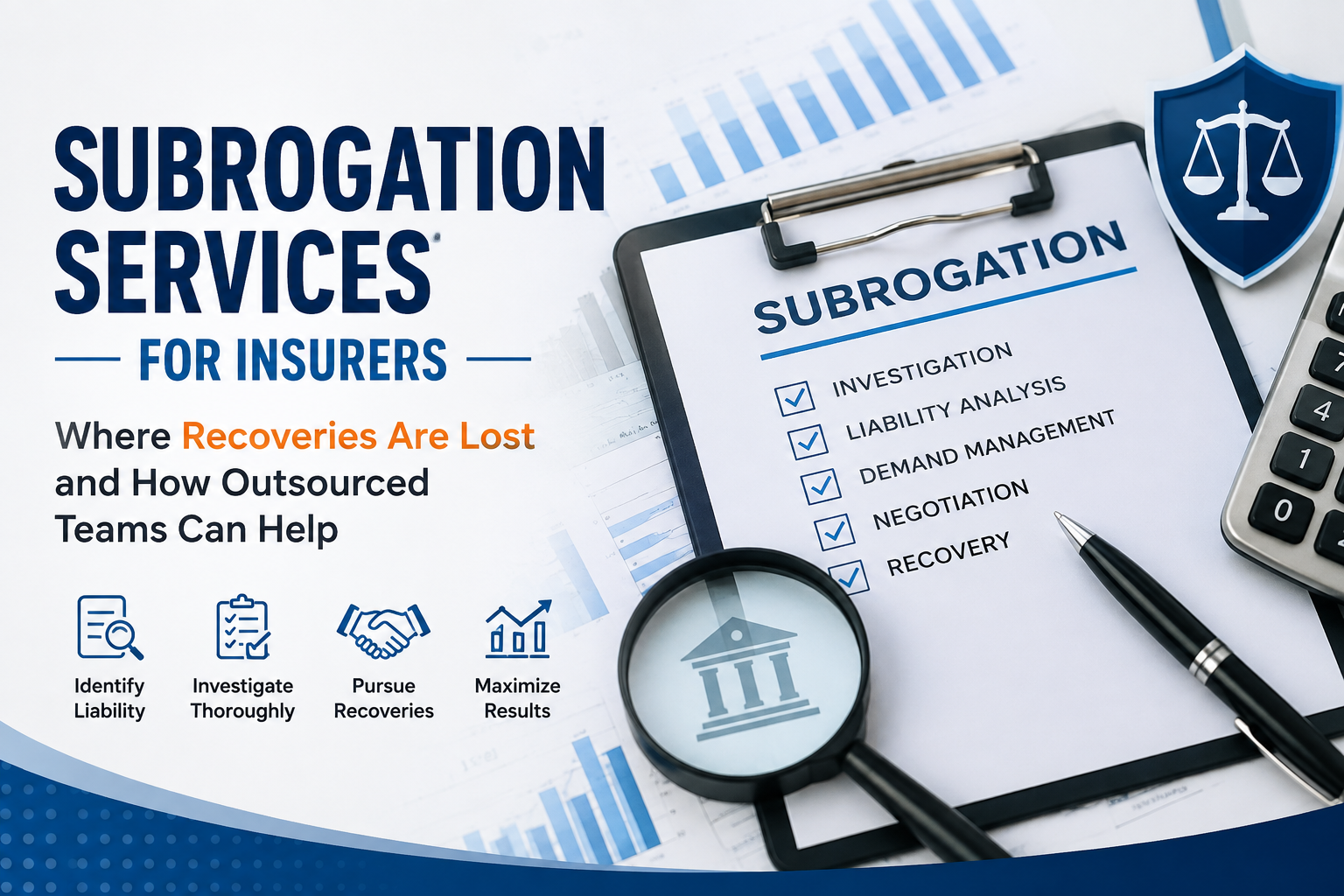
The insurance subrogation process consists of five stages: identifying a claim that can be recovered, investigating and gathering evidence, making a formal demand on the at-fault party, negotiating a settlement, and collecting the recovered funds. Each stage follows upon the previous one; if the file is weak at the investigation stage, then the demand will be weak, and a weak demand in turn results in a smaller settlement. This operational chain is what subrogation services are built to manage end-to-end.
The Subrogation Process, Stage by Stage, and Where It Breaks
Identification
We should quickly look into all the claims to find out if anyone other than the insured was at fault; in situations such as those involving automobile claims, property damage caused by a contractor’s error, and workers’ compensation cases where there is third-party liability, there is the possibility of recovery.
This is the principal cause of leakage. Frontline adjusters are assessed on the amount of claims they handle and on how quickly they process them, not on spotting opportunities for subrogation. When a claim clearly involves a third party, it is settled and closed without any individual recording it for inclusion in the recovery review. Effective subrogation services incorporate the identification of such opportunities into their standard workflow rather than relying on anyone who happens to notice.
Evidence and Documentation
How strong a subrogation claim is entirely based on the file that supports it; all the necessary items such as police reports, repair estimates, photos, witness statements, and a clear timeline must be gathered and organized before the claim is made.
The second most common reason for failure is having files that are either prepared in a hurry or are incomplete. If a demand letter is based on a poor file, then the insurer of the responsible party has a straightforward basis on which to dispute liability or propose a low settlement.
Statute of Limitations and Deadlines
The time limits for making subrogation claims vary depending on both the state and the kind of claim, in some instances being as brief as two years from the date of the loss; once the time limit has passed, a claim which was entirely recoverable when it was first made becomes worthless, even if the evidence in support of it had been very strong.
A large number of recoveries which could have succeeded just disappear when claims deadlines are tracked manually. This is a clear reason for adopting structured subrogation claims management instead of relying on ad hoc tracking distributed among the individual adjusters’ calendars.
Demand and Negotiation
The amount which in fact ends up being returned is determined by the negotiation; this phase demands a great deal of experience. When an adjuster takes on subrogation as an extra responsibility in addition to the full range of their claims work, they will be negotiating against a counterparty whose entire role it is to reduce the payment.
Follow-Through and Collection
A recovery is not complete just because it has been approved. Someone still has to make sure the payment is actually received. That can become a problem when payment plans stop, checks are delayed, or files get left behind while the team handles more urgent claims. Recoveries that are approved but never collected can slowly drag down subrogation recovery services performance.
| Stage | What Should Happen | Common Failure Point |
| Identification | Flag every claim with third-party liability | Recoverable claims never get flagged |
| Evidence gathering | Build a file that supports the demand | Documentation gaps weaken the claim |
| Deadline tracking | File within the statute of limitations | Viable claims time out unpursued |
| Negotiation | Settle for full recoverable value | Under-negotiated or rushed settlements |
| Collection | Follow through until funds are received | Approved recoveries never get collected |
Why These Gaps Happen
This is not a matter of having no legal rights or putting in insufficient effort; it is due to the fact that there are conflicting priorities. The teams are structured and assessed according to their ability to settle claims quickly, and subrogation work, especially the investigation and the follow-up phases, occupies time which is not taken into account by the standard claims performance measures.
Most adjusters are not given specific training in the area of subrogation; instead, subrogation is regarded as an extension of general claims handling rather than as a distinct field with its own set of deadlines, negotiation strategies, and documentation requirements. A great deal of the work involved in identifying issues and keeping track of deadlines is still carried out manually, using spreadsheets or general claims systems which were not designed for this purpose, even when the insurance companies as a whole have relatively modern claims systems. This is precisely the kind of gap that specialized subrogation services are intended to eliminate.
What Subrogation Services Actually Fix
Subrogation services that are dedicated do not alter the legal mechanics of subrogation; they only affect whether or not each stage of the process receives the attention it really needs.
- Dedicated review capacity to catch recoverable claims frontline adjusters don’t have time to flag
- Systematic deadline tracking so viable claims don’t quietly expire
- Documentation standards that produce stronger demand files from the start
- Negotiation handled by people whose full job is exactly that, not a side task
- Active follow-through on approved recoveries until funds are actually collected
Anyone assessing subrogation recovery services should anticipate all five of these aspects, not merely negotiation. A partner who only deals with demands and settlements, without at the same time improving upstream identification and documentation, is only addressing half the issue.
In-House vs Outsourced Subrogation Services
| Factor | In-House Only | Outsourced Subrogation Services |
| Dedicated review capacity | Competes with frontline claims work | Dedicated file review |
| Deadline tracking | Manual, easy to miss | Systematic tracking |
| Specialized negotiation experience | Varies by adjuster | Consistent, trained focus |
| Follow-through on approved recoveries | Often deprioritized | Actively tracked to close |
It is not the case that either model is automatically correct. A carrier having a low volume of small claims and strong internal training might not require outsourced subrogation services. Conversely, a carrier with a growing book of business and a subrogation unit which is consistently late with its file reviews is the more apparent choice.
What to Look for in a Subrogation Services Partner
Before engaging outsourced subrogation services, it helps to ask a few direct questions:
- Can they show how they track deadlines across a large claim volume, not just describe the process
- Do they have documented experience with your specific claim types, including auto, property, workers’ compensation, and carrier-to-carrier subrogation claims management
- How do they handle the handoff between identification, investigation, and negotiation, and who owns each step
- What reporting do you get on claims in progress, not just claims already closed
- How is pricing structured, and does it reward actual insurance claims recovery or just activity
How Techsurance Supports the Subrogation Workflow
The success of subrogation recovery relies on the same operational discipline that applies to all other aspects of claims processing: accurate documentation, clean data, and consistent tracking from the initial intake to closure. By strengthening this particular area, Techsurance’s claims processing and back-office support helps claims teams maintain the kind of documentation, validation, and status tracking that subrogation services require without it falling behind. This system also provides the audit trail that insurers need for compliance reviews relating to third-party recovery activity.
Techsurance does not operate its own subrogation department. All it offers is the back-office expertise, consistent record-keeping, verified data, and dependable tracking which enable a subrogation program to function in the way it was intended to.
Conclusion
Subrogation recovery is really more a matter of following a well-defined process than of relying on the law; in most cases, the right to make a claim exists right from the start. All that is necessary is for someone to have noticed the claim, to have prepared the file properly, to have kept track of the deadline, to have negotiated firmly, and then to have pursued it until the money had been collected. That is exactly the kind of operational work that subrogation services are there to carry out.
If your subrogation files are delayed at any of the different stages, you should get in touch with Techsurance to find out how stronger claims and improved back-office support can protect the recoveries to which your team is already entitled.
FAQs
What does the term subrogation mean in the context of insurance?
Subrogation is the right which an insurer obtains when it has paid a claim and it is therefore the insurer and not the policyholder who can go after the person who was really at fault to recover the money which was paid.
Why do insurance companies miss out on subrogation recoveries?
Most of the losses happen because recoverable claims are not identified, the evidence files are too weak to support a solid claim, the time limits for filing pass without any claim being dealt with or approved recoveries being followed through to actual collection. It is precisely this gap that subrogation services are intended to eliminate.
How does the subrogation process work, step by step?
It has five stages: identifying first a claim that can be recovered, then gathering the relevant evidence and documentation, sending out a formal demand, negotiating a settlement, and finally collecting the funds that have been recovered.
Should insurers outsource subrogation services?
It depends on claims volume and internal capacity. Carriers with a growing book of business or a subrogation unit that’s consistently behind on file review tend to see the clearest benefit from dedicated subrogation services.
What should insurers look for in a subrogation services partner?
Documented deadline-tracking practices, experience with the specific claim types involved, clear ownership across the identification-to-negotiation handoff, transparent in-progress reporting, and pricing tied to actual recoveries.
