
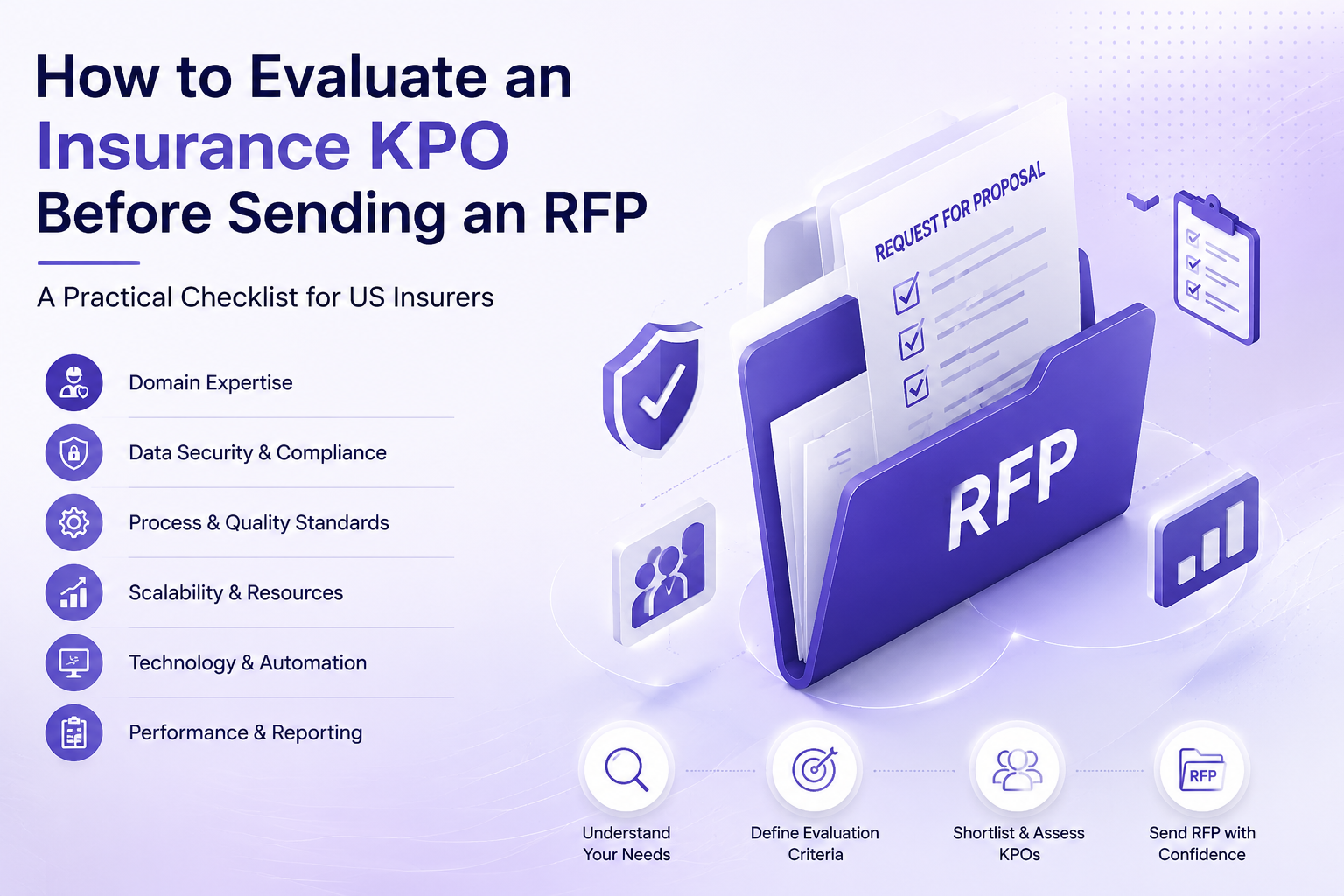
Most insurance RFPs fail before anyone writes a single question. An RFP, short for “Request for Proposal,” is the formal document you send to potential vendors laying out your requirements and evaluation criteria so their responses can be compared side by side instead of judged on whichever one pitches best. The failure happens earlier than the RFP itself, when the evaluation criteria get built after it goes out instead of before. Vendors respond to whatever you ask. If you never ask about analyst retention or audit-ready documentation, no vendor is going to volunteer that information, and you’ll end up choosing based on price and polish instead of substance.
The buyer pool has also gotten bigger and harder to sort through. The global KPO market was valued at $63.7 billion in 2024 and is projected to reach $157.5 billion by 2030, a compound annual growth rate of roughly 16%, according to Research and Markets data cited by Infomineo. More vendors, more marketing language that sounds identical from one homepage to the next. This post is a framework for evaluating an insurance KPO provider before you draft the RFP itself, so the RFP tests vendors against criteria you already trust, instead of generic capability claims you have to take at face value.
What is insurance KPO, and how is it different from insurance BPO?
Insurance KPO, or insurance knowledge process outsourcing, is the delegation of judgment-adjacent, domain-expert work: underwriting support, claims adjudication, compliance documentation, hindsight, and quality audits. It requires analysts who understand insurance, not just process steps. Insurance BPO covers the higher-volume, lower-judgment work sitting next to it, things like data entry or call handling, where the value is speed and consistency rather than expertise.
The two get lumped together constantly, and that’s where evaluation goes wrong.
| Insurance BPO | Insurance KPO | |
| Nature of work | Repetitive, rules-based: data entry, call handling | Judgment-adjacent, domain-expert: underwriting support, claims adjudication, compliance QA |
| Talent profile | Process-trained agents | Insurance-domain analysts, often with underwriting or claims backgrounds |
| Oversight need | Volume and SLA tracking | Methodology transparency, quality audits, regulatory accountability |
| What breaks if you choose wrong | Missed SLAs, slow turnaround | Compliance exposure, bad underwriting decisions, regulatory findings |
Get this distinction wrong at the evaluation stage and you’ll compare a KPO provider against BPO pricing benchmarks, which explains a lot of the sticker shock insurers report later.
Why evaluation has to happen before the RFP, not during it
An RFP is a comparison tool. It can only compare what you ask about. Skip the evaluation-criteria step and the RFP defaults to price and generic capability language, which happens to be exactly what most insurance outsourcing marketing is built to survive.
Set your criteria first. Then let the RFP put vendors through them.
Five things to evaluate before you shortlist an insurance KPO provider
This list adapts a broader KPO evaluation framework (domain depth, analyst quality, methodology, technology, engagement fit) for the specifics of insurance operations.
| Evaluation criteria | What to actually check |
| Insurance domain depth | Do analysts have underwriting, claims, or compliance backgrounds, not general BPO training? Ask for the team’s actual composition, not the company’s total headcount |
| Methodology transparency | Can they explain, in writing, how a decision or QC check actually gets made, not just confirm that one exists |
| Regulatory readiness | Do they understand your NAIC oversight obligations, and can they produce audit-ready documentation on request |
| Data security posture | Look for ISO 27001 or an equivalent certification. “Bank-grade security” with nothing behind it isn’t a posture; it’s a slogan |
| Engagement model fit | Does their pricing and delivery model match your volume pattern, or are you being fit into their default structure |
Why “years in business” and headcount aren’t evaluation criteria
A big headcount number on a homepage tells you a company has grown. It tells you nothing about analyst quality, retention, or whether the specific team assigned to your account has done this kind of work before. Ask what the team composition looks like for your workflow specifically. That’s the number that matters.
The compliance layer most evaluations skip
This is where insurance KPO evaluation departs hardest from generic KPO evaluation, and it’s the part most guides on this topic leave out entirely.
Under the NAIC Insurance Data Security Model Law (#668), insurers must conduct due diligence on all vendors, build security requirements into contracts, and monitor those relationships on an ongoing basis. The model law has been adopted in over 20 states. Separately, as of early 2026, 23 states and Washington, D.C. have adopted the NAIC’s Model Bulletin on the Use of AI Systems by Insurers, and regulators examining a carrier will expect to see evidence of vendor due diligence, contract terms that preserve audit rights, and documentation of ongoing oversight.
Here’s the part worth sitting with: Outsourcing the work doesn’t outsource the compliance obligation. If a regulator comes asking, the liability sits with you, not your vendor. Evaluation has to confirm the vendor can actually produce the documentation an examiner would ask for. A vendor telling you they’re compliant is not the same as a vendor showing you what compliance looks like on paper.
Building your RFP questions from the evaluation criteria
Once the criteria above are set, the RFP questions practically write themselves.
- Ask for the specific team composition and domain backgrounds assigned to your account, not company-wide headcount
- Ask for a documented QC or methodology process, not a summary paragraph
- Ask how they’d respond to a regulator’s audit request within 30 days
- Ask which data security certifications are current, and ask for evidence, not a badge pasted on a webpage
- Ask how their pricing model would actually apply to your volume, not a generic rate card
If you want a second opinion on whether your evaluation criteria are catching the right things before the RFP goes out the door, Techsurance’s team is happy to talk through it.
Red flags to watch for during evaluation
Some warning signs show up well before contract negotiations, if you’re looking for them.
- The vendor can’t name who specifically would work your account
- Vague answers to “how do you handle an error once it’s found”
- No named compliance or QA lead on the account
- Security claims with no certification behind them
- Pricing that doesn’t map to your actual workflow complexity. Techsurance’s pricing guide breaks down what legitimate insurance outsourcing pricing should actually look like, and what to be suspicious of when it doesn’t
Any one of these alone might be nothing. Two or three together are worth pausing on.
How Techsurance approaches insurance KPO evaluation
We’re ISO 9001:2015 and ISO 27001 certified, and our teams are built around insurance-domain analysts rather than generalist agents pulled from a shared BPO bench. Documented QC checkpoints and hindsighting processes sit underneath our underwriting and claims work specifically built for insurance accuracy rather than adapted from a generic operations playbook.
If you’re building out your own evaluation criteria, our underwriting service, claims service, insurance compliance, and risk assessment service pages go deeper into how each of these functions actually gets delivered.
Evaluate first, ask second, decide third
An RFP is only as good as the criteria that shaped it. Insurers who evaluate domain depth, methodology, regulatory readiness, security posture, and engagement fit before drafting their RFP end up asking sharper questions, and they’re a lot harder to sell a generic pitch to.
If you’re getting ready to send an insurance KPO RFP and want to pressure-test your evaluation criteria first, reach out to Techsurance. We’d rather help you ask better questions than answer easy ones.
FAQs
What is insurance KPO, and how is it different from insurance BPO?
Insurance KPO is the outsourcing of judgment-adjacent, domain-expert insurance work like underwriting support, claims adjudication, and compliance documentation. Insurance BPO covers higher-volume, lower-judgment tasks like data entry. The distinction matters because the two require very different evaluation criteria and carry different risks if the vendor gets it wrong.
What should be evaluated before sending an insurance outsourcing RFP?
Five things: insurance-domain depth of the team, methodology transparency, regulatory readiness, data security posture, and whether the engagement model actually fits your volume pattern. Setting these before the RFP goes out means your questions test for substance instead of marketing language.
What compliance requirements apply to insurance KPO vendors?
Under the NAIC Insurance Data Security Model Law, insurers must conduct due diligence on vendors, build security terms into contracts, and monitor those relationships on an ongoing basis. Many states have also adopted the NAIC’s Model Bulletin on AI Systems, which expects documented evidence of vendor oversight and audit rights.
What questions should an insurance RFP ask a KPO provider?
Ask for the actual team composition assigned to your account, a documented QC process, how they’d respond to a regulatory audit request, current data security certifications with evidence, and how their pricing model maps to your specific volume.
How do you check a KPO provider’s domain expertise before shortlisting?
Ask for the backgrounds of the analysts who would actually work your account, not the company’s total headcount. Ask for a written explanation of their methodology, not a summary claim that a process exists.
What are red flags when evaluating an insurance KPO partner?
Watch for vendors who can’t name who would work your account, vague answers about error handling, no named compliance lead, unverified security claims, and pricing that doesn’t reflect your actual workflow complexity.
How long should the insurance KPO evaluation process take?
Long enough to verify domain expertise and compliance readiness properly, which usually means weeks, not days. Rushing this stage is how insurers end up back in an RFP process a year later.
