
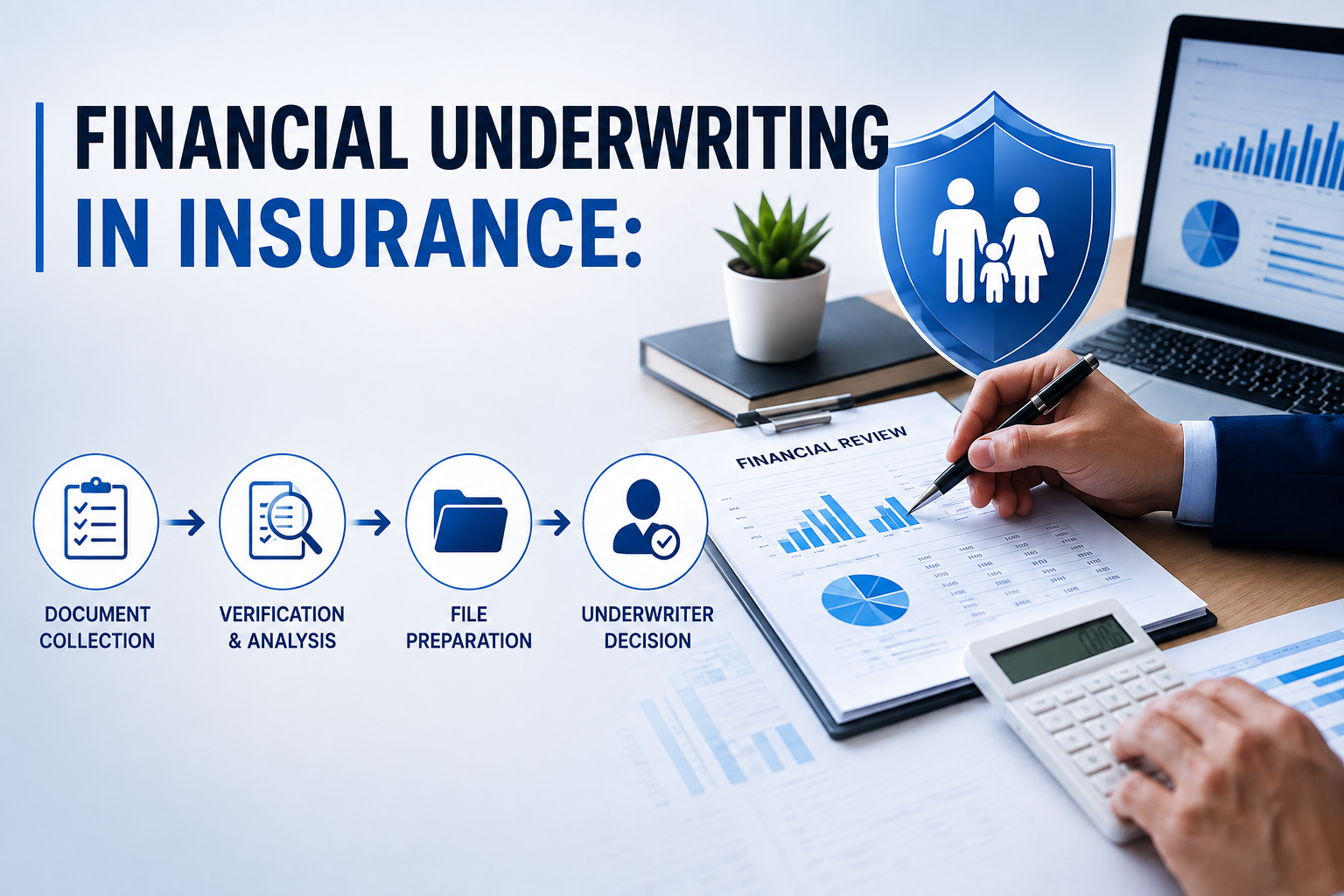
Even if an underwriter has a complete risk profile on an applicant, they can still delay considering one particular question: can this person or business actually afford the coverage they are applying for? This question is at the heart of financial underwriting, and it is the part of the process most likely to be delayed when the volume of applications increases faster than the number of staff.
The article explains what financial underwriting means, how the process functions, the checks that insurers carry out as part of it, and the situations in which carriers, MGAs, and TPAs obtain external assistance to keep up.
What Is Financial Underwriting?
Financial underwriting refers to the aspect of insurance underwriting in which the applicant’s financial situation is assessed in relation to the level of coverage they have asked for. While medical underwriting investigates whether a person is insurable from a medical point of view, this type of review looks at whether the coverage requested corresponds with the applicant’s real financial needs and their ability to pay.
The objective is clear: insurers use it in order to avoid the situation of over-insurance, which occurs when the death benefit or the amount of coverage asked for is greater than the actual economic loss that the insurance policy is intended to cover. Over-insurance increases the likelihood of fraud and results in a policy that does not meet the applicant’s real needs.
This kind of underwriting is most evident in the case of life insurance, disability insurance, and some commercial insurance types, but the same reasoning applies in any situation where an insurer has to verify that the amount of the claim would be supported by the applicant’s actual financial position.
How the Financial Underwriting Process Works
The process proceeds in parallel with medical and behavioral underwriting rather than taking its place. A typical insurance financial underwriting workflow is as follows:
- Application intake: When the application is submitted, the applicant gives information about their income, net worth, current insurance coverage, and the reason for obtaining the new policy.
- Documentation request: Depending on the face amount, the insurer may ask for tax returns, pay stubs, business financials, or a signed financial questionnaire.
- Income and asset verification: The verification of income and assets involves the underwriters checking the figures given in the application against the supporting documents.
- Ratio analysis: Ratio analysis involves insurers working out the debt-to-income ratio and the coverage-to-income ratio in order to determine whether the amount requested is in proportion to the applicant’s financial situation.
- Existing coverage review: A review of the current cover is carried out, during which the underwriter looks at the other policies that the applicant already has in force to determine whether or not they have sufficient protection.
- Decision: The decision involves the insurer either approving the application in the form submitted, reducing the face amount, asking for further information, or refusing to provide coverage.
The higher the face amount, the more careful the examination becomes. A policy that is several times the applicant’s income is reviewed much more closely than one that is only a small multiple of it. The main stages are similar to those carried out in a general life insurance underwriting process when assessing health risk, except that they are applied to the applicant’s financial situation instead.
What Insurers Review
| Factor | What It Tells the Underwriter |
| Income and employment | Whether premiums are sustainable and coverage is proportional to earnings |
| Net worth and assets | Overall financial capacity and justification for large face amounts |
| Existing life insurance in force | Whether the applicant already holds adequate coverage |
| Debt-to-income ratio | Financial stability and ability to keep the policy active |
| Purpose of coverage | Whether the stated reason (income replacement, estate planning, business use) supports the amount requested |
| Source of premium payment | Confirms who is funding the policy and why |
No single one of these checks can be used by itself; instead, the underwriter considers them all together in order to form a financial picture that either supports the amount requested or does not.
Why Carriers Bring In Outside Support
The underwriting of this type involves a great deal of documentation and is by nature repetitive. With each application, you have to read new tax returns, calculate new ratios, and check the financial questionnaires against the figures already on file. It is in this kind of volume that in-house teams lose the time that should be devoted to actual risk judgment.
It is this gap that dedicated support addresses; instead of taking the place of an insurer’s underwriters, a KPO partner carries out the preparation and verification work associated with each file, such as collecting the documents, checking the figures, identifying any inconsistencies, and preparing a file in a form that the underwriter can act on swiftly.
Where financial underwriting support typically helps:
- Document collection and organization for high-volume application periods
- Income and ratio verification against submitted financial records
- Data entry and file preparation ahead of underwriter review
- Quality checks on completed files before they move to the next stage
- Flagging missing documentation or inconsistent figures for underwriter follow-up
It is still the underwriter who has to decide on the risk, although the amount of manual preparation lying between the application and that decision has changed.
In-House vs. Outsourced Support
| Factor | In-House Only | With Financial Underwriting Support |
| Staffing during peak volume | Fixed headcount, often stretched thin | Scalable capacity added as needed |
| File preparation time | Underwriters handle intake and verification themselves | Preparation handled before the file reaches the underwriter |
| Turnaround time | Slows as application volume rises | Stays more consistent across volume swings |
| Underwriter focus | Split between risk judgment and administrative work | Concentrated on risk decisions |
| Error rate on repetitive checks | Rises with fatigue and volume | Managed through dedicated QA steps |
Outsourcing at this level does not eliminate the need for underwriting expertise; it only shifts where repetitive, document-intensive work is performed.
Common Challenges Carriers Run Into
A few problems come up repeatedly across carriers, MGAs, and TPAs handling this workload at scale:
- Inconsistent documentation: Documentation is inconsistent because applicants provide incomplete tax returns or financial statements that don’t match, and someone has to follow up on the missing information.
- Backlogs during seasonal spikes: During periods of seasonal peaks, there are backlogs. The surge in applications is caused by open enrollment periods and year-end business planning, which overwhelm existing teams.
- Manual ratio calculations: Calculating ratios by hand, such as the debt-to-income ratio and the coverage-to-income ratio, leads to delays and sometimes results in errors.
- Attrition on underwriting teams: The loss of a trained underwriter during a cycle creates a skills gap that takes several months to close through hiring.
- Audit readiness: We need to be audit-ready, which means the files must be capable of withstanding both internal quality assurance checks and regulatory reviews; therefore, the documentation has to be complete and consistent right from the beginning.
When Should a Carrier Consider Outside Support?
It tends to make sense once a few of these signs show up at the same time:
- Application volume regularly outpaces the underwriting team’s capacity
- Underwriters spend more time on document chasing than risk analysis
- Financial reviews are taking longer than the agreed service timelines.
- During busy periods, carriers need extra support but may not want to add permanent staff.
- Regular quality checks are finding repeated errors in financial verification and documentation.
If none of the above situations apply, an in-house team with a steady workload might avoid the need for outside assistance. The choice comes down to capacity and consistency, not whether the in-house underwriters are carrying out their duties well.
Techsurance’s underwriting support services are designed specifically to handle the type of file preparation and financial verification that occurs when a team is dealing with increasing application volume without having a corresponding increase in underwriting staff.
How to Evaluate a Support Partner
Before signing on with any KPO partner for financial underwriting, insurers should ask:
- Has the partner got documented experience in carrying out financial reviews that are specific to insurance and not just in handling general documents?
- What quality control checks are carried out on each file before it gets to the underwriter?
- What measures does the partner take to ensure data security and compliance regarding financial documents?
- Can the partner increase its scale during seasonal volume spikes and then decrease it afterward?
- What turnaround time will the partner agree to, and how will it be measured?
- What is the procedure for the partner going back to the underwriting team regarding errors, exceptions, and the file status?
A partner who cannot give clear answers is not ready to deal with this work at production volume.
How Techsurance Supports Financial Underwriting
Techsurance acts as an insurance KPO partner to US carriers, MGAs, and TPAs at the underwriting stage, carrying out tasks such as document gathering, income and ratio checks, file quality control, and producing audit-ready documentation. The actual underwriting decision remains the responsibility of the insurer’s own team. For a more detailed understanding of how the wider insurance underwriting process fits together and how Techsurance supports insurance compliance throughout underwriting files, please see the linked resources.
Conclusion
Financial underwriting determines whether the coverage an applicant is requesting is in line with their actual financial situation, and it offers protection for both the insurer and the policyholder. Although the basic approach to the underwriting process has not changed significantly, the amount of documentation associated with each file is continuing to increase. Insurance companies that combine their underwriting expertise with dedicated support can maintain steady turnaround times without having to hire additional permanent staff. When document backlogs or delays in turnaround become a recurring pattern rather than an occasional occurrence, you should contact Techsurance to find out how financial underwriting support could be incorporated into your workflow.
FAQs
What does underwriting mean in the field of insurance?
Financial underwriting involves reviewing the applicant’s income, assets, debts, and current insurance coverage to ensure the requested amount of insurance corresponds with their actual financial needs and ability to pay.
What is the distinction between financial underwriting and medical underwriting?
Medical underwriting is used to evaluate health risk, while financial underwriting determines if the amount of coverage requested is financially justified. The majority of life insurance applications undergo both types of underwriting.
Why do insurers carry out this kind of review?
Insurers use financial reviews to make sure the coverage requested is reasonable for the applicant’s financial situation. They also help identify potential fraud and support more accurate pricing decisions.
What kind of documents are generally asked for?
There is no single document list for every case. An insurer may request tax returns, pay stubs, business financial statements, or a signed financial questionnaire, depending on the applicant’s circumstances and the amount of coverage being considered.
Does every insurance application go through financial underwriting?
Not necessarily. For smaller coverage amounts, insurers may not need a detailed financial review. A closer review is more common when the coverage is substantial or the policy is being taken for purposes such as business protection or estate planning.
How does financial underwriting support differ from outsourcing the underwriting decision?
Financial underwriting support handles tasks such as collecting documents, checking information, and preparing files for review. The final risk assessment and approval decision remain with the insurer’s underwriter.
How long does the process take?
There is no fixed timeline for every case. Applications with complete and consistent documentation can move through the review process faster, while larger or more complex cases may take longer to assess.
