
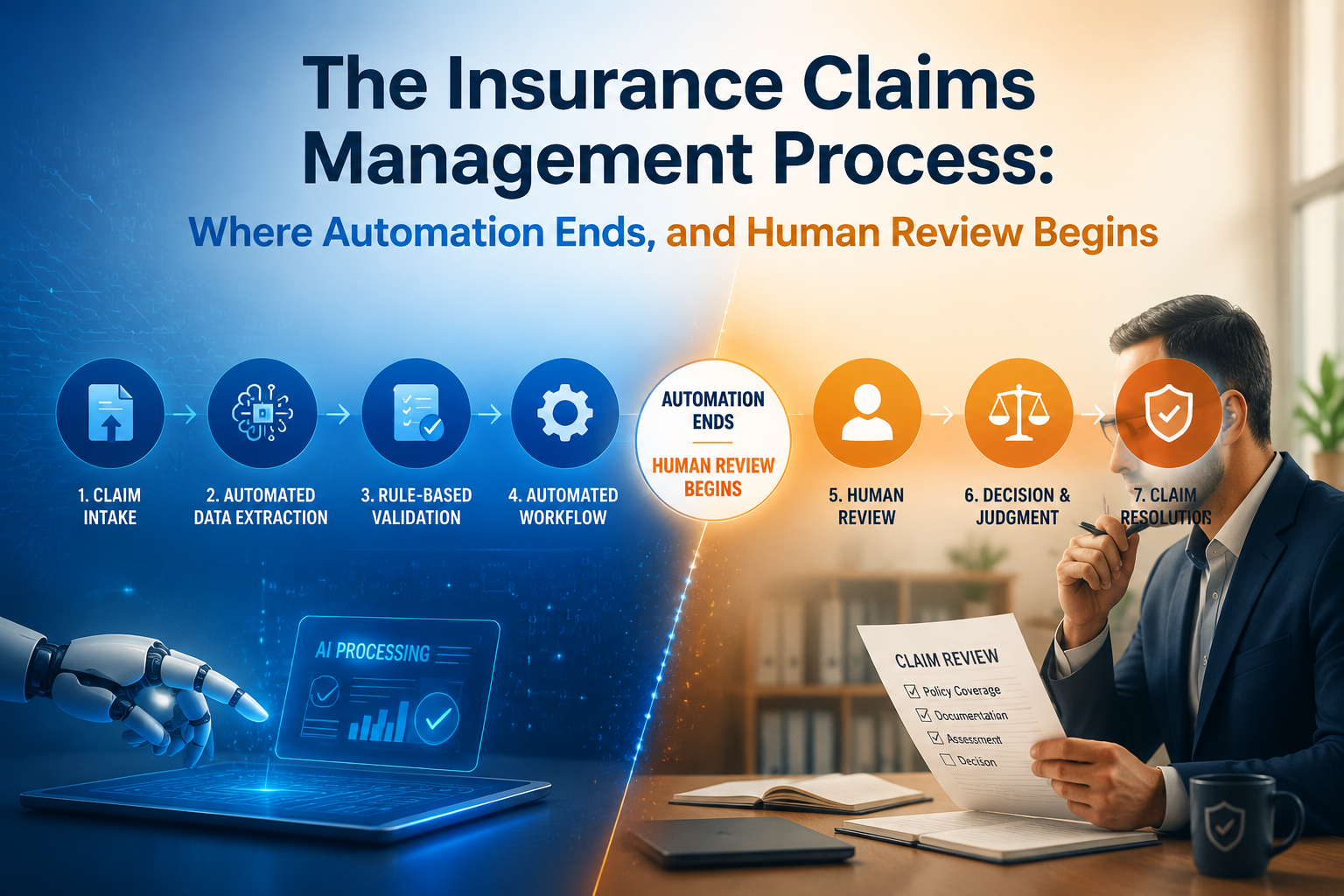
A claims team is able to operate a completely automated intake system, use a fraud-scoring model, and employ a rules engine to deal with the majority of cases in just a matter of minutes, yet still ends up with a formal complaint six weeks later since a denial was issued without any human having looked at the file. It is in that gap between ‘the system worked correctly’ and ‘the outcome was wrong’ that most claims operations actually suffer financial losses and lose trust.
It’s no longer difficult to develop the technology involved in claims automation. Optical character recognition can accurately read a document, and a rules engine can correctly apply a policy limit. The difficult aspect consists in deciding, step by step, whether each of those decisions should be left to a machine or whether a person must approve them before the claimant receives any response.
The article examines the claims management process step by step and shows at what stage that line is.
What Is the Insurance Claims Management Process?
The claims management process is the full operational path a claim travels from the moment a policyholder reports a loss to the moment the file closes. It covers intake, documentation review, validation, adjudication, payment, and, when needed, appeals.
It is not merely the result of a single adjuster’s review. It encompasses the people, systems, vendors, reporting procedures, and financial controls that ensure a claim is accurately passed from one stage to the next. Even if a claims department has competent adjusters, it may still have a bad claims management process if the transfers between stages are inconsistent or not documented.
The Claims Management Process, Stage by Stage
Claim Intake
The policyholder can report the loss by telephone, using the app, or by filling in a web form; the claim is then entered into the system, given a file number, and sent to the appropriate queue according to the type of business and the kind of claim.
This stage is mostly mechanical since tasks such as formatting a submission, checking for duplicate filings, and routing a claim to the appropriate adjuster group are based on established patterns. A rules engine carries out these tasks reliably and does so more quickly than a person would if they typed the same data into three different systems.
Validation and Documentation Review
When a claim has been logged, a person (or perhaps a machine) verifies that the necessary documents are there, that the policy details agree, and that the basic eligibility rules have been met. If, for example, the signature page is missing or the date of loss is inconsistent, this will be flagged.
Automated checks are useful for making sure the required documents are in place. The problem starts when those documents contain information that is difficult to interpret. For example, the repair estimate may not line up with the damage reported in the claim. Similarly, a medical record may mention a condition, but it may not be clear whether that condition is covered by the policy.
Adjudication and Decisioning
This is where the claim gets approved, denied, or adjusted. It is also where insurance claims processing automation and human judgment genuinely compete for the same decision.
A simple claim involving a small amount of money, one that is well supported by clear documentation and which clearly matches the policy, can be decided with high confidence by a rules engine. However, a claim where liability is in dispute, one with an unusual type of loss, or one where the coverage terms could be interpreted in more than one way has to be assessed by a person since it is someone who can take into account the relevant context, something that the rules engine was not designed to do.
Fraud and Anomaly Detection
Machine learning models are truly capable of identifying patterns among thousands of claims that a human adjuster could never spot on their own, for example, a repair shop with an unusual number of claims or a claimant history that corresponds to the behavior of a known fraud ring.
The output of the model is a score, not a conclusion. It is up to a human to decide whether to confirm or dismiss a fraud alert, since a false accusation involves real reputational and legal risk for the insurer.
Payout and Settlement
Once a claim has been adjudicated and cleared, it can be paid automatically in the case of clean, low-dollar claims. However, if the amount in question exceeds a certain dollar limit or if the settlement amount was disputed at any previous stage, the individual has to review and approve the payment before it is sent out.
Appeals and Disputes
There is no reasonable grounds for fully automating this stage since a policyholder who is challenging a decision is requesting that a person reconsider it; although automation can quickly bring the file history and previous notes to light, the actual review must still be carried out by a human.
Where Automation Genuinely Works Well
- Formatting and routing new claim submissions
- Checking documentation completeness against a defined checklist
- Applying clear, unambiguous policy rules to straightforward claims
- Pick up unusual patterns in the data and pass them to someone for a closer look
- Pay clean, low-value claims automatically when they fall within the approved limits
- Keep an eye on SLA deadlines, older claims in the queue, and changes in claim status
Where Human Review Still Has to Own the Decision
- Coverage questions where the policy language allows more than one reasonable interpretation
- Claims above an insurer’s set dollar threshold
- Any claim where a fraud model has flagged suspicious activity
- First-time or unusual loss scenarios the rules engine has no prior pattern to match against
- Claims tied to potential litigation or regulatory exposure
- Appeals, disputes, and any claim a customer has already escalated
A Practical Framework for Drawing the Line
Rather than posing the question “can this be automated”, it is more useful to ask “what will happen if the automated decision is wrong and who will find out first”.
| Claims Lifecycle Stage | Automation Handles | Human Review Required When |
| Intake | Formatting, routing, duplicate checks | Information is missing or inconsistent |
| Validation | Completeness checks against policy rules | Coverage terms are ambiguous |
| Adjudication | Clean, rules-clear claims | Judgment calls or first-time scenarios |
| Fraud detection | Statistical pattern flagging | Confirming or dismissing a flagged case |
| Payout | Low-dollar, clean claims | Above threshold or previously disputed |
| Appeals | Pulling file history for context | Every appeal, without exception |
An brief internal checklist can replace case-by-case guesswork with a repeatable decision-making process. Before automating any step in the workflow of the claims process, ask:
- What is the dollar exposure if this decision is wrong?
- Does the outcome depend on interpreting language, not just matching data?
- Has the model accumulated reliable pattern data because this particular claim scenario has occurred frequently enough?
- Shall a regulator or auditor expect a written human approval in this case?
- Has the claimant already objected to or taken this file to a higher level?
Agreeing to any of the last four points is a clear indication that the step should be classified as belonging to a person and not to a script.
What Happens When Insurers Get the Line Wrong
The regulatory response to this issue has arrived more quickly than most claims departments anticipated. The NAIC adopted its Model Bulletin on the Use of Artificial Intelligence Systems by Insurers in 2023. The basic idea is that using AI does not change an insurer’s legal responsibilities. Any decision supported by AI still has to follow the same insurance laws, whether or not a person reviewed it during the process. More than twenty states have adopted the bulletin. In addition, several states have introduced binding regulations. Florida’s HB 527 would require a qualified professional to independently review and certify any claim denial that involved an algorithm. Arizona’s HB 2175, effective from July 2026, goes a step further for health insurance claims by requiring a licensed medical director to personally approve denials instead of leaving that decision entirely to an automated system.
Over-automating the decision-making process leads to actual risks, such as unfair denials that cause disputes, findings by examiners during a market conduct review, and customer complaints that end up costing much more to resolve than the time saved by automation. On the other hand, insufficient automation also has its own drawbacks, involving longer turnaround times, higher per-claim handling costs, and adjusters spending hours on data entry rather than on the judgments that actually require their attention.
The goal isn’t the extremes; it’s to set a clear, well-documented boundary between them.
How Insurance KPO Support Fits Into This
Making sure that this line is correct involves more than simply selecting the right software; it requires the design of a process, the establishment of documented criteria for making decisions, and a sufficient amount of trained staff to actually examine the claims that need to be reviewed, not just those that happen to fall into an adjuster’s schedule.
The NAIC adopted its Model Bulletin on the Use of Artificial Intelligence Systems by Insurers in 2023. The basic idea is that using AI does not change an insurer’s legal responsibilities. Any decision supported by AI still has to follow the same insurance laws, whether or not a person reviewed it during the process. More than twenty states have adopted the bulletin.
Conclusion
The insurance claims management process has never involved a choice between automation and human review; it is a design issue, consisting of determining at each stage whether a decision should be left to a system or whether it should have a person’s name on it. If that distinction is handled correctly, then claims can be processed more quickly without losing the judgment that safeguards both the insurer and the policyholder.
When your team is working on deciding where that line should be for your own claims operation, Techsurance provides insurers with the process structure, the necessary documentation, and the staffing needed to set it up properly.
FAQs
What is the insurance claims management process?
It describes the entire sequence of operations that a claim goes through from the time it is received until it is closed, including the stages of documentation review, validation, adjudication, payment, and appeals if necessary; it also encompasses the individuals and controls that ensure that the file is processed accurately, not merely the individual review decisions.
What aspects of claims processing are entirely automatable?
Routine claims work is often the easiest part to automate. That includes sorting and routing new claims, checking that documents are complete, applying clear policy rules to simple cases, and paying low-dollar claims that meet pre-set conditions. These steps generally do not need a person involved when the claim is straightforward.
Why can’t claims automation replace human review entirely?
There are parts of a claim that software can handle well, but judgment is harder to automate. If policy wording is unclear, the loss is unusual, or the decision is being disputed, a trained adjuster still needs to step in. That human involvement is also required for certain claims decisions under laws, including Florida’s HB 527 and Arizona’s HB 2175.
What triggers should route a claim to human review?
A claim should usually be passed to a person when the stakes are higher or something about it is unclear. That can include a large potential payout, unclear coverage, a fraud flag, an unusual or first-time type of loss, possible litigation, or a dispute raised by the customer.
How do insurers decide where to draw the line between automation and human oversight?
It usually comes down to the level of risk involved. Routine work can often be automated, while claims with more financial, regulatory, or operational risk may still need a person to review them. Insurers often use factors such as claim value and complexity to decide when human involvement is necessary.
