
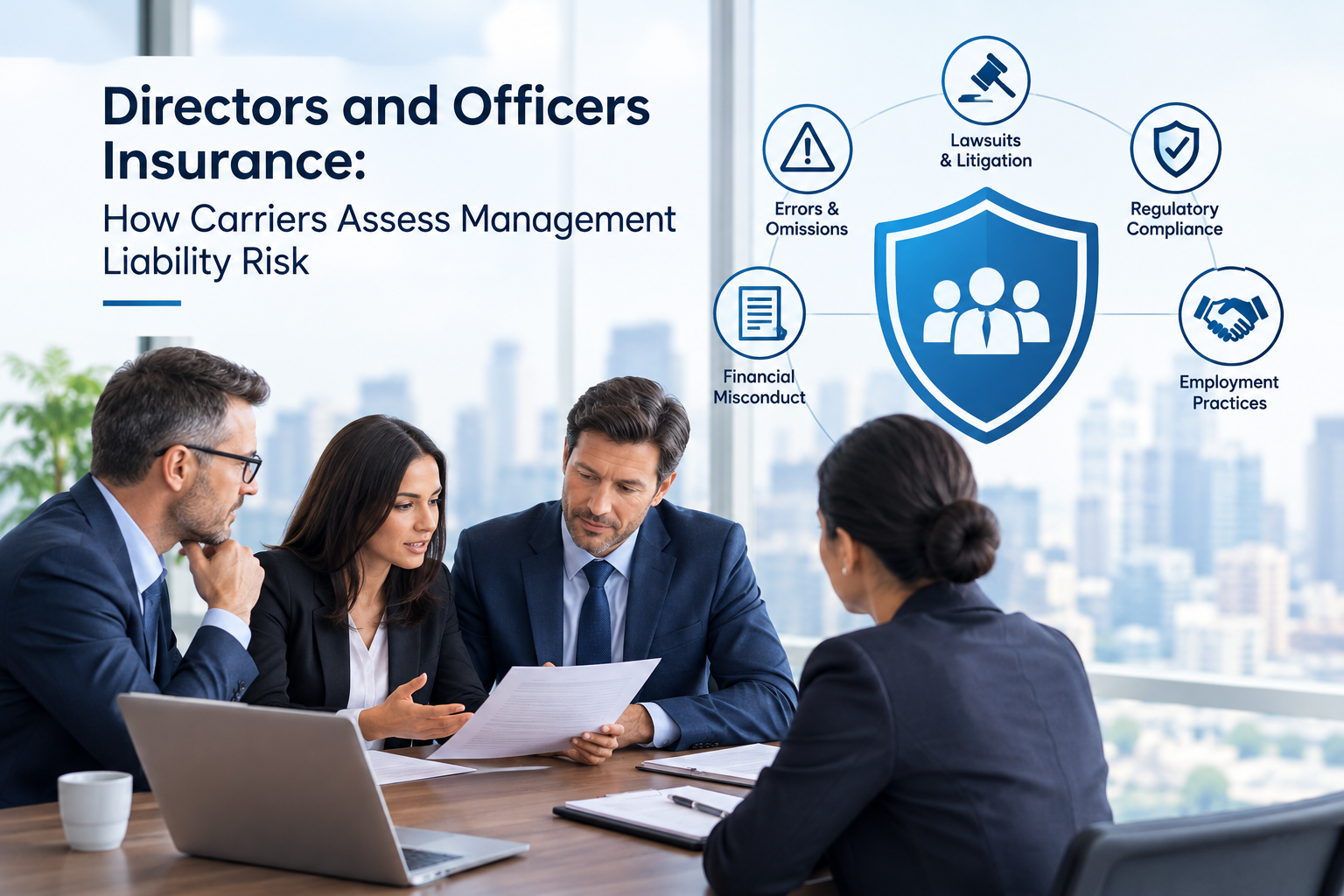
The board of a medium-sized manufacturer approves an acquisition, which later leads to a shareholder lawsuit claiming the directors failed in their duty of care during due diligence. The company’s directors and officers insurance policy is what protects those individual board members from having to face personal financial liability. Whether or not the claim is settled quickly, is disputed, or reveals a coverage gap that had been overlooked at the time of renewing the policy all comes down to the quality of the underwriting of the policy when it was first issued.
The guide explains exactly what directors and officers insurance does cover, how insurance companies price and arrange it, and what underwriters consider when deciding whether or not to take on the risk. It is designed for members of underwriting teams, MGAs, and TPAs who are dealing with D&O submissions, not just people who are looking for a quote.
When your team is deciding how much of that underwriting preparation should be carried out in-house as opposed to using a specialist partner, our analysis of financial underwriting support shows where that boundary usually lies.
What Is Directors and Officers Insurance?
D&O insurance, which is the usual term for directors’ and officers’ insurance, guards a company’s executives against suffering a personal financial loss should they be sued for acts that are either actual or alleged and which take place when they are running the business. It is a type of management liability insurance and usually includes coverage for the legal defense costs, settlements, and judgments resulting from claims of mismanagement, breach of fiduciary duty, regulatory violations, or misleading disclosures.
The definition of directors’ and officers’ insurance most commonly used in the industry makes a clear distinction: this type of coverage applies to individuals, not to the company’s products or methods of operation. Claims relating to products are covered by a separate policy, while a suit brought by a shareholder who alleges that the board misled investors concerning the company’s financial performance is covered by the D&O policy.
Specifically, what does directors’ and officers’ insurance cover? It usually consists of three areas of protection, all of which are included in a single policy.
| Coverage Part | What It Protects | Typical Trigger |
| Side A | Individual directors and officers when the company can’t indemnify them | Company insolvency, or indemnification barred by law |
| Side B | Reimburses the company for indemnifying its directors and officers | The company pays defense costs on behalf of leadership |
| Side C | The entity itself, for securities claims | Shareholder lawsuits naming the company directly |
Public companies usually have all three types of coverage, while private and nonprofit organizations tend to obtain a more limited one, since director and officer insurance is sometimes bought separately as additional protection for board members when the main policy’s limits are exceeded.
Who Actually Needs This Coverage
In practice, what is directors’ and officers’ insurance for? It is for any organization that has a board or an executive team making decisions that could lead to personal liability for individuals. This applies to public companies that are subject to the risk of securities litigation, to private companies that are dealing with mergers and acquisitions and employment disputes, and also to nonprofit organizations in which board members may be brought up by donors, regulators, or beneficiaries.
The kind of directors and officers insurance available to public companies is subject to the most rigorous underwriting examination due to the risks involved under securities law. In contrast, insurance for directors and officers of private companies usually places a greater emphasis on claims relating to employment practices and on disputes between shareholders or business partners. For nonprofit organizations, the insurance typically deals with disagreements concerning governance and with regulatory compliance, as the boards of nonprofits are often composed of volunteers who do not have extensive experience in corporate governance.
How Carriers Assess D&O Risk: The Underwriting Factors That Matter
It is at this point that the majority of articles directed at buyers come to an end. When underwriters assess an application for a directors and officers insurance policy, they consider a defined number of risk factors, and the degree to which each one applies has a direct impact on the pricing, the terms offered, and indeed on whether or not the insurance company will take on the risk.
Corporate governance structure: The corporate governance structure is assessed by examining the level of independence of the board, the experience of its directors and executives, and the quality of the documentation of the organization’s governance structures; frequent board meetings and independent supervision help to reassure the carriers when the company is being reviewed. Vouch
Executive compensation practices: How executives are compensated may indicate risky decisions or poor governance, since such conditions tend to lead to greater scrutiny of underwriting.
Financial condition: The company’s financial position is taken into account in the underwriting decision because financial distress is one of the main predictors of D&O claims activity, together with the audited financial statements, the various components of the income statement, and the strength of the balance sheet.
Litigation and claims history: History of litigation and claims. Previous lawsuits or legal disputes involving directors or officers, especially those that occurred earlier, can cause insurance premiums to rise considerably or result in the carrier being unwilling to provide coverage. The underwriters also look at any recent civil, criminal, or administrative proceedings that allege breaches of securities law, as well as any prior record of insolvency or bankruptcy.
Industry and sector volatility: The level of volatility in different industries varies, with certain sectors naturally having a greater D&O risk because of the complexity of regulations, the amount of public attention they receive, or the historical frequency of claims. Industries such as financial services and healthcare attract more underwriting attention than those with lower volatility.
M&A activity: The situation regarding mergers and acquisitions: after an organization has carried out a merger or acquisition, underwriters generally investigate the reasons for the transaction since both financing and M&A activity are common causes of D&O claims.
International operations: Companies with operations in foreign countries tend to carry higher D&O risk because of the compliance complexity in each jurisdiction, so underwriters often ask what share of the business is conducted domestically versus abroad.
Understanding the Claims-Made Structure
The majority of directors and officers insurance policies are based on a claims-made basis, so it is the policy in effect when a claim is made that provides coverage, not the one that was in force when the alleged wrongful act took place. The importance of this distinction becomes very significant in the case of a change of insurer, a merger, or when a company is closing down its operations, as a break in continuous coverage can result in previous acts being completely uninsured.
When underwriters examine a claims-made claim, they carefully look at the retroactive date and any prior-acts exclusions since these factors determine precisely how far back the insurance policy’s coverage actually extends.
Current Market Conditions Affecting D&O Underwriting
According to AM Best’s industry research and analytics team, the D&O insurance segment is currently being influenced by market uncertainty, developments in technology, problems relating to corporate disclosure, and pressure from macroeconomic factors such as tariffs. Although strong reserve takedowns during the recent peak of the hard market have led to some of the best quarterly results the segment has witnessed in recent years, claims from the softer periods between 2016 and 2019 have recently been developing in an adverse manner. The same report points out that D&O underwriters are now exposed to a wide variety of risks that are specifically connected with artificial intelligence, in addition to the well-known pressures arising from disclosure requirements and market cycles.
For companies planning an IPO specifically, the shift from private to public carries real disclosure risk, given how broad the misstatement liability provisions under Section 11 of the U.S. Securities Act of 1933 actually are. Even so, D&O pricing has stayed favorable through a competitive, soft market, with fewer IPOs and additional carrier capacity keeping terms attractive. A dynamic MGAs and carriers writing this segment need to factor into how they price it. AonAon
Where Underwriting Execution Breaks Down
Even experienced underwriting teams run into the same operational friction points on D&O submissions:
- The financial documentation is incomplete, which causes a series of back-and-forth communications with the applicant and as a result delays the quotation turnaround.
- The disclosure of governance is inconsistent since the application does not clearly indicate the board’s structure or its oversight practices.
- The litigation history does not come up during the initial review of the file but only appears later in the process.
- The time that is spent manually preparing files should be taken away from the underwriters’ time, which is otherwise used for assessing actual risk, and instead be used for chasing documents.
It is at that point that many carriers and MGAs begin to look towards obtaining execution support instead of attempting to deal with the issue by increasing their internal staff.
In-House Underwriting Support vs. Outsourced Execution
| Factor | Fully In-House | KPO-Supported Underwriting |
| File preparation speed | Limited by existing underwriter bandwidth | The dedicated team handles document gathering and validation. |
| Underwriting decision authority | Stays internal either way | Stays internal; execution work is external |
| Scalability during submission spikes | Constrained by fixed headcount | Flexible capacity for volume surges |
| Domain training | Depends on internal hiring cycles | Insurance-trained teams already familiar with underwriting workflows |
| Underwriter focus | Split between judgment calls and paperwork | Concentrated on risk judgment and exceptions |
Techsurance helps insurers by improving the execution stage associated with underwriting in such a way that decisions remain consistent, can be audited, and are scalable, allowing underwriters to spend more of their time on genuine risk assessment and less on repetitive preparation tasks. This is particularly relevant to D&O submissions, since the large number of documents and the need to make governance disclosures result in a kind of preparation burden that delays the processing time.
Those who carry out a more thorough assessment of this trade-off should refer to our comparison of managing insurance operations themselves as opposed to outsourcing them, since it looks at the differences regarding cost, risk, and the SLA in both approaches.
Risk Assessment Support for D&O Submissions
It is only through the use of a systematic risk assessment process that a large number of governance disclosures and financial statements can be turned into something that an underwriter is able to act on promptly. When risk assessment support is outsourced, it usually includes carrying out data checks, reviewing the files, validating the documents, and conducting risk profiling in accordance with the carrier’s own underwriting guidelines, although the underwriter always keeps the power to make the final decision.
The page on our risk assessment services explains how this process works in practice, mentioning how insurers increase or decrease their risk-assessment capacity according to changes in the volume of submissions.
Common Mistakes in D&O Underwriting and Buying
- Considering D&O coverage as a single all-encompassing policy without first verifying that the limits for Side A, B, and C actually correspond to the organization’s structure.
- Failing to review the retroactive date when changing carriers can result in previous wrongful acts being left uninsured.
- The extent of the risk associated with nonprofit and private companies is underestimated since their litigation record is different from that of publicly traded companies.
- Letting manual file preparation delays cause underwriting decisions to go beyond the timeline that a broker or applicant had expected.
- Not reevaluating the coverage following significant M&A activity, since that is when D&O exposure changes the most.
Evaluating an Underwriting Support Partner
When carriers and MGAs obtain outside assistance for the execution of D&O underwriting, they should pose to their partners the same evaluation questions that would apply in any decision to outsource insurance services, namely, what SLAs cover turnaround time, how quality control is carried out on the finished files, and whether the partner actually has training in the insurance field rather than just employing general administrative staff. The guide we provide on how to select an insurance outsourcing partner sets out the specific questions that should be asked before any agreement is reached.
How Techsurance Supports D&O Underwriting Operations
Techsurance works with US carriers, MGAs, and TPAs on underwriting execution, including document gathering, file quality control, and audit-ready documentation for lines like directors and officers insurance, where governance and financial disclosures drive the underwriting decision. The goal isn’t replacing underwriting judgment. It’s clearing the preparation workload so underwriters can spend their time where it actually matters: assessing the risk in front of them. You can see the broader case for this model on our Why Techsurance page.
Conclusion
Directors and officers insurance underwriting comes down to reading governance quality, financial stability, and litigation history accurately, then structuring the policy so Side A, B, and C coverage actually matches how exposed the organization’s leadership really is. The carriers that do this well aren’t necessarily the ones with the most underwriters. They’re the ones whose underwriters spend their time on risk judgment instead of chasing paperwork.
FAQs
What is directors and officers insurance?
This type of coverage guards the company’s directors and executives against suffering a personal financial loss if they are sued for wrongs that are actual or alleged that they have committed while managing the business, such as a breach of fiduciary duty, mismanagement, or misleading disclosures.
What does directors’ and officers’ insurance cover?
The cost of legal defense, as well as the settlements and judgments associated with management liability claims. Most policies consist of three sections: Side A, which provides individual protection; Side B, which reimburses the company for indemnification; and Side C, which covers the entity itself against securities claims.
How do carriers underwrite D&O insurance?
To decide on the price, the terms, and whether or not to assume the risk, underwriters assess a company’s corporate governance, its financial condition, litigation history, the risks associated with the industry, its most recent M&A activities, executive compensation, and its international operations.
What’s the difference between D&O insurance for public and private companies?
The public company, which offers D&O coverage, places a strong emphasis on risks relating to securities litigation, while the private company one tends to focus more on employment practices and disagreements between shareholders and as a result has different pricing and coverage arrangements.
Why does the claims-made structure matter for D&O policies?
The policy that comes into effect when a claim is made is the one that provides coverage, not the one that was in effect at the time the alleged act took place; therefore, a coverage gap that occurs during a change of carrier or a transition between companies can leave previous wrongful acts entirely without insurance.
Can underwriting support services help with D&O submissions specifically?
Yes. Document-heavy files and governance disclosures make D&O submissions well suited to outsourced file preparation and risk assessment support, since the underwriting decision itself stays with the carrier’s own team.
