
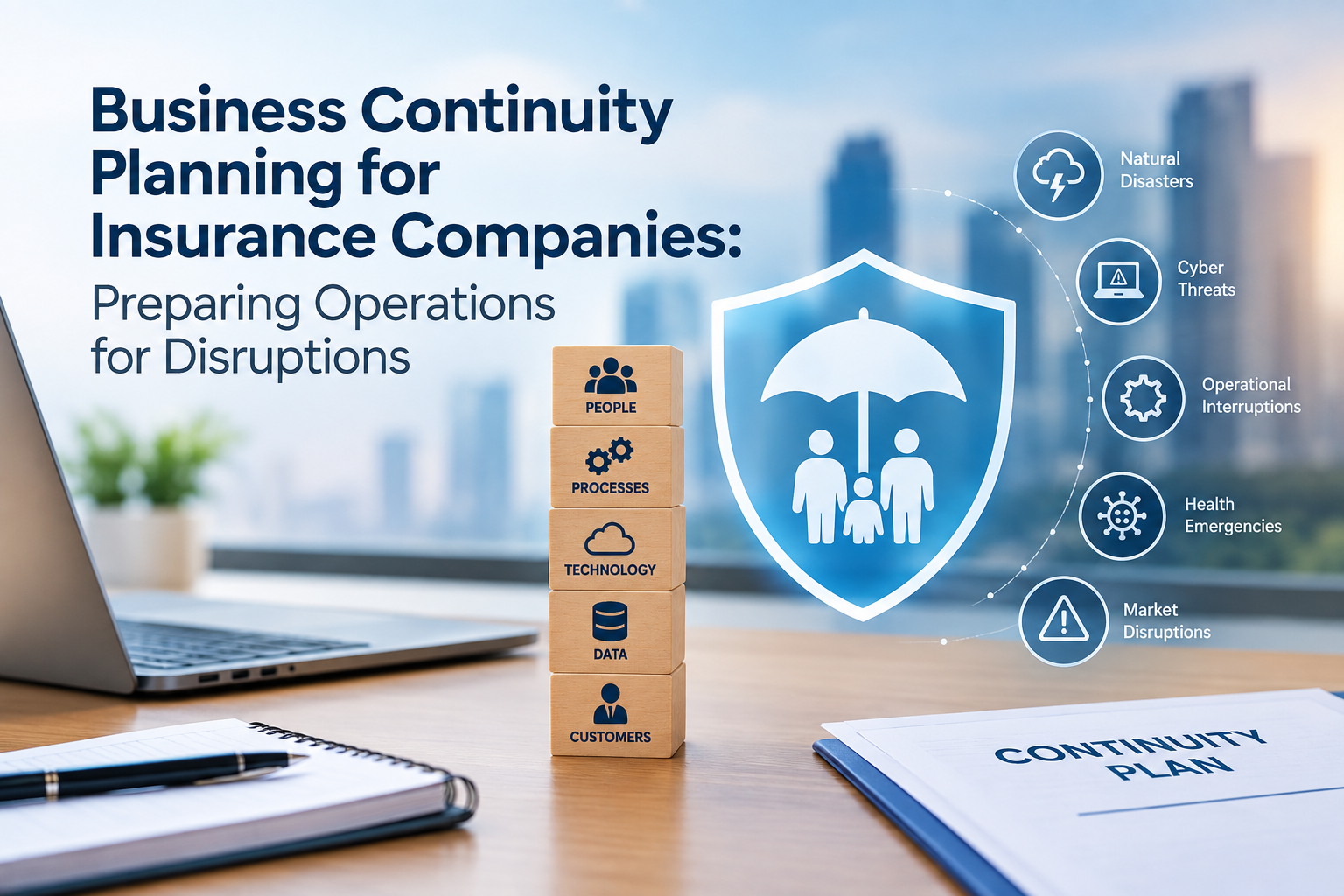
On the same day a regional hurricane causes 4,000 new claims, it also cuts power to the carrier’s claims center. Employees usually responsible for handling those claims now have to look after their own flooded houses. The number of calls increases threefold. The policy administration system is on-site and therefore inaccessible. This is not merely a hypothetical stress test; it is the situation that insurance operations teams have actually experienced following Hurricane Ian, the 2021 Texas freeze, and numerous other smaller regional incidents since.
It is the business continuity plan that decides whether the carrier is handling claims within 48 hours or is still working on getting email access two weeks later; for insurance companies in particular, the stakes are greater than in most other industries since the incident that disrupts their office is generally the same one that causes a surge in demand for their services.
The guide explains the actual contents of a business continuity plan, the reason why insurance business continuity planning differs from a general template, the regulatory expectations that carriers and MGAs have to meet, and the operational decisions that distinguish a plan that works from one that merely fulfills an audit checklist.
If your team is in the middle of reviewing your own continuity program, the guide we have on how to choose an insurance outsourcing company includes the vendor evaluation questions, that apply directly to continuity and surge-capacity partners.
What Is a Business Continuity Plan?
A business continuity plan, usually referred to as a BCP, consists of a series of written procedures designed to ensure essential business activities continue to operate during and after a disruption. The plan specifies which operations must continue, the resources they depend on, and how the organization will maintain those operations if its normal premises, staff, systems, or vendors are no longer available.
For an insurance company, what is a business continuity plan in practice usually comes down to three questions: which functions absolutely cannot pause (claims intake, policy issuance, fraud checks), how fast each one needs to recover, and who is authorized to make decisions when leadership can’t get to the office.
A business continuity plan is not the same as a disaster recovery plan, even though the two are closely related. The table below shows the areas in which they are similar and where they differ.
Business Continuity Plan vs. Disaster Recovery Plan
It is one of the more common mistakes that auditors identify during insurance compliance checks to confuse the two documents.
| Factor | Business Continuity Plan | Disaster Recovery Plan |
| Scope | Entire organization: people, processes, facilities, vendors | Primarily IT systems, data, and infrastructure |
| Goal | Keep critical operations running. | Restore technology after an outage |
| Owner | Operations leadership, compliance, risk management | IT and infosec teams |
| Example trigger | Office closure, staffing shortage, vendor failure | Server outage, ransomware attack, data center loss |
| Insurance application | Claims intake continues; policy servicing stays open | The core policy admin system comes back online. |
Questions about disaster recovery and business continuity plans are frequent since the two documents depend on each other. A carrier may have a technically sound disaster recovery plan yet be unable to ensure business continuity if no backup staff have been assigned to answer the phones when the systems are down.
Why Business Continuity Planning Matters More for Insurance Companies
The disruption and increased demand that affect most industries occur separately, whereas for the insurance industry they happen simultaneously. If an insurance company experiences a disruption to its facilities, this has an impact on claims processing, policy administration, customer service, and support for agents, all of which become time-critical following a regional catastrophe. When the volume of claims rises after a serious storm or disaster, the insurance company may at the same time be suffering facility damage.
It is precisely this issue that means general small-business continuity plans are not suitable for carriers, MGAs, and TPAs. A retail shop that closes for three days following a storm loses three days’ worth of sales. Similarly, an insurance company that stops operating for three days after a storm is failing its policyholders at the very moment when they need a claim to be paid.
The case for having a business continuity plan is well established in areas other than insurance. About 40% of companies never reopen following a disaster, and an additional 25% cease operations in the year after. While insurance companies generally do not close as a result of a single event, regional MGAs and smaller agencies lacking a written plan have done so.
Regulators have also moved away from viewing continuity planning as optional guidance; both state regulators and the NAIC standards require that documented continuity programs be in place, and the importance of competitiveness extends beyond compliance since being operational while your regional competitors are not is a trust-building opportunity that has a lasting impact on policyholder relationships.
Key Components of an Insurance Business Continuity Plan
An insurance BCP typically covers more ground than a general business template because so many of its functions carry regulatory weight. The components of a business continuity plan built for insurance operations usually include:
- Business impact analysis: A business impact analysis determines which functions (such as claims intake, underwriting, policy issuance, and premium collection) are the most important and for how long each can cease operating before actual damage takes place.
- Risk assessment: The risk assessment identifies the disruption scenarios most probable to affect the organization, such as those caused by regional weather events, failures of vendors, or a cyberattack on a policy administration system.
- Recovery strategies: The recovery strategies explain how each essential function continues to operate, for example by having remote staff available, using a backup facility, or employing a third-party operations partner.
- Communication plan: The communication plan includes the internal notification procedures, templates for communicating with policyholders, and the timelines for reporting to regulators.
- IT and data recovery procedures: The procedures for IT and data recovery involve restoring access to the policy administration systems, the claims platforms, and the document management tools.
- Claims continuity procedures: State that the claims continuity procedures involve intake, adjusting, and authorization of payment continuing even if the main claims center is unavailable.
- Vendor and TPA continuity clauses: What takes place if the third-party administrator or the claims vendor suffers a disruption of its own during your event regarding the clauses on continuity for the vendor and the TPA?
For a mid-sized insurance company, a simple example of a business continuity plan could involve assigning a second claims intake telephone number that directs calls to a backup team, authorizing claims adjusters to approve payments up to a specific dollar amount without needing managerial approval in the event of an incident occurring, and keeping a nightly updated, cloud-based copy of the active policy files.
Building a Business Continuity Plan: A Practical Workflow
Rather than starting from a blank page, most insurance operations teams work through a sequence like this:
- Identify critical functions: Find the key functions and make a list of all the processes that have a direct effect on policyholders, such as claims intake, claims adjusting, policy issuance, premium processing, and renewals.
- Run the business impact analysis: For each function, document the maximum tolerable downtime and the financial or regulatory cost of exceeding it.
- Assess risks by likelihood and impact: Evaluate risks by likelihood and impact; for insurers, weather events, cyber incidents, vendor failure, and staffing shortages generally rank highest.
- Build recovery strategies per function. This is where a business continuity plan template helps, since most insurance-specific templates already map recovery options against common insurance functions.
- Assign roles and decision authority: Assign specific individuals to roles and grant them decision-making authority, rather than merely assigning titles, and provide backups for each role.
- Document communication protocols: Prepare documentation for communication protocols, ensuring separate templates are available in advance for internal escalations, policyholder notices, agent updates, and regulator reports.
- Check the plan: Tabletop exercises show flaws that appear satisfactory on paper, for example, the call routing number, which no one remembers to update following a change in staff.
- Review and update annually: Annual review and updates are required, or action should be taken after any organizational change, such as introducing new systems, new vendors, or moving to new office locations.
Regulatory and Compliance Considerations
State insurance regulators have become more specific about what a compliant continuity program requires, and requirements vary by jurisdiction. Washington State requires insurers to maintain written continuity plans covering data backup, recovery, alternate communications, and regulatory reporting, while New York’s DFS circular letters mandate separate plans for continuity and disaster recovery, annual impact analysis, and customer assistance protocols during disasters.
Many carriers also design their programs in accordance with ISO 22301, the international standard for business continuity management systems, even though it is not a strict regulatory requirement, since it provides examiners with a widely accepted framework for assessing the plan.
When compliance teams assess their own program in light of these expectations, they should be looking for a BIA that has been reviewed within the past 12 months, clearly identified decision-makers together with alternates, communication procedures that have been tested (not merely written), and vendor continuity clauses that cover every TPA or claims vendor on which the carrier relies.
Common Operational Bottlenecks During a Disruption
Even carriers with a written plan run into the same handful of problems when an actual event hits:
- Staffing gaps: The number of people available to carry out the plan is often reduced because those trained to do so are personally involved in the event.
- Vendor dependency blind spots: The plan has blind spots around vendor dependency. The plan includes provisions for internal systems but does not address situations where a TPA or claims vendor is down.
- Outdated contact trees: The contact lists are outdated, and the escalation lists were put together two staffing changes ago.
- Underestimated claims surge: The number of underestimated claims increases. Although plans were based on a volume that was ‘normal plus 20%’, the actual volume after the catastrophe usually tripled.
- No pre-authorized decision limits: There are no pre-authorized decisions because adjusters cannot proceed without manager approval, and the manager can’t be reached.
These are mostly staffing and capacity issues rather than planning failures. The document was all right; the organization just did not have enough trained personnel who could keep working under pressure.
In-House vs. Outsourced Support for Continuity Operations
At this point, insurers consider whether continuity planning should remain entirely in-house or whether to bring in an external operations partner, especially for surge capacity during an actual event.
| Factor | Fully In-House | KPO-Supported Continuity |
| Staffing during a surge | Limited to existing headcount | Scalable external capacity on demand |
| Geographic risk exposure | All staff are often in one region. | A distributed team reduces single-point failure |
| Insurance domain training | Depends on internal hiring | Domain-trained teams already familiar with claims and policy workflows |
| Cost during normal operations | Fixed headcount cost year-round | Pay for surge capacity only when activated |
| Recovery speed for claims backlog | Limited by existing team bandwidth | Additional trained capacity clears the backlog faster |
Carriers are experiencing a rise in claims, longer underwriting queues, higher staffing costs, more rigorous regulatory scrutiny, and increasing demands for faster service, while insurers often lack access to trained personnel with the specialist knowledge needed to run operations efficiently. Drawing on the assumption that the current staff will be able to handle three times the usual volume of claims in the event of a regional catastrophe is equivalent to preparing a continuity plan for a staffing shortage that it is impossible to resolve on its own.
Our detailed breakdown of in-house vs. outsourced insurance operations covers the cost and SLA tradeoffs in more depth if your team is actively working through this decision.
KPIs to Measure Business Continuity Effectiveness
A written plan is useless unless someone tracks whether it actually works. Relevant key performance indicators include:
- Recovery time objective (RTO) attainment: Did each of the critical functions come back online within the target window in relation to the recovery time objective?
- Claims processing turnaround during activation: The time it takes to process claims during activation – comparing it with the baseline from normal operations, not just stating that claims had been processed.
- Communication response time: The time it takes to respond to a communication – that is, the period from the declaration of an event to the sending of the first notification to both the policyholder and the regulator.
- Tabletop exercise pass rate: The proportion of scenario completions in a tabletop exercise that do not require a workaround.
- Vendor SLA compliance during disruption: Whether or not the vendors adhered to their own continuity commitments during the disruption – namely, compliance with the SLA.
Common Mistakes in Insurance Business Continuity Planning
- Seeing the Business Continuity Plan as a compliance document rather than an operational one, drafting it once for the purpose of an audit and then never putting it to the test.
- Instead of basing the plan on the reduced capacity that would actually be present during a real regional event, base it on normal operations staffing levels.
- The plan does not include vendor and TPA continuity.
- Not pre-authorizing claims decision limits creates approval bottlenecks precisely when speed matters most.
- The annual review is being skipped, which is why the plan pertains to a system or team structure that no longer exists.
How Techsurance Supports Insurance Operational Continuity
The strength of a business continuity plan depends entirely on the operational capacity it has behind it. If your team’s continuity strategy involves rapidly scaling up claims processing, underwriting support, or policy servicing during a disruption, an experienced insurance KPO partner eliminates the need to urgently hire and train temporary staff in a crisis. Because Techsurance provides underwriting support, claims processing, and policy servicing to US carriers, MGAs, and TPAs, operations teams can tap surge capacity without going through the normal hiring process. For a comparison with building such capacity entirely in-house, please refer to our Why Techsurance page.
Conclusion
A business continuity plan for insurance operations must account for something most industries don’t face: the event that disrupts your office is often the same event driving your busiest week. Getting the plan right means going past the generic template, building in real regulatory awareness, testing it before you need it, and being honest about whether your current staffing can actually absorb a surge or whether that capacity needs to come from somewhere else.
FAQs
What is a business continuity plan for an insurance company?
It is a well-documented set of procedures that ensures that the key insurance functions, mainly claims intake, policy servicing, and underwriting, continue to operate during a disruption such as a natural disaster, a system outage, or a shortage of staff.
What’s the difference between a business continuity plan and a disaster recovery plan?
A business continuity plan encompasses the whole organization, covering the people, the vendors, and the physical operations, and usually includes disaster recovery as one of its components, while a disaster recovery plan is concerned specifically with restoring the IT systems and data following an outage.
How often should an insurance company update its business continuity plan?
At least once a year and whenever there is a major change within the organization – such as the introduction of a new policy administration system, a new vendor relationship, or a change in office locations many state regulators expect this review to be documented.
Do state insurance regulators require a business continuity plan?
Requirements differ from state to state; for example, states such as Washington and New York have specific documented requirements for data backup, communication protocols, and business impact analysis. When carriers operate in multiple states, they should review each jurisdiction’s requirements rather than assume a single plan will meet them all.
What happens if an insurance company doesn’t have a business continuity plan?
Beyond regulatory exposure, the practical risk is an inability to process claims or issue policies during the exact period when policyholder demand is highest, which damages both retention and reputation.
Can outsourced or KPO support be part of a business continuity plan?
Yes. Many insurers build surge staffing from a trained KPO partner into their continuity plan specifically to cover claims and underwriting capacity gaps during a disruption, rather than relying solely on internal headcount that may itself be affected by the same event.
