
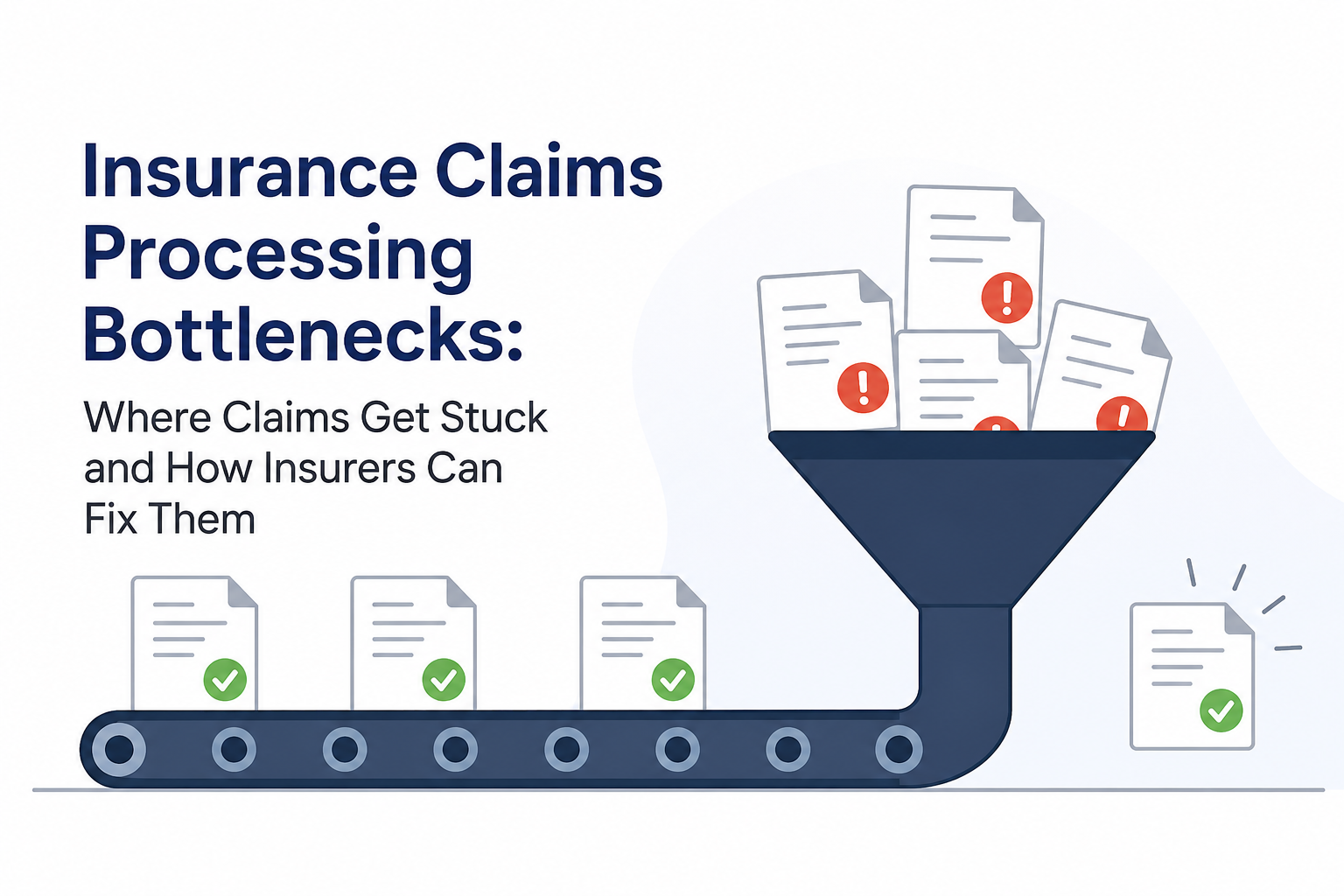
A company might employ experienced adjusters and have its claims system officially licensed, yet it could still discover that the time taken to deal with claims increases each quarter. Even though the claims processing department is properly placed in the organization chart, in fact the files end up having to wait an extra three days since the document has been received in the wrong format or because a routing rule causes a simple auto claim to go through the same review process as a disputed liability claim. Though the paperwork indicates that claims processing moves in a simple manner from intake to payment, in reality it is more similar to a relay race in which each handover carries the risk of the baton being dropped.
The pattern behind most claims processing bottlenecks is that the individual steps themselves are not the problem, but rather the transfers between steps. This article looks at the points at which claims processing comes to a standstill, the costs this brings to insurers in the form of complaints and loss of customers, and the operational solutions both used in-house and provided by external parties that help to eliminate the gap.
What claims processing actually covers
Claims processing is the series of operations by which a claim is taken in and then paid out finally; it includes registration, the review of the documentation, verification of coverage, investigation if necessary, settlement, and closing. The process should be distinguished from claims adjudication, which refers to the decision-making stage within the sequence, and from claims administration, which involves the everyday tasks of handling files, carrying out correspondence, and keeping records alongside it.
All insurers have some form of claims processing procedure; the difference lies in the friction between stages, since that friction primarily causes delays. Whatever term the insurer uses internally- for example, claims processing, claims operations, or claims administration-the basic workflow and its weak points are almost the same throughout the industry.
Why claims processing delays cost more than insurers think
A slow claim usually does not fail as a result of the technical decision but rather because of the waiting period. According to the J.D. Power 2025 U.S. Property Claims Satisfaction Study, the average time taken to process a property claim has now reached 44 days, which is the longest such figure ever recorded in the study. This average time comes on top of the state-level regulatory deadlines; under the NAIC Unfair Claims Settlement Practices Act model, most states require insurers to acknowledge a claim within 10 to 15 days, to make an accept-or-deny decision within 15 to 40 days of receiving proof of loss, and to release the payment within 5 to 30 days after approval.
If you keep missing those opportunities, the result can be seen in three areas. Firstly, the number of complaints goes up, since delays in handling claims are still one of the main categories listed in the state market-conduct data. Secondly, customer retention decreases, the claims history of a policyholder being the main factor in their decision as to whether or not to renew. Thirdly, operating costs rise since a file that has to be reopened or escalated requires a great deal more staff time than one that is settled on the first attempt.
Delays in claims processing are seldom due to a single incompetent adjuster; instead, they are generally the result of a workflow issue that appears every time a policy is renewed until the problem has been mapped out.
Where claims get stuck: the five real bottlenecks
The five stages in question account for the majority of delays when carriers, MGAs, and TPAs are processing claims, regardless of the type of business involved, and the easiest way to find out where a given book of business is losing time is to compare claims processing with these five stages.
Intake and documentation: The handling and recording of claims is where a considerable amount of delays in insurance claim processing begin, since the documents come in inconsistent formats via email, fax, portals, and paper mail, and employees have to spend hours looking for missing pages rather than actually processing the claim.
Coverage and eligibility verification: Checking coverage and confirming eligibility. The policy data is stored in one system and the claims data in another, and the two systems do not always update each other in real time. A verification step which should take only a few minutes, ends up requiring a call to underwriting.
Triage and routing: The process of triage and routing involves simple claims and complex claims going through the same queue. For example, when a simple claim for a car accident has to wait behind three files that are in dispute over liability, the average time taken to deal with all the claims increases, even though the majority of the claims did not require such a detailed examination.
Adjudication and quality review: The adjudication and quality review is the most delicate stage, since an incorrect decision at this point leads to compliance risks or to an unjust denial. Although it is right for insurers to include checks, when these are manual and not documented, the time taken for the review has no clear explanation.
Settlement and reporting: Settlement and reporting involve payment accuracy, approval sign-off, and reporting updates. If there is a weakness in an earlier stage, for example, poor documentation or unclear coverage data, this problem reappears at this stage in the form of rework, which is where a delay in claims processing ends up costing the most.
The following table shows, for each stage in the claims processing procedure, the usual cause and cost.
| Backend Stage | Typical cause | What it costs the insurer |
| Intake and documentation | Non-standard formats, multiple channels, missing pages | Staff time spent chasing files instead of processing them |
| Coverage verification | Disconnected policy and claims systems | Manual lookups, delayed eligibility decisions |
| Triage and routing | No complexity-based queue separation | Simple claims stuck behind complex ones |
| Adjudication and review | Manual, undocumented QA checks | Inconsistent review time, compliance exposure |
| Settlement and reporting | Upstream errors surfacing late | Rework, payment delays, reporting gaps |
The insurance claims backlog problem: why it is not just a staffing issue
To address the growing insurance claims backlog, most insurers tend to increase staffing during surge periods, such as catastrophe season, when taking on a new book of business, or during a system migration. This provides only a temporary solution because it doesn’t address fundamental issues in the claims processing workflow, so the backlog reappears the next time claim volume rises. A backlog signals a problem with claims processing, not the level of staffing required.
A backlog usually starts when one part of the claims process cannot keep up with the rest. For example, intake may be moving normally while document verification or adjudication takes longer. New claims keep coming in, but that slower queue continues to build. Week after week, more claims are received than closed. Simply looking at the total claim volume will not solve it. The delay at that particular stage has to be fixed first.
Claims processing workflow optimization: what actually moves the needle
Optimizing the claims processing workflow works best as a series of steps rather than a single amendment. Insurers that achieve measurable progress in this area usually follow a sequence similar to the one mentioned.
- Map the current workflow stage by stage. Most teams have never documented where a claim actually goes, only where the process design says it should go. The two are rarely identical.
- Measure first-pass resolution rate. This is how many claims are complete without rework, escalation, or a reopened file. It is one of the clearest indicators of where the workflow is unstable.
- Separate claims by complexity before routing: Put simple claims on a different path from disputed or more complicated ones. When both sit in the same queue, the easier cases often end up waiting behind work that naturally takes longer. Sorting them early helps keep routine claims moving while the tougher cases get the extra review they need.
- Standardize documentation intake: No matter where the documents come from, bringing them into one consistent format makes the process easier to manage. It also cuts down on the back-and-forth that often slows claims down at the start.
- Automate the repetitive, rule-based steps: If a task follows the same rules every time, it is a good place to use automation. Data entry, duplicate checks, and basic eligibility verification fit that category. Coverage disputes do not, because they involve judgment and should remain with trained staff.
- Build quality checks into the workflow, not after it: Quality checks work best when they are part of the process from the beginning. A maker-checker approach allows one person to complete the work and another to review it before settlement, reducing the chances of errors being discovered later.
- Re-measure quarterly: Claims processing workflow optimization needs regular review. Claim volumes change, staffing changes, and the type of claims coming in changes too. When that happens, the slowest part of the process can shift, so it needs to be checked again every quarter.
In-house scaling vs. claims processing outsourcing
When claims come in faster than the internal team can handle, insurers usually have a few options. They can hire more people, bring in better technology, or work with a specialist through broader insurance process outsourcing. Each option solves a different kind of capacity problem. It can also change how quickly claims move through the system over an underwriting year.
| Factor | In-house scaling | Claims processing outsourcing |
| Speed to add capacity | Slower, tied to hiring and training cycles | Faster, since the partner already has trained staff |
| Cost during volume swings | Fixed cost regardless of claim volume | Scales with actual volume |
| Domain expertise | Depends on internal training investment | Insurance-specific teams already in place |
| Technology investment | Often requires new capital spend | Partner typically absorbs the technology layer |
| Control over decisions | Full internal control | Retained through SLAs, approval matrices, and reporting |
Insurance claims outsourcing does not mean giving an outside partner control over the final decisions. In a well-run claims management outsourcing setup, the insurer still handles coverage decisions, escalations, and final approval. The outsourcing partner takes care of the routine, rule-based work that tends to slow the process down when claim volumes rise. Techsurance’s health claims service follows this kind of model, supporting the process from intake through settlement while the insurer keeps final decision authority.
How to evaluate a claims processing outsourcing partner
It does not follow that every insurance claims processing outsourcing partner will be suitable for all types of insurance books. A partner who is suitable for handling a high volume of motor vehicle claims is not automatically appropriate for dealing with complicated commercial liability cases. Therefore, before entering into an agreement, members of the insurance operations and procurement teams should obtain clear answers to a number of questions.
- Which of the stages in the claims processing does the partner carry out, and at which point does the insurer maintain control?
- What are the SLAs that specify turnaround time at each stage, not just the total cycle time?
- What approach does the partner take with regard to handling the documentation and integrating with the insurer’s current claims system?
- What kind of quality assurance system is there, and how frequently are the results reported back?
- How is the partner able to scale up during a volume surge without the accuracy dropping?
- What standards on compliance and audit trails does the partner adhere to, and is it possible to check these against ISO or similar certifications?
Techsurance deals with US insurers, MGAs, and TPAs regarding precisely these questions, and in this case the details are more important than the sales pitch. A partner who is unable to give specific answers to the SLA and integration questions is not ready to manage a live book of claims processing.
KPIs that measure claims handling efficiency
It is difficult to improve claims handling efficiency without first establishing a baseline, and claims processing metrics, which only show the total cycle time, fail to indicate where the problem lies. The metrics listed below provide insurers with a set of figures to use for tracking before and after any change to the workflow or outsourcing.
| KPI | What it measures | Why it matters |
| First-pass resolution rate | Claims completed without rework or escalation | Direct indicator of workflow stability |
| Turnaround time by stage | Time spent at intake, review, adjudication, settlement | Shows exactly where delays concentrate |
| Pend rate and pend age | How many claims stall, and for how long | Flags documentation or verification gaps |
| Reopen rate | Claims reopened after initial closure | Signals quality issues upstream |
| Escalation rate | Claims requiring manual intervention beyond standard review | Tracks whether automation thresholds are set correctly |
Tracking these five consistently, rather than only the total cycle time, is usually what separates insurers who fix claims processing bottlenecks from insurers who keep adding staff to the same broken sequence.
Common mistakes when trying to fix claims processing bottlenecks
The most common mistake that insurers make is to deal with the symptoms rather than the actual stages. If adjusters are hired without first separating the claims according to their complexity, this simply shifts the same claims processing bottleneck further down the line. When a new claims system is purchased without first standardizing the intake process, the new system ends up with the same documentation problems as the old one. And by measuring only the total cycle time without having stage-by-stage turnaround data, it becomes almost impossible to determine which claim processing improvement actually had an effect.
Insurers who achieve lasting progress generally begin on a smaller scale than anticipated by setting up a single queue, a single KPI, and one workflow change, and then proceed to the next stage only after these have been measured.
If your team is looking to close claims processing bottlenecks without expanding every function in-house, Techsurance supports US insurers, MGAs, and TPAs with specialized claims processing operations, built around the same first-pass resolution and turnaround metrics covered above.
Where this leaves claims teams
A claims backlog usually does not come from one single issue. It is often the result of delays building up at different points in the process, whether that is intake, verification, routing, or settlement. The first step is to find where the process is actually slowing down and fix that problem instead of only adding more people. Insurers that regularly review their workflow, separate claims based on complexity, and track first-pass resolution are usually able to bring backlogs under control more effectively.
Techsurance offers specialized claims processing services to insurance carriers, MGAs, and TPAs, handling the whole process from intake through to settlement and operating according to well-defined turnaround and quality standards. If you want to find out where your current claims processing workflow is losing time, then please contact Techsurance.
FAQs
What does the term claims processing mean in the insurance industry?
The entire series of operational activities carried out when dealing with claims covers the process from the time the claim is accepted right through to the final payment; this consists of carrying out the registration, examining the documentation, checking the coverage, making the assessment, and arriving at a settlement.
What is the primary reason for delays in the processing of claims?
The principal reasons for delays amongst the different carriers and business lines are the gaps in the documentation when the cases are first received, the fact that the policy and claims systems are not linked, and the habit of sending claims of various levels of complexity through the same queue.
What is the difference between claims processing and claims adjudication?
The decision stage in the claims processing procedure is adjudication, at which time the claim is either approved, denied or put on hold. Claims processing as a whole includes the stage of adjudication.
What would be considered a healthy first-pass resolution rate in the processing of claims?
As there is no single figure applicable across the entire industry since the rate differs according to the type of business and the complexity of the claim, a steadily increasing or always low first-pass resolution rate is a reliable indication that a stage in the workflow requires attention.
When should an insurer consider claims processing outsourcing instead of hiring internally?
It makes good sense to outsource in cases where the volume of claims varies, when internal hiring is unable to keep up with growth, or when a particular line of business requires domain expertise that would take a long time to develop in-house.
Does insurance claims outsourcing mean giving up control over claim decisions?
No. The insurer still stays in charge of the important decisions around a claim, including coverage decisions, escalations, and final approvals. The outsourcing partner supports the process by taking care of tasks like document review, verification, and other routine steps that are handled according to agreed rules and SLAs.
What should insurers ask a claims management outsourcing partner before signing an agreement?
Insurers ought to check which stages the partner is responsible for, find out how the SLAs are defined according to stage rather than just on the basis of the total cycle time, ascertain the way in which system integration functions, and also find out what quality assurance and compliance standards apply.
