
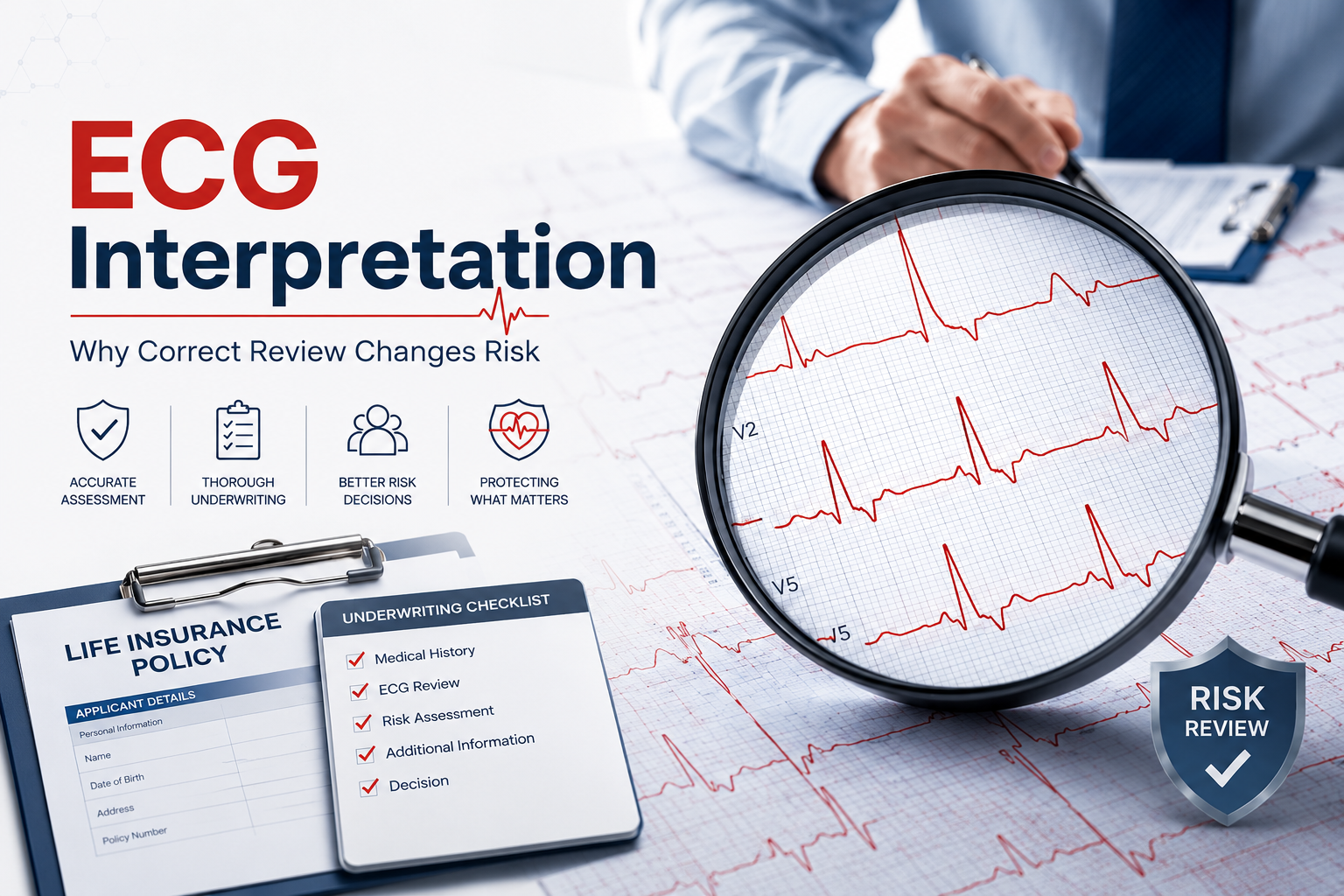
An ECG in a life insurance file can look like a small test report. In reality, it can change the full underwriting path. A harmless pattern can lead to a higher premium if it is read too aggressively. A serious heart signal can be missed if it is treated as routine.
This poses a risk to both the applicant and the carrier. The applicant can lose a fair offer. The carrier can accept a higher mortality risk at a price built for a healthier applicant.
An ECG, also called an electrocardiogram, records the electrical signals that make the heart beat. Underwriters use it to look for rhythm issues, signs of heart strain, possible past heart attack, and other heart-related concerns. The final underwriting meaning depends on the ECG findings, the applicant’s age, symptoms, health history, and follow-up records.
This article explains ECG interpretation in simple terms. It shows what the test measures, how common ECG findings affect underwriting, where review errors create risk, and how Techsurance helps life insurers handle ECG-related files with better consistency.
What an ECG measures and why underwriters care
The heart works through electrical signals. These signals tell different parts of the heart when to squeeze and relax. An ECG uses 10 patches to record those signals as waves on a graph. These waves are plotted on 12 different graphs, which help indicate things like whether the heartbeat is regular, whether the signal travels through the heart properly, and whether the heart muscle shows signs of strain or damage. Underwriters use it to answer a risk question: does this finding suggest higher future mortality risk?
Here are the various components of an ECG:
| ECG component | What it is | Why underwriters review it |
| P wave | Signal that starts in the upper heart chambers | Can show rhythm issues or upper chamber strain |
| PR interval | Time the signal takes to move from upper to lower chambers | Can show delays in signals travelling through the atrioventricular node or cases of signals travelling too fast. These can signal heart conditions, all of which increase risk. |
| QRS complex | Signal that activates the lower heart chambers | A wide or unusual pattern can carry risk |
| ST segment | Early recovery phase after the main beat | Can show strain or reduced blood flow |
| T wave | Later recovery phase after the beat | Can show strain, blood flow issues, or secondary changes |
| QT interval | Total electrical reset time | A long reset time can link to rhythm risk |
How ECG findings affect life insurance ratings
Underwriters review ECG findings to decide whether the file can move forward, requires more records, requires a higher rating, or requires medical director review. The same finding can yield different results for different applicants. For example, an ECG signal that looks minor in a young applicant can carry more weight in an older applicant with diabetes and high blood pressure. A finding already reviewed by a cardiologist can also carry less concern than the same finding with no follow-up records.
Here are some of the major ECG findings:
Left ventricular hypertrophy
Left ventricular hypertrophy, or LVH, means the left lower chamber of the heart appears enlarged or thickened. The left lower chamber is the part of the heart that pumps blood to the body. An ECG can suggest LVH when the electrical signal looks unusually strong. This can happen because a thicker heart muscle creates a larger electrical signal.
LVH becomes more important when it appears with a strain pattern. A strain pattern means the ECG also shows changes that suggest the heart muscle is working under pressure.
LVH can be linked with:
- High blood pressure
- Aortic valve disease
- Thickened heart muscle disease
- Higher rhythm risk
- Heart failure risk
- Sudden cardiac death risk
Left bundle branch block
Left bundle branch block, or LBBB, means the electrical signal travels through one side of the heart more slowly than expected. Think of the heart’s wiring as two main branches that help the lower chambers beat in sync. LBBB means the left branch is delayed or blocked.
LBBB becomes more common with age. It can appear in older applicants without symptoms, but unexplained LBBB still needs careful review. In underwriting, a new or unexplained LBBB often prompts additional records. The underwriter may request medical notes, an echocardiogram, a stress test, or prior ECG records.
A case with LBBB can still be rateable when records show the heart is pumping well and there is no evidence of blocked arteries. The rating then depends on age, symptoms, time since diagnosis, and carrier rules.
Atrial fibrillation
Atrial fibrillation, often called AFib, is an irregular heartbeat. The upper chambers of the heart do not beat in a steady pattern. AFib matters in life insurance underwriting because it can increase stroke risk. It can also link with high blood pressure, diabetes, heart valve disease, heart failure, and aging. Underwriters review the type of AFib, how often it happens, whether the heart rate is controlled, and whether the applicant takes blood-thinning medication. The various types of AFib and their impact on underwriting are:
| AFib type | Simple meaning | Underwriting concern |
| Paroxysmal AFib | Comes and goes | Review episode frequency and cause |
| Persistent AFib | Lasts longer and needs treatment | Review medication and heart records |
| Permanent AFib | Ongoing rhythm issue | Higher rating risk |
| AFib with prior stroke | Stroke has already occurred | Much higher concern |
| AFib with heart failure | Heart function is affected | Higher concern |
ST segment and T wave changes
The ST segment and T wave show how the heart recovers after each beat. Some of these changes are minor and have little effect on the rating. Other changes can suggest reduced blood flow to the heart muscle or strain from a thickened heart. Understanding these requires experience/training. For example, ST changes caused by LVH strain should be reviewed as part of LVH. They should not be treated as a separate heart artery problem unless other records support that concern.
ST segment or T wave changes need more attention when:
- The change appears in several ECG views
- The change is new compared with an older ECG
- The applicant has chest pain or shortness of breath
- The applicant has diabetes or high blood pressure
- The file has a history of heart artery disease
- The ECG also shows LVH or bundle branch block
- No follow-up testing appears in the file
Pathological Q waves
Q waves are part of the ECG signal. Some Q waves are normal. Larger or longer Q waves can suggest a past heart attack. This can be difficult for underwriters because the applicant may not report a past heart attack. Some people have silent heart attacks with few symptoms. Others have ECG patterns that appear concerning, but subsequent tests show no significant damage. The location of Q waves also matters. Different ECG views look at different areas of the heart. Q waves in one area can suggest a different pattern from Q waves in another area.
When pathological Q waves appear, underwriters often look for:
- Prior doctor records
- Prior ECGs
- Heart imaging
- Stress test results
- Hospital records
- Symptoms history
- Medication history
- Cardiologist notes
Right bundle branch block
Right bundle branch block, or RBBB, means the electrical signal travels more slowly through the right branch of the heart’s wiring. This is different from LBBB because the right side of the heart handles blood flow to the lungs.
Isolated RBBB can appear in people without serious heart disease. It often has a more favorable underwriting view than LBBB. The table below shows how RBBB can vary:
| Case | What it is | Underwriting view |
| Isolated RBBB | Only the right branch pattern appears | Often rateable |
| RBBB in a healthy applicant | No symptoms or cardiac history | Standard or small table in some guides |
| RBBB with other ECG changes | More than one finding appears | More records can be needed |
| RBBB with symptoms | The file has added concern | Medical review can be needed |
| RBBB with known heart disease | Context raises risk | Rating depends on records |
Why ECG review errors create financial risk
ECG review errors can harm both business quality and risk selection. Errors can be of 2 kinds: overrating and underrating.
Overrating happens when a harmless or minor finding gets treated as serious. This can lead to higher premiums, extra records, postponements, or lost cases. Applicants and distributors can move to another carrier if the process becomes slow or too conservative.
Under-rating happens when a serious finding gets missed or dismissed. This creates a larger financial issue. The carrier accepts risk at a price built for a healthier applicant.
The biggest review problems often come from:
- Reading one ECG finding without context
- Ignoring the applicant’s age
- Missing blood pressure or diabetes history
- Treating old stable findings as new
- Missing new findings compared with prior ECGs
- Using poor quality ECG recordings
- Requesting broad records instead of focused records
- Documenting the file too vaguely
This means the ECG in the file should not be treated as perfect by default. The reviewer should check recording quality, compare prior records, and ask whether the finding makes sense in the full file.
ECG finding vs underwriting rating direction
Use this table as a guide to understand the complexities of ECG findings and how they need to be handled within the context of underwriting:
| ECG finding | What it can suggest | What happens to the underwriting decision? |
| High voltage LVH only | Strong signal without strain | Can be mild in some files. Requires verification. |
| LVH with strain | Heart muscle may be under pressure | More records or table rating |
| New LBBB | Possible heart disease | Postpone or full heart review |
| LBBB with normal testing | Reviewed conduction delay | Rating can be possible |
| Paroxysmal AFib | Irregular rhythm that comes and goes | Rate depends on control and history |
| Persistent AFib | Ongoing rhythm issue | Often table rating |
| ST depression | Possible strain or blood flow issue | More records if meaningful |
| T wave inversion | Recovery pattern change | Context decides rating impact |
| Pathological Q waves | Possible past heart attack | APS or heart test review |
| Isolated RBBB | Right side conduction delay | Often more favorable than LBBB |
How specialist KPO teams improve ECG-based underwriting
High-volume underwriting teams may encounter the same ECG finding multiple times in a week. If each reviewer handles it differently, ratings become inconsistent. A specialist KPO team helps create consistency across files. Here’show they do it:
Protocol-based review
A protocol is a defined review path. It tells the team how to handle ECG findings such as LVH, LBBB, AFib, ST changes, Q waves, and RBBB. Carrier-specific protocols are important. A generic checklist does not capture each carrier’s risk appetite, rating rules, age bands, or referral standards. A KPO team can review files in accordance with the carrier’s protocol, keeping the workflow consistent across high volume.
QA review
QA review catches two types of errors. It catches overly conservative ratings that slow the file. It also catches missed findings that can create risk. In ECG cases, QA review is especially useful because many findings overlap. For example, ST changes linked to LVH strain should not be counted again as a separate blood flow issue unless records support that view.
Flexible volume capacity
Underwriting volume changes with campaigns, product launches, distribution activity, and seasons. Internal teams can become stretched during busy periods. A specialist KPO team gives the carrier trained capacity during these periods. This keeps ECG-related cases moving without the need to hire permanently at every peak.
Better escalation summaries
Medical directors should receive focused summaries. They should not spend time building the file from the beginning. A KPO team can prepare a summary that includes:
- ECG finding
- Recording quality
- Applicant age
- Coverage amount
- Symptoms
- Related history
- Prior records
- Missing items
- Rating question
How Techsurance fits into ECG-based underwriting workflows
Techsurance provides specialist insurance KPO services for underwriting, claims, QA, and back office operations. For ECG-based underwriting, Techsurance helps with file review, context assembly, QA, and escalation preparation. Here are specific parts of the workflow where Techsurance can add value:
| Workflow need | Techsurance role | Carrier benefit |
| ECG file review | Review findings against carrier protocols | More consistent first pass review |
| Recording quality check | Flag poor quality ECGs | Fewer decisions from weak tracings |
| Context assembly | Gather APS and prior test details | Better file readiness |
| LVH or LBBB review | Apply defined escalation rules | Less rating variation |
| AFib review | Prepare risk context summary | Faster medical director review |
| QA review | Check findings and documentation | Lower review error risk |
| Volume peaks | Add trained review capacity | More predictable turnaround time |
| Reporting | Track cases and referral reasons | Better workflow visibility |
Conclusion
Strong ECG-based underwriting depends on plain but careful review. The team needs to understand what the ECG shows, what the applicant’s records say, and how the carrier’s rules apply. Techsurance helps life insurers manage ECG-related underwriting volume through specialist KPO assistance, file review, context assembly, QA, and protocol-based workflow execution. If ECG-related delays, documentation gaps, or volume pressure affect rating quality, a focused conversation can identify where specialist assistance would be most helpful. Get in touch with our team today.
FAQs
What is ECG interpretation in life insurance underwriting?
ECG interpretation in life insurance underwriting involves reviewing the heart’s electrical signals to determine whether they indicate a higher mortality risk. Underwriters use ECG findings with age, symptoms, health history, medications, and doctor records to decide rating, postpone, or referral action.
Why do life insurers ask for an ECG?
Life insurers request an ECG when age, coverage amount, or health history warrants a deeper heart review. The ECG can show rhythm issues, conduction delays, possible heart strain, or signs of past heart damage.
An abnormal ECG does not always mean a higher premium. Some findings are minor or already explained by prior records. A higher premium is more likely when the finding is new, unresolved, linked to symptoms, or associated with other health risks.
Can someone get life insurance with LBBB or LVH?
Yes, applicants with LBBB or LVH can still receive offers when records show stable heart status. New, unexplained LBBB often requires further review. LVH with controlled blood pressure differs from LVH with strain and no follow-up records.
How does a KPO team help with ECG underwriting?
A KPO team reviews ECG files under carrier protocols, gathers context, prepares referral summaries, and performs QA review. The carrier keeps final underwriting authority. The KPO team helps improve file readiness and consistency.
