
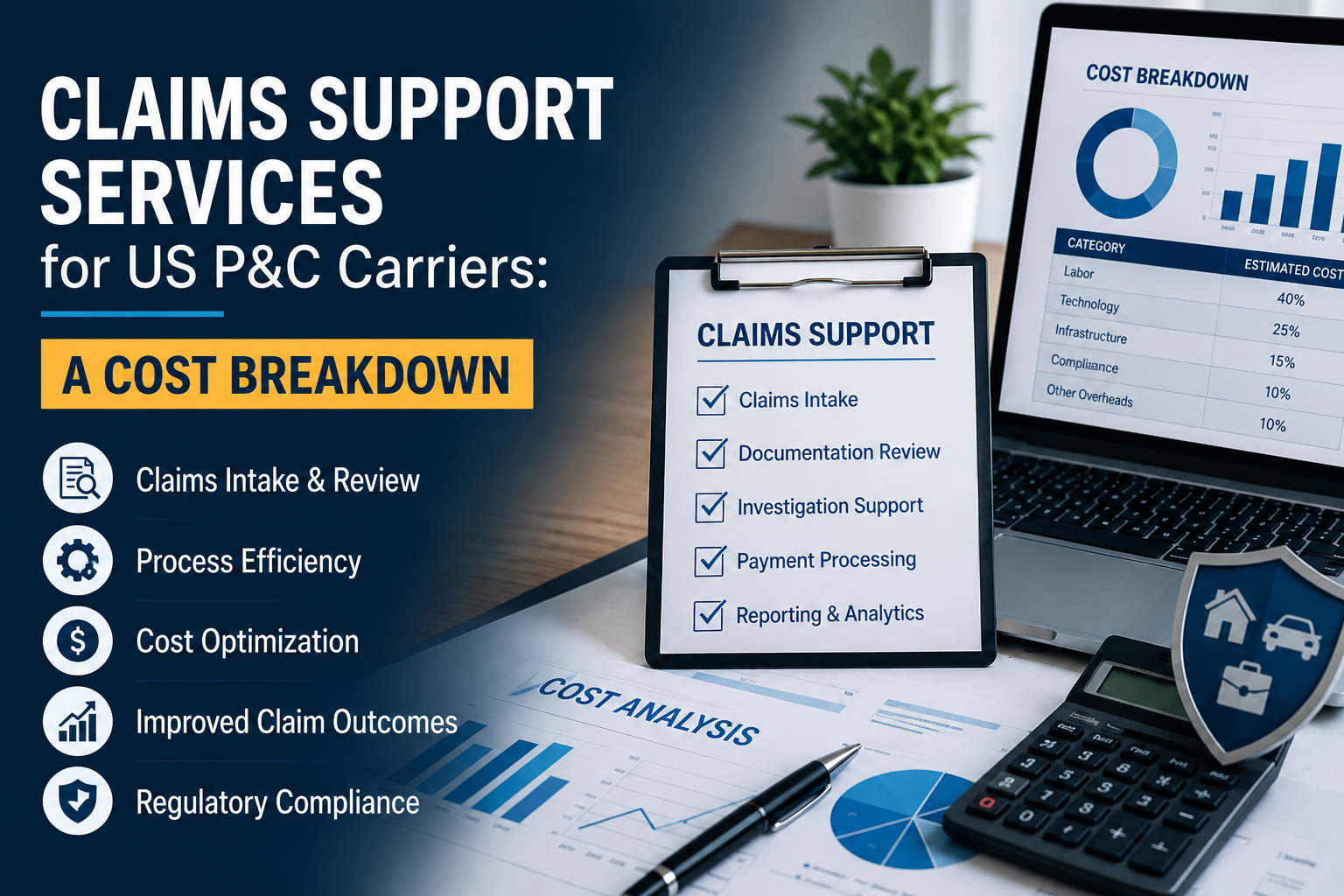
The property and casualty (P&C) insurance industry is facing a staffing crisis, with nearly half of the workforce expected to retire in the next 15 years, particularly affecting underwriting. Submission volumes are rising, combined ratios are under pressure, and brokers are demanding faster quote turnarounds, which many carriers are struggling to meet.
The growing trend in the US Property and Casualty (P&C) insurance market is to separate underwriting judgment from operations. Licensed underwriters focus on risk selection and pricing, while a dedicated operations team handles tasks such as intake, policy review, renewal preparation, and quality reviews. This division of labor enhances efficiency and allows for measurable financial outcomes from underwriting support services.
In house underwriters in the US cost between $75,000 and $195,000 depending on experience and skill, which is why carriers often see operational savings of between 20% to 40%, which in some cases goes up to as much as 75% by using a specialized insurance operations partner for underwriting workflows rather than handling them entirely in-house. However, actual savings depend on the outsourced functions, the complexity of the book of business, and the partner selected.
This article provides a comprehensive overview of the costs involved. You will discover what underwriting support services entail, where savings originate, and which outsourced functions yield the highest returns.
What are underwriting support services?
Underwriting support services are the operational, non-risk-bearing tasks that surround the underwriting decision but do not require underwriting authority. These administrative and processing functions consume a substantial portion of an underwriting team’s time without directly contributing to risk selection or pricing.
Underwriting support services are structured operational workflows that prepare, validate, and organize insurance submissions, policies, and related documents, enabling licensed underwriters to focus on risk decisions rather than administrative processing.
To be specific about what this covers, here is the range of functions that fall under the umbrella of underwriting support.
The following list covers the core underwriting support functions that carriers and MGAs most commonly include in an outsourced operations model.
- Submission intake, logging, and initial sorting
- Data extraction from broker submissions and application documents
- Clearance checks for duplicates, conflicts, and prior declinations
- Loss run analysis preparation and indexing
- Quote packet preparation and assembly
- Policy review and checking against carrier guidelines
- Renewal prep and file organization
- Endorsement processing and documentation
- Bordereaux management and reporting
- QA and QC validation across workflows
- Regulatory documentation and filing preparation
None of these tasks requires a licensed underwriter to perform them. All of them take time away from the underwriters who perform them, rather than focusing on risk decisions. Separating these functions from the underwriting role creates operational and financial benefits.
Why US P&C carriers are outsourcing underwriting operations
The talent shortage in P&C underwriting is real and well-documented. A significant portion of the experienced underwriting workforce is approaching retirement age, and the number of qualified professionals entering the field has not kept pace. The result is a capacity gap that carriers and MGAs cannot close through hiring alone.
At the same time, submission volumes have grown. Digital distribution channels, expanding MGA programs, and a harder market that is driving more accounts to seek coverage have all increased the volume of work entering underwriting queues. More submissions arriving in a team with fewer experienced underwriters creates a bottleneck that slows every step of the process.
Combined ratio pressure adds urgency to the cost conversation. When expense ratios climb, every operational inefficiency becomes a financial problem. Administrative tasks performed by highly compensated underwriters are expensive. If those same tasks can be performed at lower cost by a specialized operations team without sacrificing quality, the expense ratio improves.
Carrier service level agreement (SLA) expectations from agents and brokers have also shifted. The expectation for a quote response within 24 to 48 hours of a complete submission is now standard across most commercial lines segments. Carriers that cannot meet that timeline lose submissions to competitors that can.
Outsourcing underwriting operations addresses all of these pressures at once. It frees underwriters to focus on risk selection. It scales capacity during renewal seasons and catastrophic events without the carrier needing to hire and train additional staff. And it delivers consistent turnaround performance because the processing work is managed through defined workflows with measurable SLAs.
Cost breakdown of underwriting support services
This is the section that carriers and MGAs want most. What does it actually cost, and where do the savings come from?
The cost comparison between an in-house model and a specialized insurance KPO model covers multiple components:
| Cost component | In-house team | Specialized insurance KPO model |
| Recruitment and onboarding | High; ongoing for replacement hiring | Lower; partner manages staffing |
| Training and ramp-up | Internal burden; 3 to 6 months to productivity | Domain-trained teams; faster deployment |
| Technology licensing | Additional per-seat licensing required | Shared operational infrastructure |
| QA and oversight | Requires separate QA team investment | Integrated QA workflows included |
| Scalability during peak seasons | Difficult; limited by hiring timelines | Flexible capacity adjustments |
| Turnaround performance | Variable; depends on team capacity | SLA-driven and consistently measured |
| Operational cost per file | Higher across all volume levels | Lower due to scale and specialization |
| Management overhead | Internal supervisory cost | Managed by the partner |
The aggregate savings figure that most carriers see when they move from a fully in-house model to a specialized KPO partner falls in the range of 20 to 40 percent of operational costs. The exact figure depends on current in-house cost levels, the functions being outsourced, and the volume being processed.
Which underwriting tasks deliver the highest ROI when outsourced?
Underwriters in the US spend a significant share of their working time on administrative activities that do not directly contribute to risk selection or pricing. Studies across the P&C sector have consistently found that underwriters spend anywhere from 30 to 50 percent of their time on non-underwriting tasks. That is a large portion of expensive professional capacity being consumed by work that a trained operations team can handle.
The functions that deliver the highest return when outsourced are those that are high in volume, well-defined in process, and time-consuming relative to their complexity.
Here is a breakdown of the highest-ROI underwriting support functions:
| Function | Why does it deliver high ROI when outsourced |
| Submission intake and logging | High volume, rules-based, frees underwriters from queue management |
| Clearance processing | Time-intensive; defined criteria; scales with submission volume |
| Data validation and extraction | Repetitive; error-prone when rushed; benefits from dedicated focus |
| Loss run indexing and prep | Document-heavy; time-consuming; does not require underwriting knowledge |
| Quote packet preparation | Structured work; significant time savings per submission |
| Renewal prep and file assembly | Cyclical and predictable; high volume during renewal periods |
| Policy checking | Detail-oriented; SOP-driven; benefits from specialized QA reviewers |
| QA audits | Cross-workflow function: improves accuracy across all other tasks |
| Bordereaux management | Data-intensive; reporting-focused; well-suited to trained processing teams |
Operational challenges underwriting leaders face in 2026
The operational environment for P&C underwriting in 2026 is shaped by several converging pressures that have changed how carriers and MGAs approach capacity and cost.
Submission volume growth has outpaced team growth at most carriers. Digital distribution channels, program business expansion, and a market environment that continues to push more complex risks toward specialty and E&S markets have all contributed to heavier submission queues. The incoming volume requires processing capacity that in-house teams are not always sized to absorb.
The underwriting talent gap has widened. A generation of experienced commercial lines underwriters is moving toward retirement. The technical knowledge they carry, including familiarity with complex risk classes, manuscript policy language, and multi-system workflows, takes years to build. The professionals entering the field today are building that knowledge while working through record submission volumes.
Catastrophic event-driven spikes create irregular capacity demands. A major weather event can drive a sudden surge in claims-related submissions, endorsement requests, and coverage reviews. In-house teams sized for normal volume are not built for these surges. The cost of scaling up quickly through traditional hiring is high and the process is slow.
Digital submission growth is adding complexity rather than reducing it. More submissions arriving through digital channels means more data in more formats. Extraction, validation, and normalization of that data require processing capacity that the underwriting team itself should not provide.
In-house vs specialized insurance operations partner
The choice between building underwriting support capacity in-house and partnering with a specialized insurance KPO comes down to expertise, cost, and scalability. Generic business process outsourcing providers are a third option that many carriers have tried and found wanting. The following table covers the key differences.
This comparison spans the dimensions that matter most to P&C carriers evaluating their underwriting operations model.
| Factor | Generic BPO | Specialized insurance KPO |
| Insurance domain expertise | Limited; general admin background | Deep insurance workflow knowledge |
| Underwriting terminology | Basic familiarity | Advanced working knowledge |
| Regulatory awareness | Generic | Insurance-specific and state-aware |
| QA process maturity | Variable; not insurance-calibrated | Structured and insurance-native |
| Scalability for P&C operations | Moderate | High; built for insurance volume patterns |
| Workflow integration | Limited; requires significant onboarding | Insurance-native; faster deployment |
| Error rate during ramp-up | Higher due to knowledge gaps | Lower due to existing domain expertise |
| SLA accountability | Inconsistent | Defined and measured |
How Techsurance helps US P&C underwriting operations
Techsurance provides specialized underwriting operations for US P&C carriers and MGAs. Our underwriting services cover the full range of pre-underwriting and post-bind processing functions that consume the underwriting team’s capacity but do not directly contribute to risk decisions.
The Techsurance team handles submission intake management, clearance processing, data extraction, policy checking, renewal prep, endorsement processing, and bordereaux management through documented, SOP-driven workflows. Every function is supported by a multi-level QA process that catches errors at the point of processing rather than downstream. Insurance-trained staff handles the work, which means less ramp-up time, fewer errors during onboarding, and faster delivery from the start.
Operational scalability is built into the Techsurance model. During renewal seasons, catastrophic events, and new product launches, capacity adjusts to the carrier’s volume without the carrier needing to hire temporary staff or stretch existing teams. During slower periods, the cost model adjusts to reflect lower volume. Turnaround performance is tracked against defined SLAs, and reporting gives carrier management teams visibility into workflow performance at every stage.
Techsurance helps carriers and MGAs improve underwriting operations through specialized insurance workflows tailored to business volume, regulatory requirements, and turnaround goals.
Conclusion
The operational pressure on U.S. property and casualty underwriting teams is a persistent issue. Submission volumes will continue to rise, and the talent shortage will likely worsen. Broker service-level expectations will remain high. Carriers and MGAs that rely solely on in-house staff may see rising expense ratios and overextended underwriters, often handling tasks outside their expertise.
Separating underwriting judgment from operations is both financially and strategically beneficial. When licensed underwriters focus on risk selection and pricing, they generate more quotes efficiently and make better decisions. Trained operations teams handle intake, data extraction, policy checking, and quality assurance, which speeds up workflow and reduces errors. This approach leads to significant cost savings, measurable productivity gains, and consistent performance, whether during quiet renewal periods or busy seasons with catastrophic events.
The carriers and MGAs that are winning on turnaround time, expense ratio, and broker responsiveness in 2026 have deliberately decided to stop asking their underwriters to do two jobs at once. They have invested in an operational model that puts the right work in front of the right people. That decision pays dividends through the year in the form of better operations.
If your underwriting operation is carrying a backlog, missing SLA targets, or losing broker relationships to faster competitors, the path forward starts with an honest assessment of how underwriter time is actually being spent. Techsurance works with US carriers and MGAs to build underwriting support workflows that address exactly that problem, with insurance-trained teams, structured processes, and turnaround performance that brokers and underwriters both rely on.
FAQs
What are underwriting support services in insurance?
Underwriting support services are the operational, non-risk-bearing functions that prepare, validate, and organize submissions, policies, and related documents before and after underwriting review. They include submission intake, data extraction, clearance checks, policy checking, renewal prep, and QA validation.
How much does P&C underwriting outsourcing cost?
The cost of outsourcing P&C underwriting operations varies based on the functions included, submission volume, complexity, and the partner selected. Many carriers report operational savings of 20 to 40 percent compared to fully in-house models when working with a specialized insurance KPO.
Can underwriting support functions be outsourced?
Yes. A wide range of underwriting functions can be outsourced to a specialized insurance operations partner. These include submission intake, clearance processing, data extraction, loss run indexing, quote packet preparation, policy checking, renewal prep, endorsement processing, and bordereaux management.
What underwriting tasks should remain in-house?
Risk selection, coverage pricing, policy approval, and delegated authority decisions require licensed underwriters and should remain with the carrier. Operational and administrative tasks that feed into or follow from those decisions are the appropriate candidates for outsourcing.
How do MGAs use underwriting support services?
MGAs use underwriting support services to manage the operational workload that comes with delegated authority programs. Submission intake, clearance, data entry, policy checking, and bordereaux management all consume significant staff time in an MGA environment. Outsourcing these functions to a specialized partner allows MGA underwriting staff to focus on binding business and managing the delegated authority relationship rather than processing paperwork.
Does outsourcing underwriting support improve turnaround time?
Yes. When submission intake, clearance, and file preparation are handled by a dedicated operations team with defined SLAs, underwriters receive well-organized files faster. Quote turnaround shortens because underwriters spend less time on administrative tasks and more time on the risk review that produces the quote.
What is the difference between underwriting and underwriting support?
Underwriting is the process of evaluating risk, setting coverage terms, and pricing policies. It requires licensed professionals and involves decision-making authority. Underwriting support covers the operational tasks surrounding the process, including intake, data extraction, document validation, policy checking, and renewal preparation. Underwriting support does not involve risk decisions.
Are underwriting support services compliant with US insurance regulations?
Underwriting support services are compliant when the partner operates under documented SOPs, maintains audit-ready workflows, handles data securely, and adheres to the carrier’s defined guidelines. The carrier remains responsible for regulatory standing. The partner executes within the framework defined by the carrier.
