
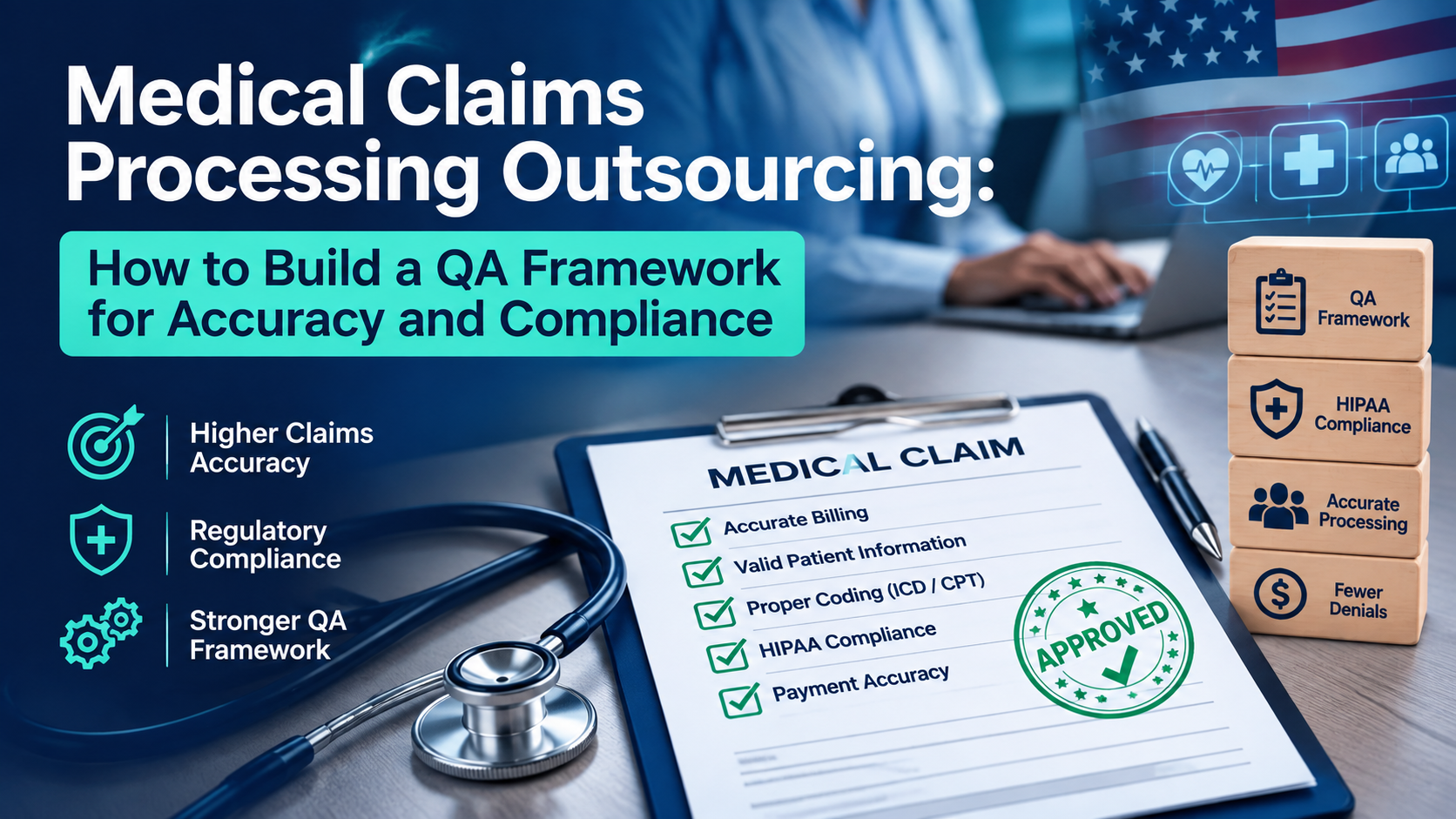
A claims team may achieve all of its turnaround time targets and yet still fail an audit. Speed does not mean accuracy, and accuracy does not mean compliance. Generally, the problem relating to volume is resolved within the first quarter when a health plan or a TPA shifts its medical claims processing outsourcing to a KPO partner. It is the quality issue that decides whether that relationship lasts into the second year.
When it comes to this subject, most of the advice just lists quality assurance as a bullet point- for example, “we monitor accuracy” or “we carry out QA checks.” Such statements give a claims operations leader no useful information regarding how to construct a quality assurance system, how to determine its scale, or how to hold a vendor to it. The purpose of this article is to provide that information. It outlines the various elements that make up a quality assurance framework for medical claims processing outsourcing, showing where HIPAA-compliant claims processing controls fit into that framework, and lists the questions you should ask a vendor before agreeing to a contract.
What Medical Claims Processing Outsourcing Actually Covers
The amount of claims work handed to an outsourcing partner can vary quite a bit. In some cases, the partner handles intake, eligibility checks, medical records, coding validation, adjudication support, payments, denials, and appeals. In other cases, they may only take care of one part of the workflow, such as documentation review or pended-claim resolution. The payer can still keep the final decision on the claim in-house.
The work you outsource changes where errors are most likely to show up. A partner handling intake and data entry faces a different kind of risk from one involved in adjudication support. Before you set up the QA process, be clear about which parts of the claims administration process actually sit with the outsourcing partner. If the checks do not match the work they are responsible for, problems can go unnoticed until an audit brings them to light.
Common functions that are often handled by an outsourced claims team include:
- Registering new claims and checking for duplicates
- Verifying eligibility and coordination of benefits
- Reviewing medical documents against the payer’s policy requirements
- Checking CPT and ICD-10 codes for accuracy
- Pended claim resolution and provider follow-up
- Payment accuracy checks before disbursement
- Denial categorization and appeals support
For healthcare claims processing outsourcing that involves only data entry, the quality assurance process needs to be less extensive than in the case where the vendor provides recommendations regarding coverage. The framework should be matched to the real scope, not to a general template.
Why Accuracy and Compliance Break Down Without a Framework
Ad hoc quality assurance seems to be similar to a supervisor randomly checking a small number of files each week and highlighting any obvious errors. It is able to pick up typos but seldom detects systemic problems and almost never identifies the compliance gaps that appear during a formal audit.
Three things go wrong without a structured framework:
Errors go undetected: For instance, if a processor always misreads a particular payer’s documentation requirement, random spot checks could fail to pick up the mistake for months. It is only when errors are sorted and monitored over time that a trend becomes apparent, not when each file is reviewed separately.
Compliance drift happens quietly: Compliance drift occurs slowly. The requirements under HIPAA relating to PHI access controls, handling only the minimum necessary data, and maintaining audit trails are not something you can tick off once and be done with. These requirements deteriorate as staff members leave, as new types of claims are added, and as shortcuts are introduced into the daily workflow. Having a framework that includes regular compliance checks picks up on this situation before a regulatory body does.
Rework can cost more than the outsourcing saves: The numbers only make sense if claims are being handled correctly in the first place. Once an overpayment, a wrong denial, or a coding mistake slips through, fixing it later usually takes more time and money than catching it before payment. A 2026 claims outsourcing guide makes the same point. If too much of the work has to be corrected afterward, the savings start getting eaten up by rework, disputes, and audit problems.
The health claims processing support offered by Techsurance is based on maker-checker quality control measures and the maintenance of audit trails at all stages, rather than relying on spot checks at the end of the cycle – this is the structural difference that the article below argues for.
The Building Blocks of a Medical Claims QA Framework
A working QA framework for medical claims processing outsourcing has six parts. Skip any one of them, and the framework has a blind spot.
1. Define quality standards before anything else
Quality must refer to something specific, not something vague like ‘correct’ or ‘compliant.’ For each type of claim, write down the actual standard: what constitutes a complete documentation set, which coding conventions are to be applied, what constitutes an on-time turnaround window, and what level of payment accuracy is acceptable. If there are no written standards, two auditors will reach a different conclusion about the same file.
2. Build a sampling methodology, not a spot check
Even using random sampling fails to detect low-frequency, high-cost errors; a defensible medical claims audit procedure involves three different types of sampling.
| Sampling type | What it catches | Typical rate |
| Random sampling | Baseline accuracy across all claim types | 5-10% of total volume |
| Targeted sampling | High-dollar claims, new claim types, new hires | 100% of flagged categories |
| Statistical sampling | Confidence-interval-based accuracy rate for reporting | Sized to claim volume and desired confidence level |
The sample size should vary according to the volume and the level of risk rather than remaining constant. For example, a payer that handles 50,000 claims per month should have a different sample size from one that processes 2,000, and a claim type that has a record of errors should be subject to a more extensive sample than a claim type that is stable.
3. Build an error taxonomy
All errors do not have the same significance. For example, omitting a middle initial is not in the same category as making a coverage determination based on the wrong policy version. It is necessary to divide the errors into at least three groups:
- Financial errors: the claim is paid for the wrong amount, either too much or too little, or the wrong fee schedule is applied.
- Procedural errors: something in the process is missed, such as a required document, correct routing, or a data field that should have been completed.
- Compliance errors: the problem involves rules or access, for example, PHI being handled incorrectly, a missing audit trail, or someone viewing information without authorization.
Compliance errors need to follow a different escalation procedure than procedural ones; treating them in the same way is what turns a small procedural gap into a reportable HIPAA incident.
4. Set an audit cadence
Audits carried out in advance pick up errors before any money is transferred, since this is most important when it comes to financial errors. Audits conducted after payment identify the errors that had escaped the preliminary review and add real data to the error taxonomy. Audits carried out concurrently, those that examine claims while they are in progress, are most suitable in the case of new types of claims or when new staff members have just been onboarded, since the cost of allowing errors to build up is then highest.
Most mature medical claims processing outsourcing arrangements run all three, weighted differently depending on claim risk.
5. Weave HIPAA-compliant claims processing into the framework, not around it
Compliance checks should happen as part of the regular QA review, not as a separate exercise every few months. When a claim is checked for accuracy, the reviewer should also confirm that PHI is only available to staff who have a documented reason to access it. File activity should show who opened the record and when, using the user ID and timestamp. Data shared between the payer and the outsourcing partner should also be encrypted while it is being transferred and while it is stored. Retention requirements should be checked in the same review.
The way Techsurance handles its HIPAA and SOC 2 requirements for medical claims KPO is to regard these controls as being built into the workflow rather than treating them as a separate audit exercise, which is the approach outlined in this section.
6. Close the loop with feedback and reporting
QA that isn’t passed on to the person who made the mistake achieves nothing. The findings should be fed back into specific coaching, not dumped in a monthly PDF that no one reads. Establish a reporting schedule that brings forward:
- Accuracy rate by claim type and by processor
- Rework rate and root cause
- First-pass resolution rate
- Compliance exception count and severity
- Turnaround time against SLA, reported alongside accuracy, never instead of it
Failing to include accuracy figures when reporting turnaround times in the same dashboard masks the compromise that a vendor might be making between speed and accuracy.
In-House QA vs Outsourced QA
| Factor | In-house QA | Outsourced QA (KPO partner) |
| Staffing for reviewers | Requires dedicated headcount, often hard to hire for | Reviewer capacity scales with claim volume |
| Domain-specific error patterns | It depends on tenure of internal staff | Benefits from cross-client pattern recognition |
| Compliance certification maintenance | The internal team tracks HIPAA/SOC 2 independently | Partner maintains certifications as part of service |
| Audit trail tooling | Often bolted onto existing claims systems | Frequently built into the outsourcing workflow from day one |
| Cost during volume spikes | Fixed headcount strains under sudden volume | Flexes with claim volume without a hiring cycle |
| Governance visibility | Direct, but limited by internal reporting maturity | Depends entirely on the vendor’s reporting discipline |
Neither column achieves a clear victory. A payer that has a well-established internal compliance function and a steady claim volume might not need to outsource quality assurance at all. On the other hand, one that experiences seasonal spikes, introduces a new type of claim, or has a documented shortfall in the controls for processing HIPAA-compliant claims will usually obtain more benefit from a partner who has already set up the audit infrastructure.
How to Evaluate a Medical Claims Processing Outsourcing Partner
Ask these questions before signing, not after the first audit finding:
- What does your sampling methodology entail, and how does sample size vary with claim volume?
- Could you provide the accuracy and rework figures from a similar client, not just the turnaround time?
- What compliance certificates do you possess (for example HIPAA, SOC 2 Type II, and ISO 27001) and when were they most recently audited?
- What manner of error taxonomy do you use to classify financial, procedural, and compliance findings?
- How does an escalation appear when a mistake in the compliance category is discovered?
- What are the procedures for controlling and logging access to PHI within your claims platform?
- What form does a pilot program lasting between 30 and 60 days take, and what occurs if it fails to achieve the accuracy level agreed upon?
A vendor that gives you the turnaround-time figures rather than the accuracy figures when answering the first two questions is telling you where the priorities of its quality-control program really are.
Common Mistakes That Undermine Claims QA
Treating compliance as a once-a-year audit event: Seeing compliance as merely a once-a-year audit. The processing of HIPAA-compliant claims requires continuous monitoring, not a last-minute rush before the scheduled review.
Measuring only turnaround time: The only thing being measured is turnaround time. A vendor who meets all its SLA deadlines yet increases its error rate has been optimizing for the wrong result, and most contracts only reveal this when a dispute from either the payer or the provider comes up.
Fixed sample sizes regardless of volume or risk: The sample size is fixed regardless of the volume or the level of risk. A 2% random sample is reasonable in the case of claim types that are stable and of low risk but is not sufficient when dealing with a newly added claim category or a high-dollar claim segment.
No feedback loop back to processors: There is no feedback mechanism returning to the processors; if the findings are merely put in a report and never get to the person who made the mistake, the same error will certainly occur next month.
Vague error definitions: The definitions of ‘accuracy’ are vague. Whenever the payer and the vendor define ‘accuracy’ differently, each QA report turns into a negotiation rather than a measurement.
Rolling Out a QA Framework With an Outsourcing Partner
- Agree to the standards together. Before the transition starts, the payer and the vendor should put into writing what the terms “accurate” and “compliant” mean for each kind of claim.
- Carry out a pilot study using full quality assurance instrumentation. Before expanding, test the sampling method, the classification of errors, and the frequency of reporting on a small number of claims.
- Check the compliance controls on your own. Don’t just accept a vendor’s HIPAA certification. Ask for the date and details of the audit, and make sure the way they handle PHI is in line with your own policies.
- Before going live, establish the escalation thresholds and agree on the error rate or the level of non-compliance that will cause a formal review, rather than deciding afterwards when the first incident occurs.
- Increase the sample size in proportion to the volume. When the volume of claims goes up, adjust the sampling rates rather than retaining a fixed percentage since that percentage would then become statistically meaningless at a large scale.
- Prepare reviews on a monthly basis for the first two quarters; since the arrangements are in their early stage, they require more rigorous supervision than a well-established partnership, and only when the accuracy trends have stabilized should the review frequency be reduced.
The phased approach being described is based on the same principle that underlies wider insurance process outsourcing projects: having measurable quality controls from the very beginning, rather than adding them in after the volume has increased.
Conclusion
A KPO can process claims quickly and still create more work later. If those claims keep coming back with errors, the cost simply shifts from processing to correction. A proper QA setup helps catch that earlier. It should cover how the work is checked, which claims are sampled, how mistakes are recorded, how often audits happen, how HIPAA is handled, and whether the vendor actually fixes recurring problems.
If your team is considering whether the current claims process of yours, whether it is carried out in-house or outsourced, has these six elements, then Techsurance’s health claims processing services incorporate maker-checker quality control, documented audit trails, and compliance controls aligned with ISO 27001 at all stages of the claim lifecycle, not as additions afterward.
FAQs
What might be meant by medical claims processing outsourcing?
This involves delegating one or more of the various stages that make up the health claim process, from the initial intake to payment, to a third-party specialist rather than managing all of those stages on one’s own with internal staff.
Is medical claims processing outsourcing automatically compliant with HIPAA?
Not so: for HIPAA-compliant claims processing it is necessary to look at the specific controls that a vendor has regarding access to PHI, encryption, and audit logging; merely having general experience in claims does not ensure compliance unless that experience is incorporated into the workflow.
How frequently should a medical claims audit be carried out?
Most advanced programs combine three types of audits: conducting pre-payment audits on high-risk claim categories, carrying out post-payment audits for the purpose of broader accuracy tracking, and carrying out concurrent audits when onboarding or when a new claim type is being rolled out.
What is the difference between a medical claims audit and routine QA checks?
Routine QA focuses on the claim being worked on at that moment and catches mistakes before they move further through the process. A medical claims audit looks across a larger group of claims instead. By reviewing samples and sorting the errors found, the payer can see whether the same problems keep coming back and whether there are wider accuracy or compliance issues.
What sample size is appropriate for claims QA?
There is no single sample size that works for every claims operation. It depends on claim volume and risk. Stable, low-risk claim types may only need a smaller random sample. High-value claims or newly introduced claim types usually need much closer review, sometimes all or nearly all claims, until the error rate settles.
What questions should I ask before choosing a claims processing outsourcing vendor?
Ask to see how the vendor checks claim quality in day-to-day work, not just what they promise in a proposal. Find out how claims are picked for review, what their actual accuracy and rework numbers look like, and how those numbers are reported. Check that their compliance certifications are current and note the latest audit dates. Their reports should also make it easy to tell whether an error was financial, procedural, or compliance-related.
