
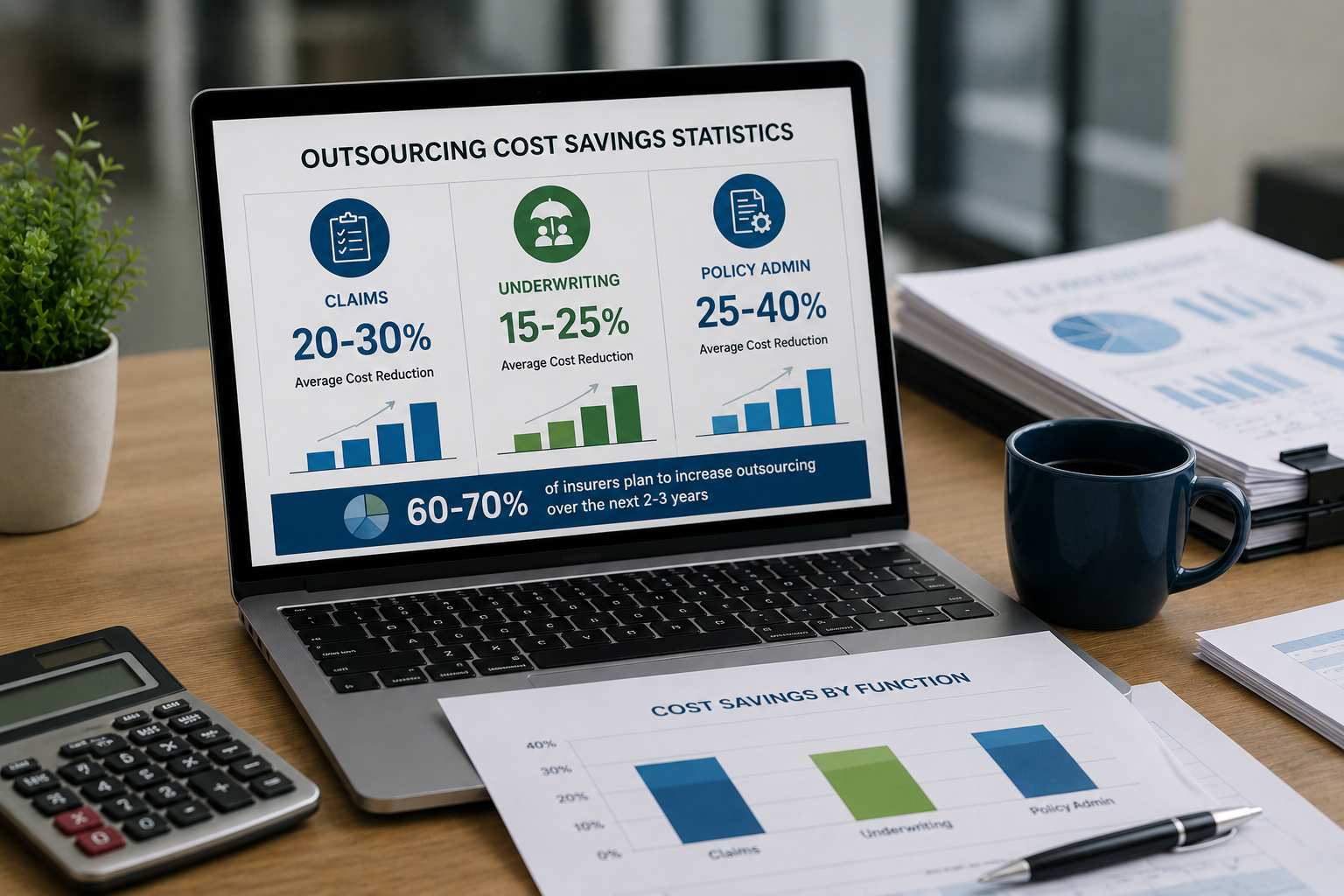
Saving costs on insurance outsourcing seems easy until you analyze the data. The total insurance business process outsourcing market worldwide totaled $7.2 billion in 2024 and is projected to grow at 5.4% annually through 2034. Such growth can be attributed to the increased need for insurance companies to control their operations.
The pressure to reduce costs for the U.S. property and casualty insurers is obvious. For instance, in 2024, the industry had a combined ratio of 100.7% with a loss ratio of 69.4% and an expense ratio of 31.2%. Besides, global insured catastrophe losses totaled $137 billion in 2024. These numbers further underscore the growing pressure on costs in the insurance sector.
However, when trying to understand costs, it is easy to get lost in headline numbers rather than understanding on-ground realities. Here’s where this article will help: it not only covers general statistics on cost savings from outsourcing but also focuses on the areas where those savings occur.
Where outsourcing cost savings actually come from
Cost savings associated with insurance process outsourcing occur for three reasons: elimination of work duplication and error correction, flexible scalability without fixed personnel costs, and shorter cycle times that reduce administrative overhead.
Labor cost arbitrage plays a role here, but it is rarely the primary source of cost reduction. When an insurance company outsources its claims processing to another geographic region where wages are lower, but error rates are higher, it will pay more for corrections than it saves on salaries.
So, if you’re choosing an outsourcing partner, start by checking their rework rate, how they scale during surges, and the average cycle time for each process. If they can provide this information precisely, only then should you believe in their cost-saving claims.
The sections below walk through cost savings in each major function:
Cost savings in claims processing
Claims processing is the most resource-intensive function in most insurance operations. Every claim processing step has the potential to cause rework if done incorrectly. Here is where outsourcing generates savings in claims:
- Reduced rework: When an outsourcing partner runs structured quality checks at each stage of the claims workflow, fewer errors reach the adjudication stage. Correcting an error late in the process costs significantly more than catching it at intake.
- Fewer disputes: Claims handled with proper documentation and consistent adherence to process generate fewer follow-up disputes from policyholders or providers. Each dispute adds labor cost and extends the time to close.
- Faster cycle times / lower reserve-carrying costs: The longer a claim remains open, the longer the carrier holds reserves against it. Shortening the average cycle time, even by a few days, releases reserves faster and reduces the administrative cost of managing open files.
Cost savings in underwriting support
Underwriting is a knowledge-intensive function, and the cost savings from outsourcing it look different from those in claims. The goal is not to hand over risk assessment decisions. It is to remove the administrative burden from underwriters so they spend their time on core risk evaluation rather than on file preparation, data gathering, and compliance documentation.
Underwriting decision support and audit support are recognized outsourcing service categories specifically because they improve operational results and lower costs while allowing underwriters to focus on the work that requires their expertise. In practical terms, this means the following types of tasks are well-suited to outsourced handling:
- Gathering and organizing supporting documentation before a file reaches the underwriter
- Running pre-submission completeness checks so underwriters receive files that are ready for review
- Preparing renewal data packages for the underwriting team
- Conducting post-bind audits to identify errors or gaps in file documentation
Each of these tasks, if done internally, consumes expensive underwriter time. Outsourcing the administrative layer of underwriting support translates directly into a lower cost per policy reviewed. In addition, when files arrive complete and organized, underwriters make decisions faster, reducing the administrative carrying cost of in-progress submissions and shortening response times.
Cost savings in policy administration
Some examples of policy administration include Policy issuance, endorsements, cancellations, reinstatements, and issuance of certificates of insurance. The aforementioned activities are suitable for outsourcing for one simple reason: large transaction volumes and repetitive actions that do not require underwriting. The cost benefits in policy admin come from a combination of scale and speed, as the table below will show:
| Task | Internal cost driver | Outsourcing cost benefit |
| Policy issuance | Staffing fixed headcount to handle peak volumes | Variable capacity that scales with submission volume |
| Endorsements | Manual keying errors requiring correction cycles | Process-driven quality checks reducing error rates |
| Certificate of insurance generation | Turnaround delays creating producer friction | Faster processing reducing time per transaction |
| Cancellations and reinstatements | Multiple handoffs between teams | Centralized processing reducing coordination overhead |
| Renewal preparation | Underwriter time spent on administrative packaging | Pre-packaged renewal data delivered ready for review |
A comparison of cost drivers by function
The table below gives a consolidated view of where savings originate across the three main functions. If you’re wondering which functions to outsource, use this table to map your own operation’s cost drivers against the areas where outsourcing is most likely to generate returns:
| Function | Primary cost driver | Secondary cost driver | Main outsourcing benefit |
| Claims processing | Rework from documentation errors | Reserve carrying costs on open claims | Faster cycle times, lower error rates |
| Underwriting support | Underwriter time on administrative tasks | Delays in time-to-quote | File completeness, faster turnaround |
| Policy administration | High-volume manual transaction processing | Staffing costs during peak periods | Scalable capacity, lower cost per transaction |
What outsourcing cost savings statistics often leave out
Almost all figures regarding savings are quoted as net. The problem with such a method is that it fails to account for the carrier’s expenses incurred during and after the transition period. The following are the elements most commonly ignored:
- Time for integration and setup costs: For instance, transferring the claims adjudication process to the outsourced vendor will involve process mapping, information-sharing agreements, system setup, and training personnel on the new process. There is a cost associated with all that, which is not included in the savings amount mentioned.
- Vendor management cost: After a relationship with the carrier has been established, someone within the carrier will need to oversee it. This involves tracking performance metrics, escalating issues, reviewing quality reports, and attending periodic governance meetings. These are internal labor expenses that persist even if the function is outsourced.
- Reduced production during transition period: During the transition period when a new outsourcing vendor is coming online, production decreases, and error rates are higher than at steady state. Savings calculated starting on the first day of the outsourcing contract, rather than waiting until the end of the transition period, are overestimated.
- Over-exposure due to inexperienced outsourcing partners: Some outsourcing vendors offer extremely low pricing because they fail to invest in developing their people’s expertise in insurance regulations. Should such outsourcing vendors make errors that lead to overexposure for the firm, the cost of fixing the problem can exceed the savings realized.
Outsourcing versus automation: Where cost savings actually originate
One of the recurring questions posed by insurance operations executives is whether to pursue outsourcing or automation. This dichotomy is always posed as a choice between two competing levers; in reality, the two levers work hand in hand.
AI and machine learning are employed in claims, underwriting, and policy management processes to automate mundane tasks and identify outliers for further human analysis. These tools will not make judgments on complex claims, abnormal risk assessments, or exceptions in the policy management process – they will handle the bulk of predictable, repetitive work to free up human labor for the complex work.
Here’s how the two levers interplay in each of the processes:
- Claim processing: Claims that can be processed easily are routed through automated claim intake and triage to ensure quick processing. Complex or disputed claims are reviewed by outsourced professionals who analyze the documentation and make judgments based on their review. This combination reduces the cost per claim without compromising the quality of the process for claims that really need it.
- Underwriting assistance: Data is automatically collected by tools that gather information from submission systems and other data sources. The outsourced teams assist in reviewing the data for accuracy and any missing information. This helps to reduce the time and cost needed to take a submission from intake to final decision.
- Policy administration: Automation handles rule-based transactions, such as standard policy issuance and certificate generation. Outsourced teams handle exceptions, complex endorsements, and situations where the automated system flags a file for manual review.
How to evaluate cost savings claims from an outsourcing partner
Before accepting any cost savings figure from an outsourcing partner, ask the following questions. The answers will tell you whether the number is credible.
The questions below are organized by function. Each one is designed to surface a specific piece of evidence that either supports or undermines the quoted figure.
For claims processing
- What is your average claims cycle time by claim type, and how does that compare to our current average?
- What is your rework rate on claims files returned to us for additional information?
- How do you handle compliance-related holds, and what is your average resolution time for those?
For underwriting support
- What is your file-completeness rate on submissions delivered to underwriters?
- What is your average turnaround time from submission receipt to underwriter-ready file?
- How do you handle state-specific documentation requirements?
For policy administration
- What is your error rate on policy issuance and endorsement processing?
- How do you scale capacity during renewal season or in response to catastrophe-driven volume spikes?
- What is your average processing time for certificate of insurance requests?
A partner who cannot answer these questions with specific data is quoting savings figures they cannot verify. On the other hand, a partner who can answer them is one whose cost savings projections are worth taking seriously.
Conclusion
Sustainable cost savings in insurance outsourcing come from three places: reduced rework, scalable capacity, and faster cycle times. These drivers play out differently depending on whether you are looking at claims processing, underwriting support, or policy administration. Treating outsourcing as a single cost lever with a single savings percentage misses the function-by-function variation that determines whether a specific outsourcing investment will deliver returns.
The statistics you will find in industry reports and vendor materials are illustrative at best. They reflect ranges across carriers with varying baseline processes, partner quality levels, and ramp-up timelines. Before putting any of those figures into a business case, verify them against function-specific data from the partner you are evaluating.
Ask about claims cycle times. Ask about underwriting turnaround. Ask about policy admin error rates. Ask whether the quoted savings account for transition costs and ongoing quality assurance. Partners who can answer those questions with specific, verifiable data are the ones whose proposals are worth trusting.
If you want to discuss the cost drivers specific to your claims, underwriting, or policy admin workflows, reach out to our team at Techsurance.
FAQs
What is a realistic cost savings percentage from insurance outsourcing?
No one figure works for all carriers and all functions. This range varies widely in industry literature, and the results depend on your starting point in process maturity, the level of partnership you choose, and the function you decide to outsource. It would be much better to focus on process metrics rather than percentage targets, such as claims cycle time and underwriting turnaround time.
Does outsourcing claims processing reduce reserve carrying costs?
Yes. When claims cycle times shorten, carriers close files faster and release reserves sooner. The administrative cost of maintaining open reserves, including staffing, system overhead, and reporting, decreases as the volume of open claims at any given time falls. This is one of the less-discussed but measurable financial benefits of faster claims processing.
What is the difference between outsourcing and automation in insurance?
Outsourcing transfers a function or process to an external vendor that offers labor and skill. Automation involves using technology to perform repeatable rule-based processes by machines without human interference. These two are complementary in that automation handles predictable, high-volume work, whereas outsourcing handles difficult, judgment-intensive work. Insurers that use both incur relatively low transaction costs.
The most common omissions are integration and setup costs, vendor management overhead, reduced throughput during the ramp-up period, and compliance risk from underqualified partners. A savings figure that does not account for these factors is almost certainly overstated.
How do I know if an outsourcing partner has sufficient insurance domain expertise?
Ask for references from carriers in similar lines of business. Ask specifically about their training and quality assurance processes for insurance-specific regulatory requirements. Ask for their error rates by function and how they track and report errors over time. If a partner cannot provide this information, their domain expertise is likely insufficient for the compliance demands of insurance operations.
Is policy administration a good candidate for outsourcing?
Yes, for most carriers. Policy issuance, endorsements, cancellations, reinstatements, and certificate of insurance generation involve high transaction volumes with standardized, repeatable processes. These characteristics make them well-suited to outsourced handling. The savings come from variable capacity that scales with volume and lower per-transaction costs at scale, rather than from any single dramatic efficiency gain.
