
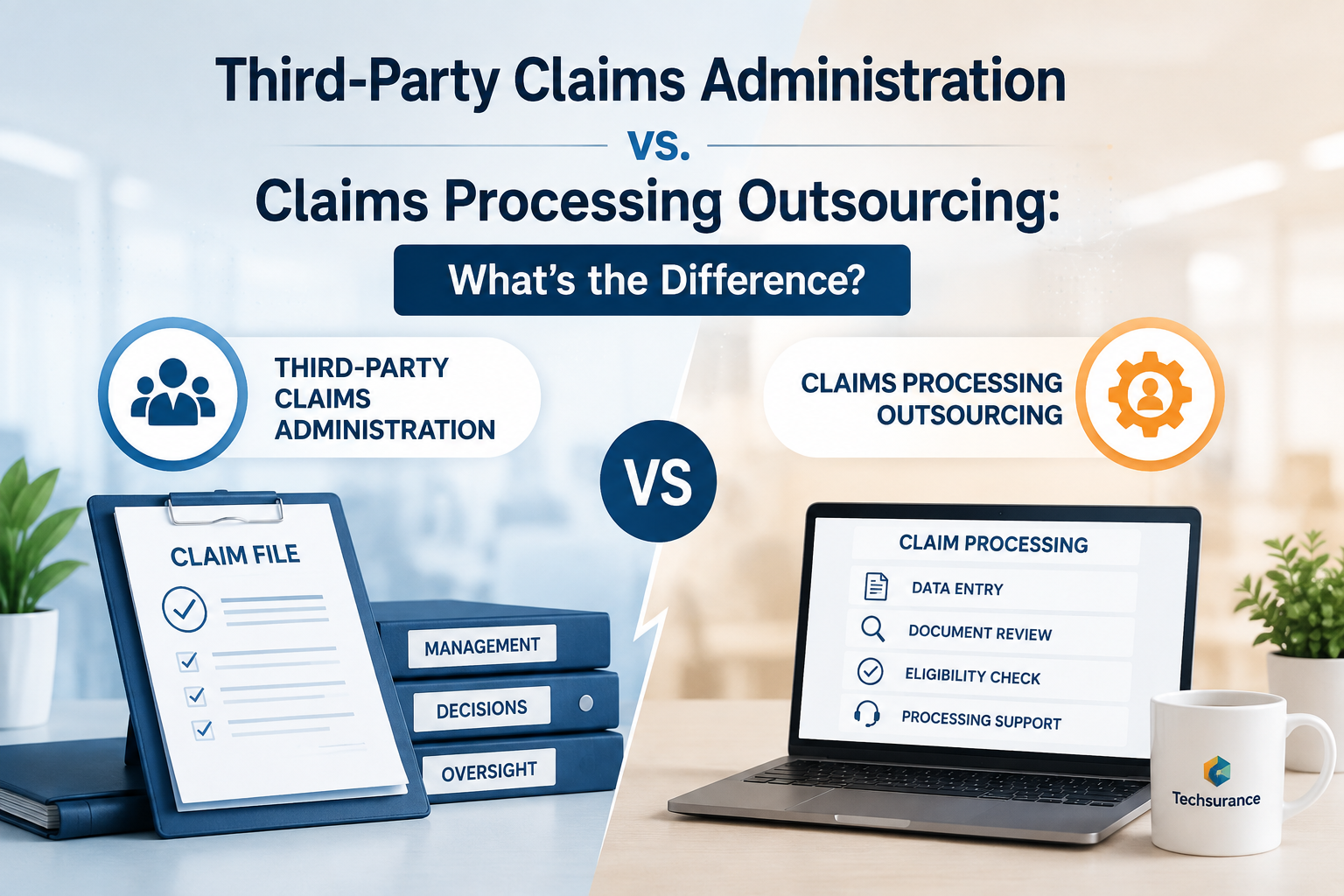
Last year, an MGA in Texas entered into a vendor agreement with the understanding that it would obtain a licensed claims handler. Six weeks later, however, a state market conduct examination identified the file since the vendor had not registered as a third-party administrator in that state. The company had in fact hired a claims processing outsourcing partner rather than a TPA, and no one had picked up the discrepancy before the contract was sent out for signing.
Third-party claims administration and claims processing outsourcing are treated as though they are the same thing, but they aren’t. The first refers to a company that is licensed by the state and which can adjust and settle claims on the insurer’s behalf. The second is an operational support agreement in which a vendor operates within the insurer’s own authority and never assumes the power to settle claims. Confusing the two can result in real risks: selecting the wrong kind of contract, failing to make the required compliance filing, or using a vendor who is legally prohibited from carrying out the work.
The guide explains the differences between third-party claims administration and claims processing outsourcing, where insurance claims processing support lies somewhere between the two, and outlines how an insurer, an MGA, or a claims team should determine which of these options is appropriate for a particular program.
What is third-party claims administration?
Third-party claims administration, commonly referred to as TPA services, involves an external organization being given the authority to handle, adjust, and settle insurance claims for an insurer, a self-insured employer, or an MGA. A TPA functions according to a written administrative services agreement and, in most US states, must obtain its own certificate of authority or TPA licence from the state insurance department, apart from the insurer’s own license.
In simple terms, third-party claims administration means that the external company can take the place of the insurer in making binding decisions about claims.
The requirement in question originated with the NAIC’s Third Party Administrator Statute, which was first introduced in 1977 and has since been amended. The model law usually stipulates that TPAs, which underwrite, adjust, or settle life, annuity, or health claims, must hold a license from the state insurance department in the states where they operate. Most states have adopted some form of the statute, although the specific thresholds and exemptions differ from state to state.
Under this model, claims administration services generally cover the key steps involved in managing a claim, such as:
- Receiving the claim and conducting an initial coverage review
- Gathering the required documents and supporting information for investigation
- Setting appropriate claim reserves
- Supporting claim adjustment and settlement decisions
- Payment issuance, often from funds the TPA holds on the insurer’s behalf
- Regulatory reporting tied to the claims the TPA handles directly
What makes the difference isn’t the task list but the authority; a TPA is able to bind the insurer when making a decision about a claim within the scope of its agreement, whereas a claims processing vendor cannot.
What is claims processing outsourcing?
Claims processing outsourcing, also known as insurance claims outsourcing, claims management outsourcing, or insurance claims processing support, refers to a situation where an insurer delegates certain processing tasks to an external partner while its own staff remains the official decision-maker. The outsourcing partner carries out its work within the insurer’s systems, in accordance with the insurer’s standard operating procedures, and usually has no independent authority to settle claims.
In practice, this may include tasks such as:
- Receiving claims and entering the required information into the system
- Reviewing documents and checking that the details are complete and accurate
- Checking eligibility and coverage to support the adjuster’s final decision, rather than replacing it
- Providing claims processing support when insurers face sudden increases in claim volumes
- Quality assurance and audit support
- Surge capacity during high-volume periods
A partner who provides claims processing services is able to get a file 90% of the way towards a decision, after which the insurer’s licensed adjuster still has to approve the remaining 10%.
Third-party claims administration vs. claims processing outsourcing, at a glance
| Factor | Third-party claims administration (TPA) | Claims processing outsourcing |
| Licensing | Needs a state TPA license or certificate of authority in most states | Generally doesn’t require a TPA license because it doesn’t hold settlement authority |
| Decision authority | Can adjust, approve, and settle claims within the agreement’s scope | The insurer’s team makes the final coverage and payment call |
| Relationship type | A standalone regulated entity with its own compliance obligations | An operational extension of the insurer’s existing claims team |
| Common use case | Self-funded health plans, workers’ comp programs, run-off books | Surge capacity, insurance claims processing support, back-office claims work |
| Contract type | Administrative services agreement, often filed with state regulators | Master services agreement or statement of work, not filed with regulators |
| Fund handling | Frequently holds and disburses claim funds directly | Rarely touches client funds |
Why the difference actually matters
The difference between the two models is not one of preference regarding vocabulary; it’s a legal issue. When a vendor settles claims and makes payments without having a TPA licence in the states where the people insured are located, that constitutes a compliance problem for the insurer, not merely for the vendor. Since regulators make the insurer answerable for the actions of anyone who is administering claims on its behalf regardless of whether that person has a licence, failing to obtain the necessary licensing for third-party claims administration is one of the quickest ways of leading to a market conduct examination.
The cost structure is just as different. While TPA agreements involve licensing fees, the requirement for surety bonds in most states, and continuous state filings, outsourcing agreements omit all of these since the vendor does not take on the insurer’s regulatory responsibilities. For an insurance company which wants to increase its capacity for processing insurance claims without having to file for each new state every time it adds a vendor, that difference alone can determine the sourcing model.
Where the terms blur
Certainly, some of the confusion is justified. A few of the vendors operate both models, providing licensed TPA services in the states where they are registered and pure claims processing outsourcing support in all the other states. The marketing materials never always make the distinction clear, and the term claims administration services is used loosely to refer to anything from full claims authority right down to simple data entry.
Before you agree to anything, you should consider whether or not this vendor needs a TPA license in my state for the particular work I’m employing them to do; if the answer is yes and they don’t have the license, that is a reason to reject them, not just a minor shortfall that can be dealt with.
When third-party claims administration is the right call
A TPA that is properly licensed is one where an insurer transfers actual claims authority rather than merely delegating labour. This situation usually occurs when:
- Self-funded employer health plans, where the employer isn’t licensed to adjust claims itself and needs a TPA to do it legally
- Workers’ compensation programs where state law requires a licensed handler
- MGA or program business where the program administrator needs full delegated claims authority as part of the underlying agreement
- Legacy or run-off blocks of business where an entity needs to legally stand in the original insurer’s place for closing out old claims
In all the cases, the insurer is not merely transferring the workload but is transferring the power to make decisions.
When claims processing outsourcing makes more sense
Outsourcing is appropriate whenever the objective is increased capacity or greater efficiency, not when it involves a transfer of authority. Typical situations include:
- Catastrophe season or open enrollment surges, where claim volume spikes for a few months and licensing a new TPA relationship for that window doesn’t make sense
- Document-heavy intake work: claims administration process steps like data entry, document review, and file preparation that need to happen before an adjuster ever touches the claim
- Insurance claims processing QA and audit support, where a partner reviews closed files for accuracy without touching open decisions
- Cost-efficient scaling for carriers that want more claims management outsourcing capacity without new state filings every time headcount grows
That is also the position occupied by a specialist in insurance process outsourcing: it lies within the insurer’s workflow and is operating under the insurer’s own licence, dealing with volume not with authority.
How the two workflows actually run
A TPA claim lifecycle usually looks like this:
- Claim received directly by the TPA under its delegated authority
- Coverage and eligibility confirmed against the policy
- Investigation and documentation completed
- Reserve set
- Adjusting decision made and, if applicable, disputed items resolved
- Payment issued from funds the TPA controls
- Regulatory reporting filed as required by the TPA’s home state
An outsourced insurance claims processing workflow looks different at almost every step:
- Claim received into the insurer’s own system
- Outsourcing partner completes intake, de-duplication, and initial data validation
- Documentation gathered and reviewed against the insurer’s checklist
- File routed to the insurer’s licensed adjuster with a recommendation, not a decision
- Insurer’s adjuster approves, denies, or requests more information
- Payment issued by the insurer, not the outsourcing partner
- Outsourcing partner supports QA and reporting, but files nothing with regulators on the insurer’s behalf
The feature of the second workflow is that all the decision points remain within the insurer’s own authority; that is precisely what the model is about.
Common mistakes insurers make between the two
The biggest mistake on this list is to enter into a full administrative services agreement when a simple statement of work could have been used instead; such an agreement leads to licensing costs, bond requirements, and state filings even though no delegation of authority was actually needed from the start.
The other mistake involves incurring legal liability rather than wasting money by hiring a business process outsourcing firm or an outsourcing vendor to carry out work that in fact requires settlement authority; if that vendor is making payments or taking binding coverage decisions without having a TPA license then the insurer will be held responsible for it during an examination.
A few other patterns worth watching for:
- To assume that if a vendor provides claims administration services then this always involves licensed TPA work is incorrect since it often does not.
- The fact that a TPA is licensed in Texas does not mean that it is licensed in Ohio, and the company’s licensing status is not confirmed state by state.
- Seeing claims processing outsourcing as a cheaper alternative to a TPA when, in fact, the arrangement involves delegated authority costs is not the main consideration here. Regulatory scope is.
How to evaluate a partner, whichever model fits
Before signing with either type of vendor, get clear answers on:
- What independent decisions can this partner take and what will remain with our team?
- If the relationship in question is a TPA relationship, is the licence active in all the states where our covered population is located?
- What does the outsourcing insurance claims handling scope of work actually include, task by task?
- What is the method of measuring quality and what occurs when accuracy falls below the required level?
- Who has control over the claim funds and what controls surround the disbursement?
- How does the situation progress when a claim is outside the standard parameters?
The vendors who give direct answers rather than offering vague reassurances are generally the ones deserving of a pilot engagement.
Where Techsurance fits
Techsurance functions as an outsourcing partner for claims processing and is not a licensed TPA; this is deliberate. When insurers, MGAs, and claims teams use Techsurance, they retain full authority over the decisions regarding adjustments and settlements. The company provides support with intake, the review of documentation, preparing the claims adjudication process, and carrying out quality checks on insurance claims all in accordance with the insurers’ own standard operating procedures, supported by insurance compliance procedures which ensure that the documentation remains audit-ready.
When a program requires delegated claims authority, a licensed TPA will be needed. If what is required is processing capacity, a quicker turnaround time, and consistent quality assurance without losing control, then this is the type of work for which Techsurance was designed. Teams who are deciding which model is suitable for their claims volume can also look at how to select the appropriate claims outsourcing partner before narrowing down their choice of vendors.
FAQs
Is third-party claims administration equivalent to claims processing outsourcing?
No.Third-party claims administration refers to the delegation of the power to adjust and settle claims and usually requires a state license in order to carry out such activities. Claims processing outsourcing, on the other hand, operates within the insurer’s own authority and is not involved in making the final decision regarding coverage or payment.
Does outsourcing claims processing need a state license?
Not usually, since the vendor is not assuming responsibility for claim settlement. The insurer continues to keep its own licensed team responsible for it. Although requirements may still differ from state to state, it’s worthwhile to check them for any program with an unusual scope.
Can one company offer both TPA services and claims processing outsourcing?
Yes, quite a few do. A vendor could obtain TPA licences in certain states for the purpose of having that authority delegated in those states, while at the same time providing pure insurance claims outsourcing support in all the other areas. The two service lines should still be separately scoped and contracted.
What is the difference between claims administration and claims adjudication?
Claims administration involves the day-to-day work of managing a claim from the time it is received until it is closed. This can include data entry, routing the claim, communicating with the relevant parties, and tracking payments. Claims adjudication, on the other hand, focuses on deciding whether a claim should be paid, denied, or sent for further manual review. In simple terms, claims administration covers the overall process, while adjudication is one part of that process.
How much can claims processing outsourcing improve turnaround time?
It depends heavily on the baseline the insurer is starting from and which stages of the claim get outsourced. Programs that outsource intake and documentation review tend to see the clearest turnaround gains, since those stages create the most upstream delay when handled manually. Actual numbers should come from a pilot against the insurer’s own current metrics, not a generic industry figure.
What should we ask before signing with a TPA or an outsourcing partner?
Start with what decisions the vendor can make independently, whether any licensing is required for the scope of work, how quality gets measured, and who holds claim funds if any change hands. A partner that can’t answer these clearly in the sales process usually can’t answer them clearly six months into the contract either.
